
Is PTFE Safe? A Simple Answer You Can Trust
 Written by Irina Webb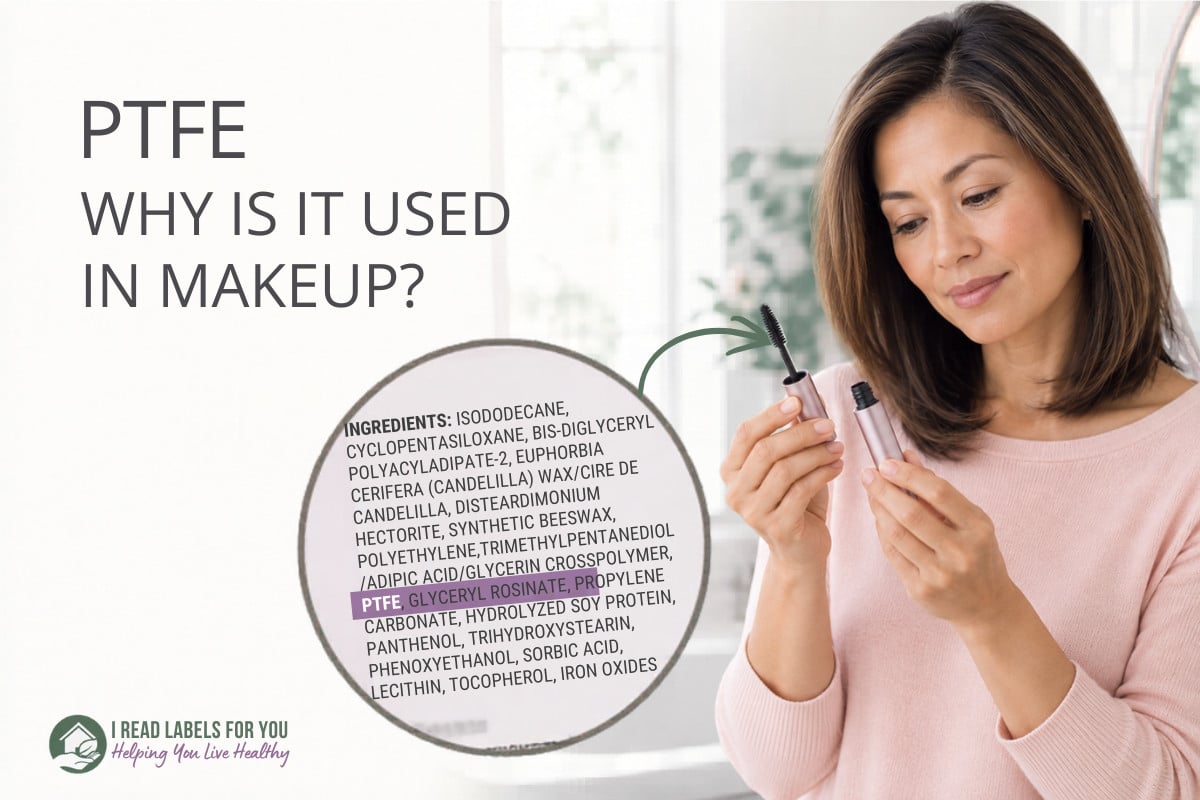
No, PTFE is not a safe choice for cosmetics in my view, even though the plastic itself barely touches your body. PTFE, or polytetrafluoroethylene, is Teflon plastic milled into a powder for mascara and face powder. It stays on your skin but carries traces of banned PFAS. My rating is Not A Fan.
PTFE has no limits under the European Union’s cosmetics rules today, but that may end soon. In March 2026, Europe’s Committee for Risk Assessment backed a full ban on PFAS, the “forever chemical” family that includes PTFE, in all cosmetics. At least five U.S. states already ban intentionally added PFAS in cosmetics.
Keep reading to learn which banned chemicals its own supplier says every grade contains, whether “PFOA-free” on a label means safe, and what PTFE has to do with your dental floss and frying pan.
What Is PTFE?
PTFE is a plastic made only of carbon and fluorine. Its long chains contain at least 20,000 repeating units, and the carbon-fluorine bond is among the strongest in chemistry. That strength makes PTFE slippery, heat-resistant, and almost impossible to dissolve or break down.
It belongs to PFAS, short for per- and polyfluoroalkyl substances. People call them forever chemicals because nature has almost no way to destroy them.
What Does PTFE Do In Cosmetics?
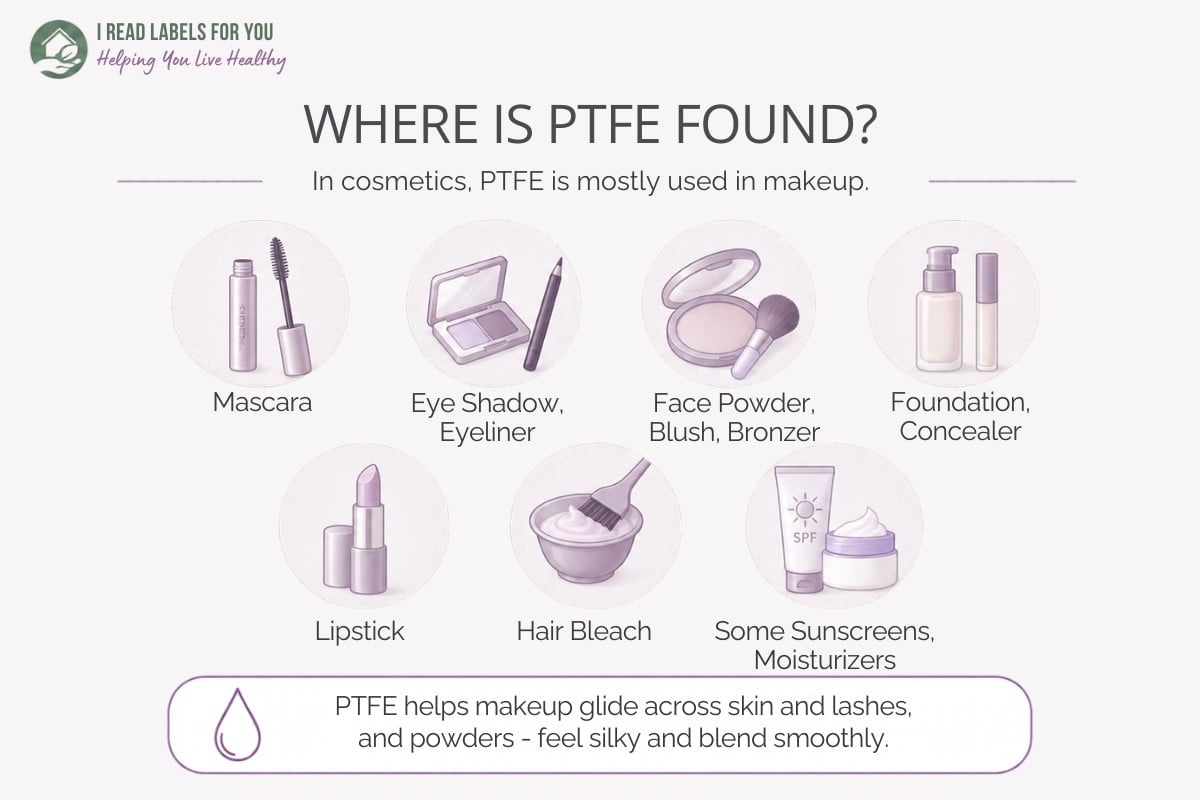
In makeup, PTFE works as a bulking agent and slip modifier. The tiny powder fills out a formula and makes it glide across skin and lashes. It also helps powders feel silky and blend smoothly.
According to the 2023 report from the Cosmetic Ingredient Review (CIR), an industry-funded panel, PTFE appeared in 365 U.S. products. Most were eye products, at up to 13% in mascara and 12% in eye shadow.
You’ll find PTFE most often in:
- mascara
- eye shadow, eyeliner
- face powder, blush, bronzer
- foundation, concealer
- lipstick
- hair bleach
- some sunscreens, moisturizers
PTFE never goes into food on purpose. However, the U.S. Food and Drug Administration (FDA) permits fluorinated plastics like it in food-contact surfaces, which is why it lines so many nonstick pans.
How Is PTFE Made?
Manufacturers start with tetrafluoroethylene, a gas. Next, they link it into chains in water, a step that long relied on PFOA, a fluorinated soap that Europe now bans in cosmetics. After 2006, many factories switched to shorter fluorinated chemicals, such as PFHxA, and other replacements.
The starting gas matters too. Europe classifies tetrafluoroethylene as a presumed human carcinogen, and the U.S. National Toxicology Program found “clear evidence” that it causes cancer in rats and mice.
For cosmetics, one supplier blasts the plastic with an electron beam to shorten the chains, then bakes it to drive off leftover PFOA. Finally, it mills the plastic into a powder averaging 5.58 microns, smaller than a red blood cell.
The baking does not remove everything. According to a supplier quoted in the CIR report, “all commercial grades of PTFE contain some trace level of PFOA and perfluorooctyl sulfonate (PFOS).” Europe bans both chemicals as cosmetic ingredients.
Does PTFE Penetrate The Skin?
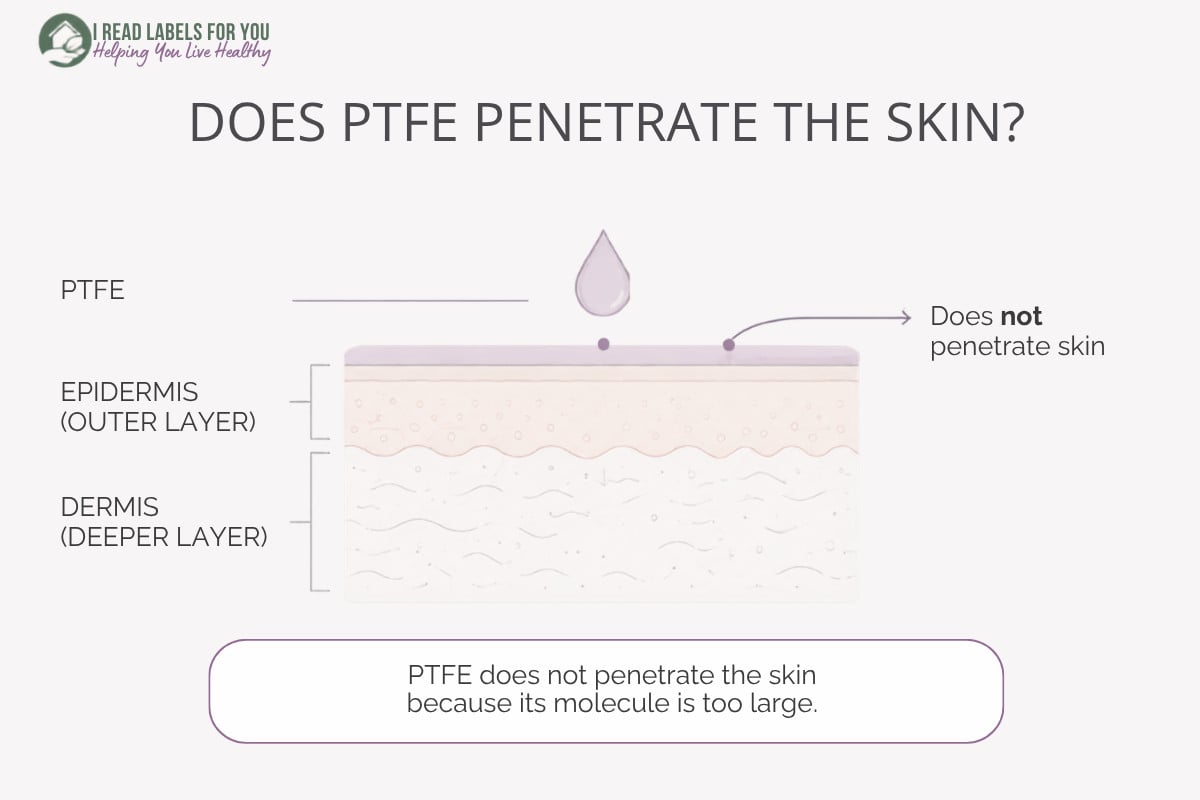
No, PTFE does not penetrate the skin. Size decides it: even after irradiation, cosmetic PTFE weighs 15,000 to 50,000 daltons. A dalton measures molecule size, and skin starts blocking molecules at about 500 daltons, so PTFE is 30 to 100 times too big.
In addition, nothing dissolves it. A LogP, which compares how well a chemical mixes with oil versus water, cannot even be measured for PTFE. It simply sits on top of your skin.
Two caveats matter, though. Small impurities like PFOA are not held back by the plastic’s size. And the fine powder can be breathed in from loose powders, so skin is not the only route.
What Is PTFE Called On Labels?
Ingredient lists may use any of these names:
- PTFE
- Polytetrafluoroethylene
- Teflon
- Polytef
- Tetrafluoroethylene Homopolymer
Other fluorinated ingredients often sit nearby. Watch for words containing “perfluoro” or “polyfluoro,” such as Perfluorodecalin, which are also PFAS.
Does The U.S. FDA Restrict PTFE In Food And Cosmetics?
No, PTFE faces no FDA limits in cosmetics. It’s not on the agency’s brief list of prohibited and restricted cosmetic ingredients, and no FDA rule caps PFOA traces in makeup.
On the food side, the FDA permits PTFE coatings on pans and processing equipment. Food additives face a looser test through the Generally Recognized As Safe (GRAS) route, where a company can certify its own ingredient. In practice, federal oversight of chemicals in personal care stays thin.
California banned intentionally added PFAS in cosmetics from January 1, 2025. A 2025 legal review lists Colorado, Minnesota, Maryland, Vermont, and Washington among states with similar bans. PTFE fits those laws’ PFAS definitions, though each statute should be checked for its own wording.
Europe takes a more cautious view overall. It follows the precautionary principle, which lets regulators restrict a chemical once evidence of harm is credible, without waiting for proof in people.
EU Regulations On PTFE
The European Union does not restrict PTFE as a cosmetic ingredient yet. It appears in the CosIng database, entry 79028, with no annex limits. However, its impurities are another matter: PFOA, PFOS, PFNA, and PFHpA all appear on Annex II, Europe’s list of banned cosmetic ingredients.
Separately, Europe’s persistent organic pollutants law caps PFOA at 25 parts per billion in any product. That matches the target the CIR supplier says its baking step reaches.
Bigger changes are coming. Europe’s proposed ban on all PFAS explains that these chemicals “are, or ultimately transform into, persistent substances, leading to irreversible environmental exposure and accumulation.”
For cosmetics, the Committee for Risk Assessment “agrees with a full ban” with an 18-month transition and “No derogation.” A second committee drafted the same view, but the European Commission has not yet decided.
In addition, Europe’s microplastics rule restricts tiny solid plastic particles in cosmetics. PTFE powder appears to fit its definition, which would phase it out of leave-on products from 2029 and makeup from 2035.
Canadian Regulations On PTFE
Canada does not restrict PTFE in cosmetics, and Health Canada’s Cosmetic Ingredient Hotlist leaves it off. Moreover, Environment Canada proposed in 2025 to list PFAS as a toxic class but deliberately left fluoropolymers like PTFE out.
PFOA and PFOS, the impurities, already sit on Schedule 1, the toxic substances list under Canada’s environmental law. In other words, Canada regulates the leftovers but not the plastic that carries them.
Can PTFE Cause Skin Allergy And Sensitization?
No, PTFE does not cause skin allergy in the testing available. Three human patch tests of products with 2.89%, 6% and 9% PTFE, involving 107, 111 and 206 people, found no allergic reactions. Industry submitted those tests to the CIR panel unpublished.
Irritation was absent too. A formula with 7.6% PTFE and an eye shadow with 12% PTFE scored zero for irritation. In fact, surgeons wrap pacemakers in PTFE to protect patients who react to metal.
PTFE is missing from the American Contact Dermatitis Society (ACDS) Core Allergen Series. It has never been named the society’s Allergen of the Year.
Is PTFE A Hormone (Endocrine) Disruptor?
No, PTFE itself is not a known hormone disruptor, but no one has tested it for hormone effects. The concern lies with its impurity PFOA.
In a 2012 study of 10,725 children living near a Teflon factory in Ohio and West Virginia, higher blood PFOA was linked to hypothyroidism. That exposure came from contaminated water and air near the plant, not from makeup, and the traces in cosmetic PTFE are far smaller.
Is PTFE Safe To Use While Pregnant?
The pregnancy safety of PTFE is unknown, because pregnancy testing is almost nonexistent. The only study gave PTFE coating materials by mouth to 10 rats per group and found no birth defects.
Its impurity is the bigger question. Europe classifies PFOA as a reproductive toxicant that may damage an unborn child and may harm breastfed babies. The amounts in makeup are tiny, but PFOA builds up in the body over years.
If you’re expecting, you should consult with your medical provider, and choosing PTFE-free mascara and powder is an easy way to trim one PFAS source.
Are There Any Cancer Concerns Linked To PTFE?
No, PTFE itself is not linked to cancer in people; the International Agency for Research on Cancer (IARC) lists it in Group 3, not classifiable. It’s not listed by the U.S. National Toxicology Program or California’s Proposition 65.
The chemicals around it tell a different story. IARC rates tetrafluoroethylene, its starting gas, as probably carcinogenic, and PFOA as carcinogenic to humans. A 2013 study of 4,773 factory workers exposed to both found higher, but not statistically significant, rates of liver and kidney cancer and leukemia.
Solid PTFE implants under the skin caused tumors in rodents, in up to 94% of one mouse strain. The CIR panel called this a reaction to a solid object and judged it not relevant to cosmetics. Gene tests on PTFE coating materials came back negative.
Is PTFE Bad For The Environment?
Yes, PTFE is bad for the environment because it never breaks down. Every particle washed off your face stays in water, soil or sediment for an extremely long time.
Its manufacture also releases fluorinated chemicals, and PFOA from PTFE plants has contaminated drinking water near factories. Unsurprisingly, the natural certifiers COSMOS and NATRUE both leave PTFE off their approved lists.
Common Claims About PTFE: What’s True And What’s Not
Claim: PTFE And Teflon Are Different Materials
This claim is false. Teflon is a brand name, now owned by Chemours, for products made of PTFE. Chemically, the two are the same plastic, though quality can vary between suppliers.
Claim: PTFE Is Toxic
This claim is partly true. The solid plastic is inert on skin and does not get in. However, it carries PFOA and PFOS traces, it’s made from a probable carcinogen, and heated above roughly 315°C (600°F) it releases fumes.
Those fumes cause polymer fume fever, a flu-like illness. One 2012 case report describes fever and breathing trouble after a woman inhaled fumes from an overheated PTFE-coated pan.
Claim: PFOA-Free PTFE Is Safe
This claim is misleading. “PFOA-free” usually means makers stopped using PFOA, not that the product contains none. CIR’s own supplier says every commercial grade still holds trace PFOA and PFOS, and the replacement chemicals are PFAS too.
What I Think About PTFE — And What You Should Do
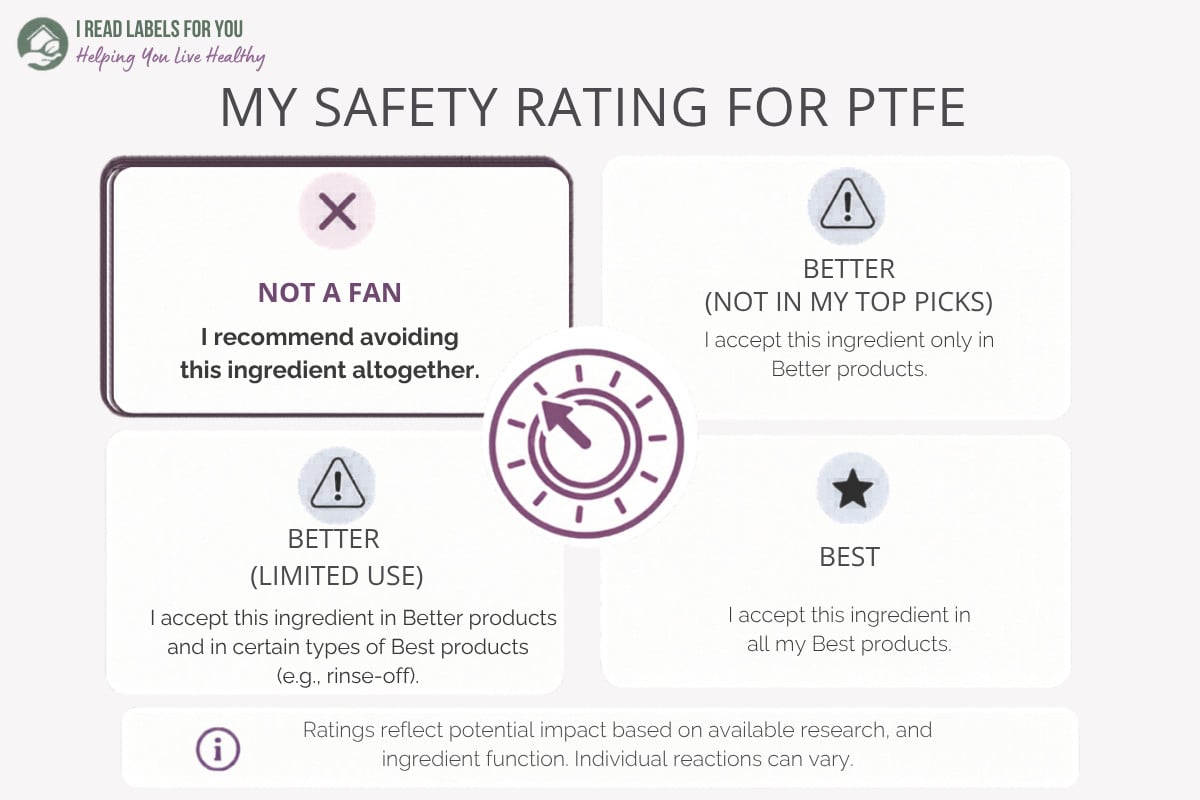
My rating for PTFE is Not A Fan. I keep it out of both my Best and Better products, and I suggest you skip it. In fairness, the plastic itself behaves well on skin. It does not penetrate, it caused no allergies in patch tests, and it does not irritate.
My concerns sit around it. First, it’s made from a probable carcinogen, historically with PFOA. Second, every grade carries traces of banned PFAS, and third, it never breaks down once it leaves your bathroom sink.
Finally, regulators are moving away from it. Europe’s risk assessors want PFAS out of cosmetics entirely, and several U.S. states already ban them.
Here’s what I suggest:
- check mascara, eye shadow, and face powder labels first
- look for PTFE, Polytetrafluoroethylene, and any “perfluoro” or “polyfluoro” names
- choose powders built on minerals, silica or starches instead
- never heat an empty nonstick pan on high
Frequently Asked Questions About PTFE
Is PTFE Floss Safe?
It’s a fair question. In a 2019 study of 178 women, those who used Oral-B Glide had higher blood levels of a PFAS called PFHxS. That finding shows a link, not proof, and Oral-B has since removed PFAS from Glide, according to Silent Spring Institute.
Is PTFE A Forever Chemical?
Yes. PTFE is a PFAS, and it does not break down in nature. Canada’s 2025 proposal left fluoropolymers out of its PFAS listing, but Europe’s proposed ban includes them.
What Did The FDA’s 2025 PFAS Report Say About PTFE?
In December 2025, the FDA reported that PTFE is the most used PFAS in U.S. cosmetics, found in 490 products. It concluded that PTFE poses “low safety concerns in cosmetic products under intended use conditions.”
However, the report left out PFAS present as impurities, such as PFOA. That leftover PFOA is my main concern with PTFE, so the FDA’s conclusion does not change my rating.
Does PFAS-Free Makeup Mean PTFE-Free?
It should, because PTFE is a PFAS. However, “PFAS-free” usually means no PFAS was added on purpose, not that none is present. The FDA notes that PFAS may also end up in cosmetics “as the result of raw material impurities.”
Can I Still Buy Makeup With PTFE In California?
No. California banned intentionally added PFAS in cosmetics from January 1, 2025, and PTFE fits its definition. The FDA’s report lists 11 states with similar bans taking effect between 2025 and 2028.
Sources
EU SCCS / SCCP Opinions:
No SCCS or SCCP opinion on PTFE (checked). SCCS opinions portal: SCCS opinions
Cosmetic Ingredient Review (CIR) Reports:
Johnson W Jr, Bergfeld WF, Belsito DV, et al., 2023. Safety Assessment of Polyfluorinated Polymers as Used in Cosmetics. International Journal of Toxicology 42(Suppl 3):144S to 161S. Sponsored by CIR, which is funded by the Personal Care Products Council. PMID 37978581: PubMed 37978581; CIR database: cir-reports.cir-safety.org
European Union Regulatory Databases:
CosIng entry 79028, PTFE, function bulking, no annex restrictions: CosIng 79028
CosIng Annexes II to VI (2026 versions), checked; PTFE not listed. Annex II bans PFOA (entry 1561), PFOS (1493), PFNA (1636) and PFHpA (1705) as cosmetic ingredients: CosIng
CLP Regulation Annex VI harmonized classifications (2026 table). PTFE not classified; tetrafluoroethylene Carc. 1B; PFOA Carc. 2, Repr. 1B, Lact.: ECHA CHEM
ECHA CHEM, PTFE, EC 618-337-2. No REACH registration (polymer): ECHA CHEM overview
ECHA universal PFAS restriction process, current stage SEAC draft opinion consultation (2026): ECHA CHEM restriction
RAC evaluation of the PFAS restriction for cosmetics, March 2, 2026: RAC cosmetics evaluation
REACH Annex XVII restrictions, including entry 78 on synthetic polymer microparticles: ECHA restricted substances
Regulation (EU) 2019/1021 on persistent organic pollutants, consolidated September 30, 2026, Annex I entry for PFOA: EUR-Lex
Other Regulators:
U.S. FDA, prohibited and restricted cosmetic ingredients. PTFE not listed: FDA
U.S. FDA, 21 CFR 177.1550, perfluorocarbon resins in food contact: eCFR 177.1550
U.S. FDA, Report on the Use of PFAS in Cosmetic Products and Associated Risks, December 29, 2025. PTFE in 490 products, low safety concern; impurity PFAS excluded: FDA PFAS report
U.S. state bans on PFAS in cosmetics, legal review, December 2025: Morgan Lewis
Health Canada Cosmetic Ingredient Hotlist. Not listed: Health Canada Hotlist
Environment Canada, CEPA Schedule 1. PTFE not listed; PFOA and PFOS listed: CEPA Schedule 1
Environment and Climate Change Canada, March 2025 proposal to add PFAS, excluding fluoropolymers, to Schedule 1: ECCC news release
International Agency for Research on Cancer (IARC) classifications. PTFE Group 3; tetrafluoroethylene Group 2A; PFOA Group 1: IARC list
U.S. National Toxicology Program, Report on Carcinogens. PTFE not listed; tetrafluoroethylene listed: NTP Report on Carcinogens
California Proposition 65 list. PTFE not listed; tetrafluoroethylene and PFOA listed: OEHHA
U.S. EPA Integrated Risk Information System. No assessment of PTFE: IRIS A to Z list
U.S. EPA PFAS drinking water standards, May 2026 proposal keeping the 4 parts per trillion PFOA limit (legal summary): Foley Hoag
PubChem Records (Chemistry, Identifiers, Skin Penetration, Hazard Codes):
Polytetrafluoroethylene, PubChem annotated polymer record (no CID; CAS 9002-84-0): PubChem PTFE
Tetrafluoroethylene (monomer), PubChem CID 8301, CAS 116-14-3: PubChem CID 8301
Peer-Reviewed Studies:
Boronow KE, Brody JG, Schaider LA, et al., 2019. Serum concentrations of PFASs and exposure-related behaviors in African American and non-Hispanic white women. Journal of Exposure Science and Environmental Epidemiology 29(2):206 to 217. PMID 30622332: PubMed 30622332
Lopez-Espinosa MJ, Mondal D, Armstrong B, et al., 2012. Thyroid function and perfluoroalkyl acids in children living near a chemical plant. Environmental Health Perspectives. PMID 22453676: PubMed 22453676
Consonni D, Straif K, Symons JM, et al., 2013. Cancer risk among tetrafluoroethylene synthesis and polymerization workers. American Journal of Epidemiology. PMID 23828249: PubMed 23828249
Case report of polymer fume fever after inhaling fumes from an overheated PTFE-coated pan, BMJ Case Reports, 2012. PMID 23230259: PubMed 23230259
Survey of PFAS in European cosmetics, Environmental Science and Technology, 2022; PTFE was among the most frequently listed PFAS ingredients. PMID 35959763: PubMed 35959763
Silent Spring Institute, update on Oral-B Glide floss, 2026: Silent Spring Institute
Natural Cosmetic Standards:
COSMOS-standard approved raw materials. PTFE not listed: COSMOS-standard approved raw materials
NATRUE certified and approved raw materials. PTFE not listed: NATRUE certified raw materials
Skin Allergy Resource:
American Contact Dermatitis Society (ACDS), Helpful References, including the Core Allergen Series 2020. PTFE is not on the series and has never been Allergen of the Year: ACDS Helpful References
Last verified: 10-11-2026

Download The Free Guide!
5 Powerful Steps To A Non-Toxic Home
Join our informed consumer community and get our free guide the “5 Powerful Steps To A Non-Toxic Home”.


Before commenting, please read our Comment Policy.