
Is Ethoxydiglycol Safe? A Simple Answer You Can Trust
 Written by Irina Webb
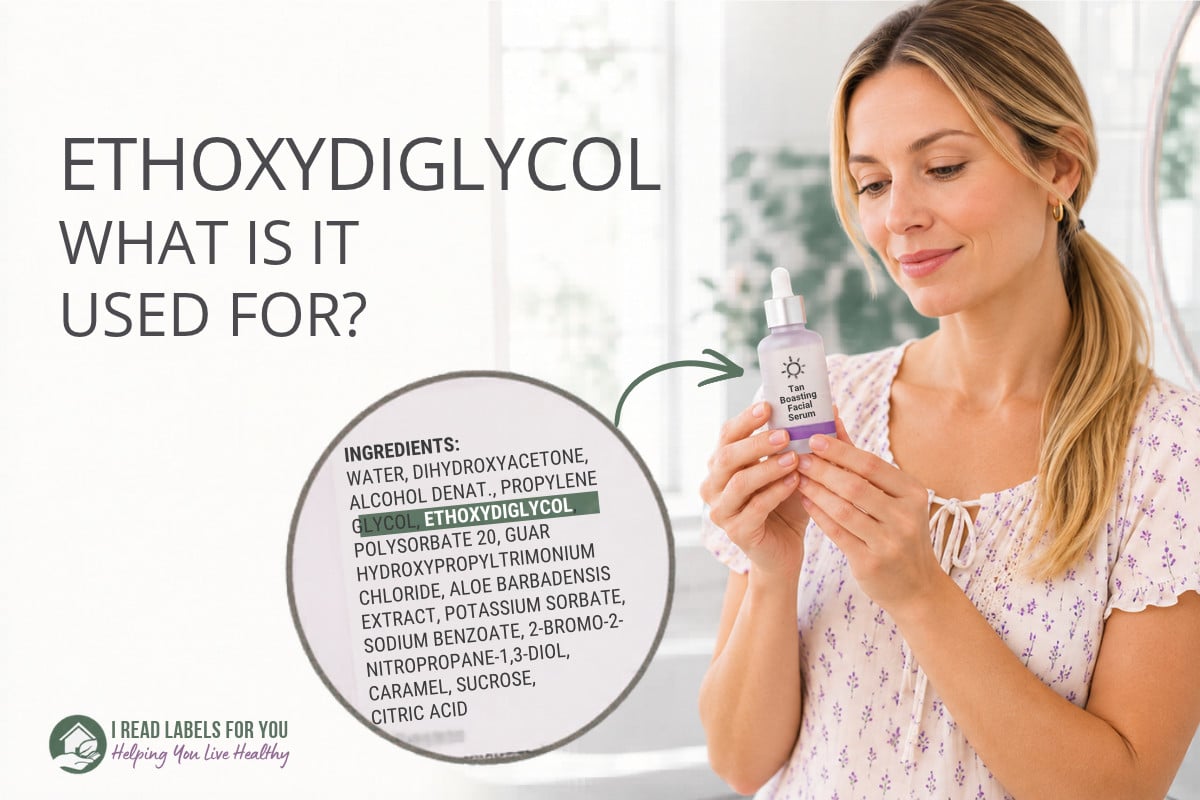
No, Ethoxydiglycol is not an ingredient I recommend, even though it’s not an allergen and showed no genetic damage in testing. It’s a clear solvent that dissolves other ingredients and helps push them into your skin. It is made with ethylene oxide, a gas known to cause cancer in people, and about half of it passes through skin. My rating is Not A Fan.
Ethoxydiglycol is restricted in the European Union, which caps it at 2.6 percent in most leave-on products. Europe also bans it in eye products and oral-care products, and limits its toxic impurity, ethylene glycol, to 0.1 percent. The U.S. Food and Drug Administration sets no limit at all. A 2003 industry survey found American products using it at up to 80 percent.
Keep reading for three things most labels will never tell you. First, why the ingredient’s best-known talent is also my biggest worry. Second, what one supplier’s own California warning lists. Third, how thin Europe’s safety margin really is at full use.
What Is Ethoxydiglycol?
Ethoxydiglycol is a man-made solvent from a chemical family called glycol ethers. Its chemical name is diethylene glycol monoethyl ether, often shortened to DEGEE. Drug makers sell a purified grade under the trade name Transcutol.
Structurally, it’s ethanol, the alcohol in drinks, with two units of ethylene oxide attached. That makes it an ethoxylated ingredient. One supplier’s own specification sheet even calls it an “Ethoxylated alcohol.” The molecule is small and mixes freely with water.
What Does Ethoxydiglycol Do In Cosmetics?
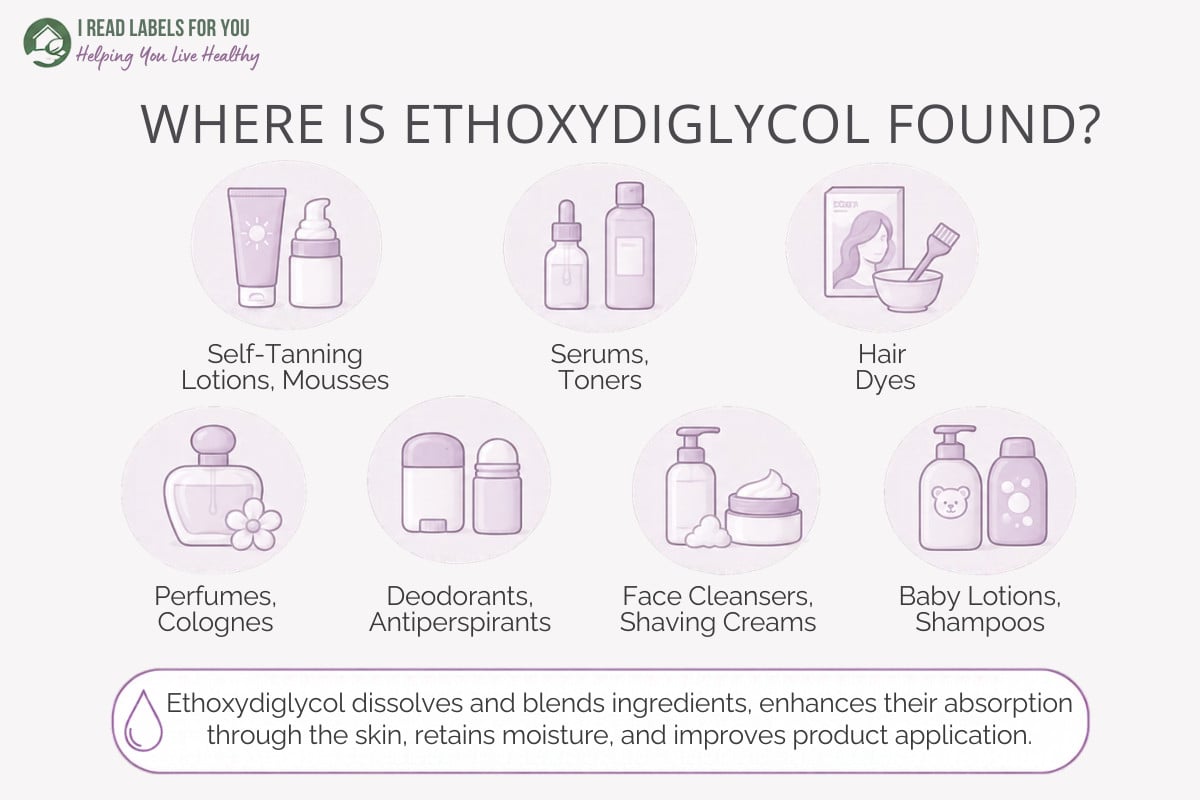
Ethoxydiglycol’s first job is dissolving things. According to the 2013 opinion of Europe’s Scientific Committee on Consumer Safety (SCCS), it can dissolve both oil-loving and water-loving compounds. Formulators use it to keep active ingredients, dyes and fragrance oils evenly mixed.
Its second job is the one I care about most. The SCCS states plainly that Ethoxydiglycol “enhances the percutaneous absorption through the skin and mucosal barriers.” In other words, it helps other ingredients get deeper into you. That’s why some drugs use it.
It also holds moisture, and it helps self-tanners spread without streaks. On top of that, perfume makers add Ethoxydiglycol to fragrance blends to improve how a scent spreads. The SCCS notes that a third of alcohol-based products may contain at least traces of it.
You’ll find Ethoxydiglycol most often in:
- self-tanning lotions and mousses
- serums and toners
- hair dyes
- perfumes and colognes
- deodorants and antiperspirants
- face cleansers and shaving creams
- baby lotions and baby shampoos, at low levels
It is not a food ingredient. However, the FDA lets it serve as a component of adhesives in food packaging. Tiny amounts could therefore touch food indirectly.
How Is Ethoxydiglycol Made?
Ethoxydiglycol is built from ethylene oxide. In 1985, the Cosmetic Ingredient Review (CIR), an American safety panel funded by cosmetic companies, described the process. Makers react ethylene oxide with ethanol, then distill the product. The SCCS describes a second route, adding ethylene oxide to 2-ethoxyethanol.
That second chemical matters. 2-Ethoxyethanol is a reproductive toxicant that Europe bans from cosmetics, and it forms on the way to Ethoxydiglycol. One test batch in the SCCS file listed 0.24 percent “ethyl glycol,” a common trade name for 2-ethoxyethanol.
The leftover regulators do track is ethylene glycol, the main ingredient in antifreeze. The SCCS warns that commercial grades “may contain an appreciable amount” of it. Consequently, Europe caps it at 0.1 percent, and the cosmetic grade Transcutol CG claims under 0.062 percent.
Ethylene oxide and 1,4-dioxane, a possible carcinogen that can form during ethoxylation, are a different story. Neither the SCCS nor the CIR report mentions, limits or measures them for this ingredient. Meanwhile, that supplier’s sheet carries a California Proposition 65 warning naming ethylene oxide, methoxyethanol, ethoxyethanol and ethylene glycol.
Does Ethoxydiglycol Penetrate The Skin?
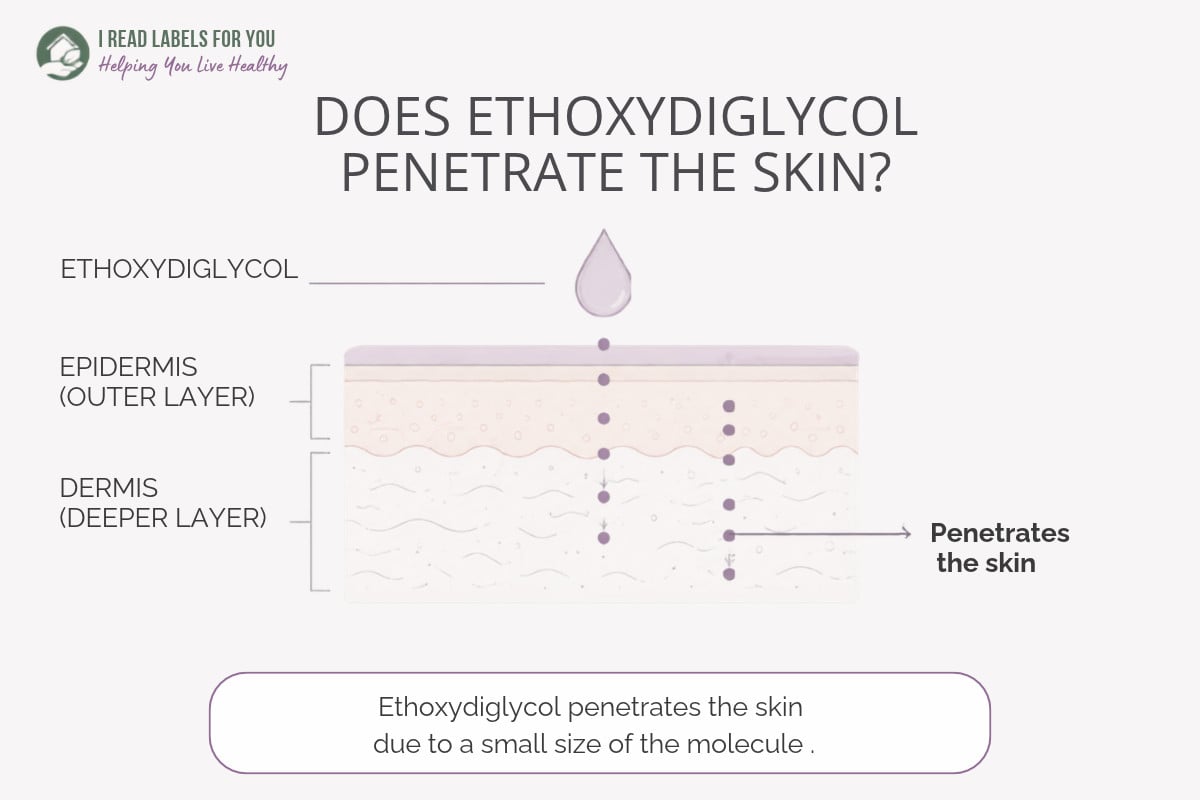
Yes, Ethoxydiglycol penetrates the skin very well. Size explains most of it. Ethoxydiglycol weighs just 134 daltons, the unit for a molecule’s mass. Size only begins to slow entry near 500 daltons, which leaves this molecule with plenty of room.
The second marker is LogP, a score for oil versus water preference. Ethoxydiglycol scores about minus 0.5, meaning it leans slightly toward water. Water-loving molecules usually struggle with skin’s oily outer layer, yet this one is small enough, and friendly enough to oils, to slip through anyway.
The measurements leave no doubt. In the SCCS human skin tests, about half of a leave-on dose passed through skin in 24 hours. Even a shampoo rinsed off after 30 minutes let about 20 percent through.
What Is Ethoxydiglycol Called On Labels?
On a label you may see:
- Ethoxydiglycol
- Diethylene Glycol Monoethyl Ether
- DEGEE
- Transcutol, Transcutol CG, Transcutol P
- Carbitol or Ethyl Carbitol
- 2-(2-Ethoxyethoxy)Ethanol
- Ethyl Digol
Do not confuse it with Diethylene Glycol, Methoxydiglycol or Butoxydiglycol. Those are separate glycol ethers with separate rules. Europe bans the first two from cosmetics, apart from trace amounts of Diethylene Glycol.
Does The U.S. FDA Restrict Ethoxydiglycol In Food And Cosmetics?
No, Ethoxydiglycol faces no FDA restriction in cosmetics, and no concentration limit applies. The agency’s banned and restricted cosmetic list is short, and this ingredient is not on it. In food, the FDA allows it only indirectly, in packaging adhesives, paper that touches dry food and sanitizing solutions.
I set a low bar for the FDA here. The agency largely reviews cosmetic ingredients after products reach stores, not before. Its Generally Recognized As Safe (GRAS) program for food is weaker still. Under it, a company’s own paid experts can declare a substance safe without the agency signing off.
Europe takes the opposite approach. Its precautionary principle allows limits once warning signs look credible, even before anyone proves damage. You can see that instinct in how Europe treats Ethoxydiglycol.
EU Regulations On Ethoxydiglycol
The European Union lists Ethoxydiglycol in Annex III, its list of restricted cosmetic ingredients, as entry 297. The limits are 2.6 percent in most leave-on products and in four spray types: fine fragrances, hair sprays, antiperspirants and deodorants. Rinse-off products may hold 10 percent, and hair dyes 5 or 7 percent.
Furthermore, Europe forbids it in eye products and oral-care products, because the SCCS never evaluated those uses. Every batch must also contain no more than 0.1 percent ethylene glycol. Under Commission Regulation (EU) 2016/314, these rules apply to products sold since March 25, 2017.
The path to that limit is telling. France first held it to 1.5 percent. In 2010, the SCCS found that 5.5 percent in leave-on products “does pose a risk to the health of the consumer.” Three years later, it accepted 2.6 percent and tightened the ethylene glycol limit.
Ethoxydiglycol has no harmonized hazard classification in Europe’s chemical law, according to the ECHA CHEM database of the European Chemicals Agency (ECHA). Europe has not named it a substance of very high concern, and no evaluation is open.
U.S. And EU Disagreements On Ethoxydiglycol
The two systems split sharply. Europe caps leave-on use at 2.6 percent. By contrast, a 2003 industry survey in the CIR’s 2006 update found up to 80 percent in American cleansers. Industry and FDA data in that update also list it in American eye lotions and mascaras, uses Europe bans.
Moreover, the CIR panel reconsidered its 1985 review in 2004 and 2005, and chose not to reopen it. Its panel set no limit, no eye restriction and no impurity ceiling. In contrast, Europe set all three.
Canadian Regulations On Ethoxydiglycol
Health Canada does not list Ethoxydiglycol on its Cosmetic Ingredient Hotlist. Consequently, Canada sets no cosmetic limit. Interestingly, the Hotlist does prohibit its close cousin Methoxydiglycol, along with 2-ethoxyethanol and ethylene oxide.
In 2018, Canada finished a screening assessment of the ethylene glycol ethers group, which included Ethoxydiglycol. It looked at cosmetics such as hair dye and deodorant and concluded the group does not meet the country’s legal test for toxic substances. Notably, Canada’s own margin for deodorant use started as low as 87.
Can Ethoxydiglycol Cause Skin Allergy And Sensitization?
No, Ethoxydiglycol has not been shown to cause skin allergy in any test I found. In one human study in the SCCS opinion, 24 adults received the undiluted solvent repeatedly under patches. The opinion records no sensitization reaction.
The CIR report adds product tests. A paste mask with 2 percent Ethoxydiglycol was tried on 213 people, and a body lotion with 1 percent on 93 people. Neither caused sensitization. Likewise, the patch-test screening panel that U.S. dermatologists use, the American Contact Dermatitis Society (ACDS) Core Allergen Series, leaves it out.
Eyes are another matter. The SCCS calls it “moderately irritant to the eye,” and the CIR report describes undiluted Ethoxydiglycol as “very irritating” to rabbit eyes. That helps explain Europe’s eye-product ban.
Is Ethoxydiglycol A Hormone (Endocrine) Disruptor?
No, Ethoxydiglycol has not been shown to disrupt hormones, but nobody has actually tested it for that. Neither the SCCS nor the CIR report contains a single endocrine study. It is also absent from the European Commission’s list of 28 potential hormone disruptors in cosmetics.
One detail deserves a mention. In a rat study described by the SCCS, the absorbed dose concentrated in the pituitary, thyroid, and adrenal glands. That shows where it travels, not that it harms those glands, yet nobody has followed it up.
Is Ethoxydiglycol Safe To Use While Pregnant?
Nobody can give a clear “yes” for Ethoxydiglycol in pregnancy because the ingredient itself looks clean while its leftovers are unmeasured. In two guideline rat studies reviewed by the SCCS, it had no effect on fertility and caused no birth defects.
Skin exposure has been tested too. In a 1984 rat study of undiluted glycol ethers on skin, Ethoxydiglycol caused no harm to the developing litters, while 2-ethoxyethanol caused malformations. A 1990 mouse breeding study by the National Toxicology Program also found no effect on fertility.
The trouble is what might come along with it. 2-Ethoxyethanol is a known reproductive toxicant, and no one publishes how much remains in cosmetic grades. Therefore, you should consult with your medical provider about products you use while pregnant or nursing.
Are There Any Cancer Concerns Linked To Ethoxydiglycol?
No, Ethoxydiglycol itself has no cancer signal, but no one has run a proper cancer study on it. The SCCS says so directly: “No adequate carcinogenicity study is available.” The ingredient did not damage genes in bacterial or animal tests.
It’s also absent from the cancer lists of the International Agency for Research on Cancer, the National Toxicology Program, and California’s Proposition 65. My cancer concern sits with its manufacturing chemical instead. Ethylene oxide causes cancer in people, and nobody reports how much of it, or of 1,4-dioxane, stays behind.
Is Ethoxydiglycol Bad For The Environment?
Ethoxydiglycol does not appear to be a major environmental problem. Canada’s 2018 assessment found “low risk of harm to the environment” from the glycol ether group. Gattefossé, the maker of Transcutol, describes its cosmetic grade as readily biodegradable, a manufacturer claim.
The volume is large, though. Europe’s chemical registry lists 10,000 to 100,000 tonnes made or imported each year. Beyond cosmetics, it goes into lacquers, wood stains, and brake fluids.
Common Claims About Ethoxydiglycol: What’s True And What’s Not
Claim: It Simply Helps Good Ingredients Absorb Better
This claim is true, and that’s exactly the problem. The Paula’s Choice ingredient dictionary praises it because “it is known to help key ingredients absorb more effectively.” The SCCS confirms the effect.
However, a penetration enhancer does not choose. It can carry preservatives, fragrance chemicals, and impurities in the same formula deeper too. Neither the SCCS nor the CIR assessed that combined effect.
Claim: It Is Contaminated With Ethylene Oxide And 1,4-Dioxane
This claim is plausible, but unproven either way. Ethoxydiglycol is made with ethylene oxide, and one supplier’s California warning names it. Still, I found no published measurement of either chemical in cosmetic-grade Ethoxydiglycol.
That silence is the issue. Europe caps ethylene glycol in this ingredient, yet sets no number for ethylene oxide, 1,4-dioxane or 2-ethoxyethanol. As a result, you cannot check, and neither can I.
What I Think About Ethoxydiglycol — And What You Should Do
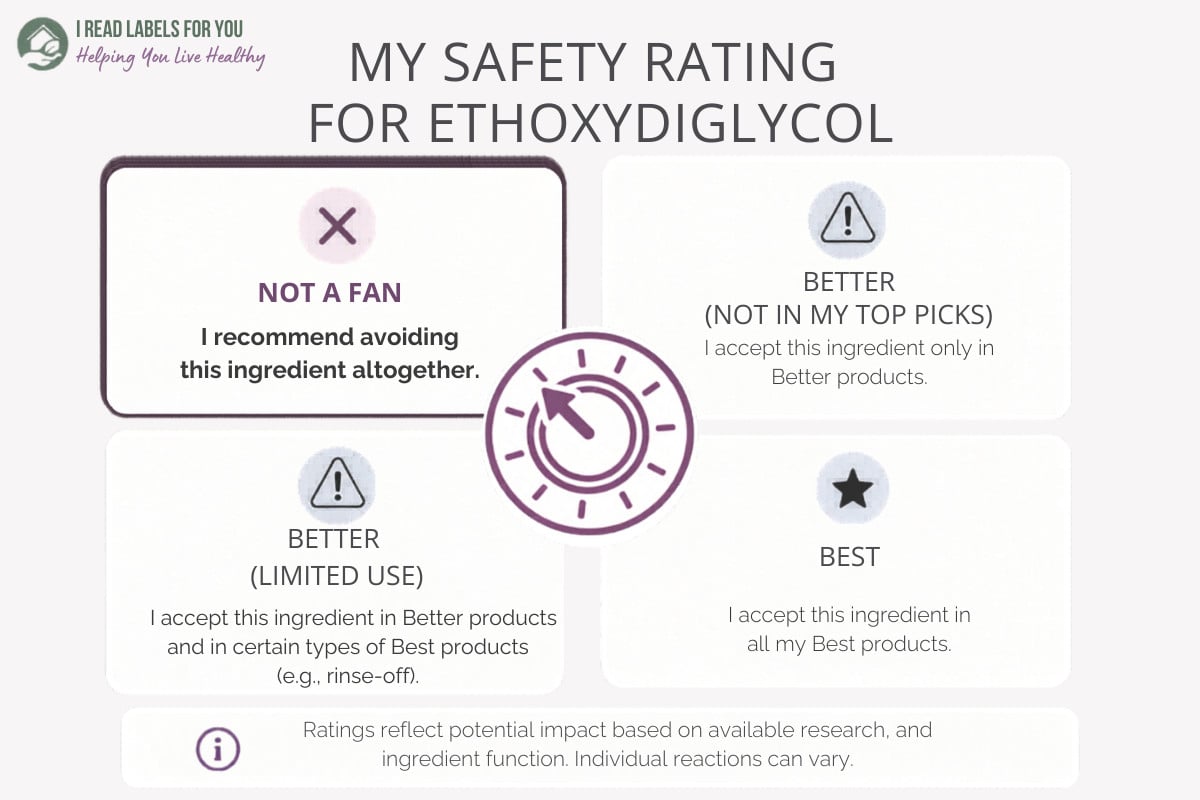
My rating for Ethoxydiglycol is Not A Fan. My first reason is how it’s made. Like every ethoxylated ingredient, it’s built from ethylene oxide, and brands do not publish what remains.
My second reason is what it does. About half of it passes through skin, and it carries the rest of the formula with it.
Europe’s safety committee compared your likely daily dose with the highest dose that harmed no test dogs. Using it in every product at the legal limit leaves a cushion of 114 times, just above the usual minimum of 100. Adding a hair dye that contains it shrinks the cushion to 97 times, below that minimum.
None of this means a product with it will hurt you. The molecule is not an allergen, and it did not cause birth defects in rats. Rather, I simply see no reason to accept those unknowns when there are other solvents that can do the job.
If you want an alternative, look for Pentylene Glycol, which I rate Best, or for formulas built on glycerin and water. Check self-tanners and serums first, since that’s where Ethoxydiglycol shows up most.
Frequently Asked Questions About Ethoxydiglycol
Is Ethoxydiglycol The Same As Diethylene Glycol?
No, they’re different chemicals. Diethylene glycol is the poison behind several mass medicine poisonings, and Europe bans it from cosmetics except as a trace. Ethoxydiglycol has an ethyl group capping one end. Still, in a rat study described by the SCCS, about 5 percent of what came out in urine was diethylene glycol.
Is Ethoxydiglycol The Same As Ethoxyethanol?
No, 2-ethoxyethanol has one ethylene oxide unit, while Ethoxydiglycol has two. That difference matters, because 2-ethoxyethanol damages fertility and is banned from European cosmetics. Ethoxydiglycol did not show those effects in rat and mouse studies.
Is Ethoxydiglycol In Baby Products?
Yes, sometimes. The 2003 industry survey in the CIR’s 2006 update lists baby lotions at under 0.5 percent. Baby shampoos came in at under 1 percent. For babies, I would skip it, since infant skin absorbs more for its body size.
Is Ethoxydiglycol Safe In Self-Tanners?
Self-tanners are where you’ll meet it most, because it smooths streaks. In Europe, a self-tanning lotion may contain up to 2.6 percent, and spray tans are not among the four spray types Europe names. I prefer self-tanners without it.
Why Does EWG Rate Ethoxydiglycol Differently?
The Environmental Working Group (EWG) gives Ethoxydiglycol a score of 1 to 5, depending on how a product uses it. Its Skin Deep entry rates the data as Good and lists ethylene oxide and 1,4-dioxane as contamination concerns.
In fact, EWG and I agree on the concern itself. EWG restricts the ingredient in EWG VERIFIED products unless the company shows substantiation. I go further, because I have never seen a brand publish that substantiation for this ingredient.
Sources
EU SCCS / SCCP Opinions:
SCCS/1507/13, Opinion on Diethylene Glycol Monoethyl Ether (DEGEE), adopted February 26, 2013, revised June 18, 2013. Contains the dermal absorption studies, the safety margins of 114 and 97, the reproductive studies, the ethylene glycol impurity limit and the statement that no adequate carcinogenicity study exists: SCCS/1507/13
SCCS/1316/10, Opinion on Diethylene Glycol Monoethyl Ether (DEGEE), September 21, 2010. Found that 5.5 percent in leave-on products poses a risk to the consumer: SCCS/1316/10
SCCP/1044/06, December 19, 2006, and SCCP/1200/08, December 16, 2008, earlier opinions on DEGEE: SCCP/1044/06; SCCP/1200/08
Cosmetic Ingredient Review (CIR) Reports:
Elder RL (ed.), 1985. Final Report on the Safety Assessment of Butylene Glycol, Hexylene Glycol, Ethoxydiglycol, and Dipropylene Glycol. Journal of the American College of Toxicology 4(5):223-248. Contains the manufacturing route, the impurities, the subchronic kidney findings and the human product tests: CIR reports database
Cosmetic Ingredient Review, 2006. Annual Review of Cosmetic Ingredient Safety Assessments, 2004/2005. International Journal of Toxicology 25(Suppl 2). The Panel decided not to reopen the 1985 report; contains the 2002 and 2003 use and concentration data: CIR reports database
European Union Regulatory Databases:
CosIng, ingredient record for Ethoxydiglycol. Functions humectant, solvent and perfuming; Annex III entry 297: CosIng, Ethoxydiglycol
CosIng, substance record for Diethylene Glycol Monoethyl Ether. Annex III entry 297, limits of 7, 5, 10 and 2.6 percent, ethylene glycol impurity at or below 0.1 percent, not to be used in eye or oral products: CosIng, DEGEE
CosIng Annexes II, IV, V and VI. Ethoxydiglycol is not listed; Annex II prohibits ethylene oxide (182), dioxane (343), 2-ethoxyethanol (666), methoxydiglycol (1000) and diethylene glycol (1370): CosIng database
Commission Regulation (EU) 2016/314 of March 4, 2016, amending Annex III. Added Ethoxydiglycol with its limits; applies to products placed on the market from March 25, 2017: Regulation (EU) 2016/314
CLP Annex VI harmonised classifications. Ethoxydiglycol has no harmonised classification: ECHA CHEM harmonised classification
Commission Regulation (EU) No 618/2012 of July 10, 2012, amending CLP Annex VI. Harmonised classification of 2-ethoxyethanol (index 603-012-00-X, CAS 110-80-5) as Repr. 1B, H360FD, “May damage fertility. May damage the unborn child,” applicable from December 1, 2013: Regulation (EU) No 618/2012 on EUR-Lex
European Chemicals Agency (ECHA) substance record for 2-(2-ethoxyethoxy)ethanol, EC 203-919-7. REACH registered, tonnage band 10,000 to 100,000 tonnes a year, not a substance of very high concern, no open evaluation: ECHA CHEM substance record
European Commission, Endocrine disruptors in cosmetics. Lists 28 potential endocrine disruptors set for priority safety assessment, in two calls for data of 14 substances each; Ethoxydiglycol is not listed: European Commission, endocrine disruptors in cosmetics
Other Regulators:
U.S. FDA, cosmetics. Ethoxydiglycol is not on the FDA list of prohibited and restricted cosmetic ingredients, and no concentration limit applies.
U.S. FDA, food contact. Listed as a component of food packaging adhesives, 21 CFR 175.105: 21 CFR 175.105; paper and paperboard in contact with dry food, 21 CFR 176.180: 21 CFR 176.180; sanitizing solutions, 21 CFR 178.1010: 21 CFR 178.1010. Not a direct food additive.
Health Canada Cosmetic Ingredient Hotlist. Ethoxydiglycol is not listed; methoxydiglycol, 2-ethoxyethanol and ethylene oxide are prohibited: Cosmetic Ingredient Hotlist
Environment and Climate Change Canada and Health Canada, Screening Assessment, Ethylene Glycol Ethers Group, final, September 1, 2018. Includes Ethoxydiglycol; concludes the group does not meet the criteria of section 64 of the Canadian Environmental Protection Act: Ethylene Glycol Ethers Group screening assessment
Environment Canada, Canadian Environmental Protection Act Schedule 1. Ethoxydiglycol is not listed: CEPA Schedule 1
International Agency for Research on Cancer (IARC) Monographs. Ethoxydiglycol is not classified; ethylene oxide is Group 1: IARC list of classifications
National Toxicology Program Report on Carcinogens, 15th edition. Ethoxydiglycol is not listed; ethylene oxide is listed as known to be a human carcinogen: NTP Report on Carcinogens
California Proposition 65 list. Ethoxydiglycol is not listed: Proposition 65 list
PubChem Records (Chemistry, Identifiers, Skin Penetration, Hazard Codes):
Diethylene glycol monoethyl ether, PubChem CID 8146. Molecular formula C6H14O3, molecular weight 134.17, experimental log Kow minus 0.54: PubChem CID 8146
Peer-Reviewed Studies:
Hardin BD, Goad PT, Burg JR, 1984. Developmental toxicity of four glycol ethers applied cutaneously to rats. Environmental Health Perspectives 57:69-74. PMID 6499820. Authors at the U.S. National Institute for Occupational Safety and Health: PubMed 6499820
Williams J et al., 1990. National Toxicology Program continuous breeding study of diethylene glycol and diethylene glycol monoethyl ether in Swiss CD-1 mice. Fundamental and Applied Toxicology. PMID 2340988. DEGEE had no effect on fertility at up to 2.5 percent in drinking water: PubMed 2340988
MakingCosmetics Inc., Ethoxydiglycol Specification Sheet, updated October 23, 2025. Supplier document, not peer reviewed. Describes the ingredient as an ethoxylated alcohol made by ethoxylation of ethanol and carries a Proposition 65 warning naming ethylene oxide, methoxyethanol, ethoxyethanol and ethylene glycol: Ethoxydiglycol specification sheet
Paula’s Choice, Ethoxydiglycol ingredient dictionary entry. Retailer content, not peer reviewed, cited for the claim discussed above: Paula’s Choice, Ethoxydiglycol
Natural Cosmetic Standards:
COSMOS-standard approved raw materials. Ethoxydiglycol is not listed: COSMOS-standard approved raw materials
NATRUE certified and approved raw materials. Ethoxydiglycol is not listed: NATRUE certified raw materials
Skin Allergy Resource:
American Contact Dermatitis Society (ACDS), Helpful References, including the Core Allergen Series 2020. Ethoxydiglycol is not on the series, and it has never been named Allergen of the Year: ACDS Helpful References
Advocacy groups:
Environmental Working Group (EWG) Skin Deep entry for Ethoxydiglycol. Hazard score 1 to 5 depending on usage, data availability Good, contamination concerns listed for ethylene oxide and 1,4-dioxane, restricted in EWG VERIFIED products: EWG Skin Deep, Ethoxydiglycol
Last verified: 11-16-2026

Download The Free Guide!
5 Powerful Steps To A Non-Toxic Home
Join our informed consumer community and get our free guide the “5 Powerful Steps To A Non-Toxic Home”.

Before commenting, please read our Comment Policy.