
Are Synthetic And Mineral Waxes In Cosmetics Safe? A Simple Answer You Can Trust
 Written by Irina Webb
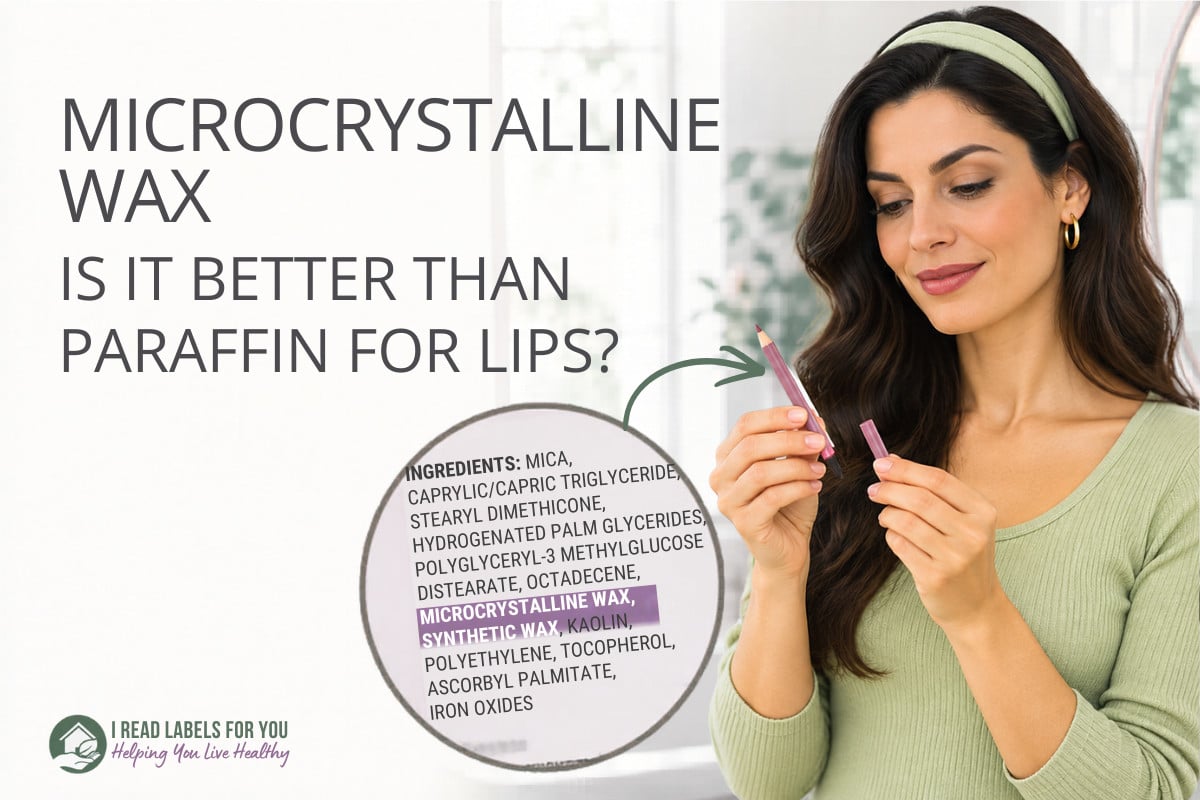
No, not all cosmetic waxes are safe in my view: two emulsifying waxes usually carry an ethoxylated ingredient, and seven others raise purity questions. The nine waxes discussed below shape lipsticks, firm up eye pencils, and thicken creams. Most come from petroleum, natural gas or coal, and the label never shows how carefully a batch was purified.
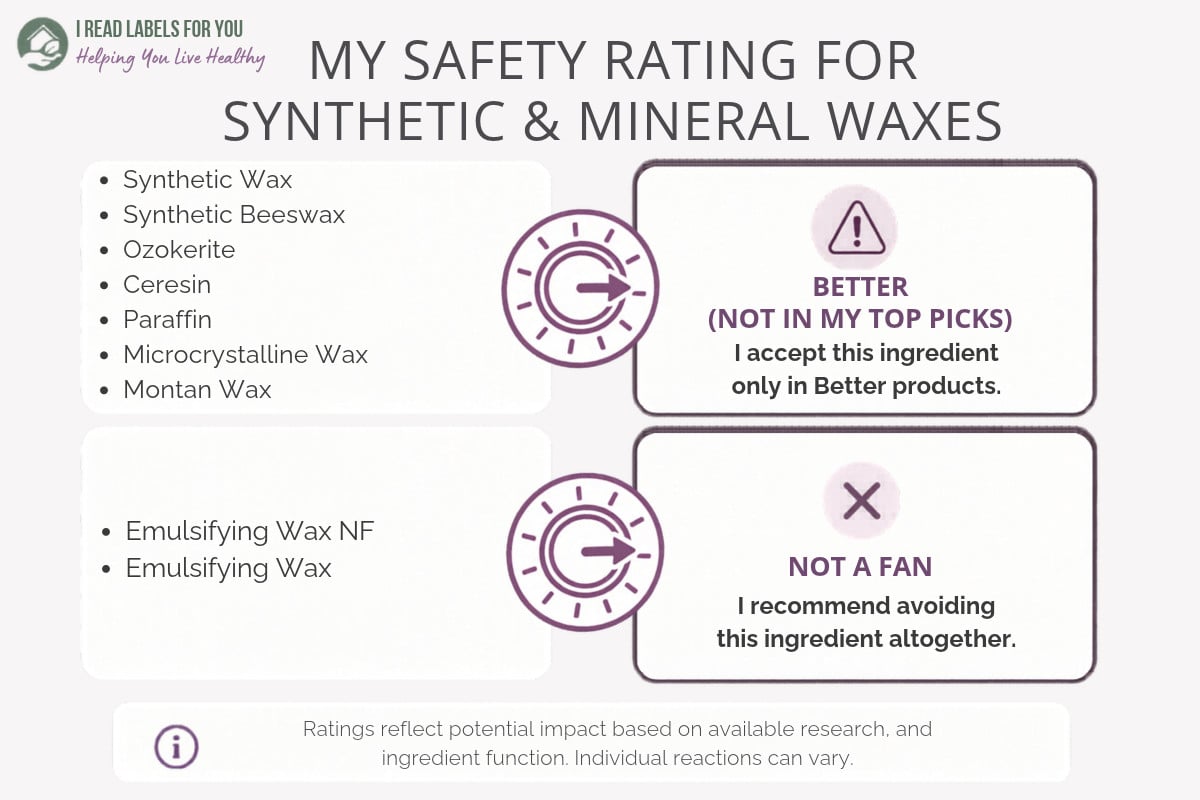
My rating for the following 7 waxes is Better (Not In My Top Picks):
- Synthetic Wax
- Synthetic Beeswax
- Ozokerite
- Ceresin
- Paraffin
- Microcrystalline Wax
- Montan Wax
My rating for the following 2 waxes is Not A Fan:
- Emulsifying Wax NF
- Emulsifying Wax
These waxes face no limits under the EU Cosmetics Regulation. Europe’s strict refining condition covers petrolatum and slack wax, yet it does not reach these finished waxes. Neither the U.S. nor Canada restricts any of the nine in cosmetics.
Keep reading to discover:
- which wax a long-term rat study linked to liver tumors, a study the industry’s 2026 safety review never mentions
- why a wax sold as Ceresin is rarely the purified mineral its name promises
- which petroleum wax German risk assessors actually recommend for lip balm
Safety Review Of Nine Waxes At A Glance
Below is each wax with the same plain-language description I use in my Label Verdict.
Synthetic Wax – Better (Not In My Top Picks)
A firm, glossy wax. Depending on the kind, it can carry leftover cobalt, a carcinogen and skin allergen; traces of aromatic hydrocarbons, linked to cancer; and small amounts of mineral-oil-like hydrocarbons that can build up in the body when swallowed. The polyethylene-type versions are plastics and may count as microplastics. The label won’t tell you what kind you are getting.
Synthetic Beeswax- Better (Not In My Top Picks)
A lab-made wax designed to imitate beeswax, with no bee material in it. It’s a blend of wax esters, fatty acids, fatty alcohols and hydrocarbons. The label won’t tell you whether those hydrocarbons come from petroleum, and its safety data are old industry studies with no tests for long-term or hormonal effects.
Ozokerite – Better (Not In My Top Picks)
A firm wax that comes from petroleum. It can carry aromatic hydrocarbons, some of which are linked to cancer, and no supplier publishes limits for them. The label won’t tell you how well it was refined, and its oily hydrocarbons can build up in the body when swallowed from lip products.
Ceresin – Better (Not In My Top Picks)
A hard white wax that comes from petroleum, usually blended with paraffin and microcrystalline waxes. Petroleum waxes can carry aromatic hydrocarbons, some of which are linked to cancer, no supplier publishes limits for them, and at least one woman developed a lip allergy traced to the ceresin in her lipstick. The label won’t tell you what’s in the blend or how well it was refined.
Paraffin – Better (Not In My Top Picks)
A firm white wax refined from petroleum, though some versions sold under the same name are made synthetically. Petroleum waxes can carry aromatic hydrocarbons, some of which are linked to cancer, and no supplier publishes limits for them. The label won’t tell you which kind of paraffin you’re getting or how well it was refined, and when it’s swallowed from lip products it adds to the mineral hydrocarbons people already take in from food.
Microcrystalline Wax – Better (Not In My Top Picks)
A soft, flexible wax refined from the heaviest part of crude oil. Its molecules are too large to get through skin, and it carries no hazard classification. The label can’t show how well a batch was refined, and suppliers don’t publish results for the aromatic hydrocarbons that are the real concern with petroleum waxes.
Montan Wax – Better (Not In My Top Picks)
A hard, dark wax extracted from lignite, a soft brown coal, then bleached with strong acids including chromic acid. The wax itself has a clean short-term record and isn’t classified as hazardous. It can be extracted with benzene and bleached with a cancer-causing form of chromium, and no supplier publishes tests showing it’s free of coal-tar-type contaminants, chromium or solvent residues.
Emulsifying Wax NF – Not A Fan
A ready-made emulsifier defined by the US pharmacopeia as cetearyl alcohol blended with an ethoxylated ingredient, usually Polysorbate 60. Polysorbate 60 is made with ethylene oxide, a known carcinogen, and can carry traces of 1,4-dioxane. A label reading just “Emulsifying Wax” doesn’t tell you which blend you’re getting.
Emulsifying Wax – Not A Fan
A general name for a ready-made blend that helps oil and water mix, without a fixed recipe behind it. The most common versions contain Polysorbate 60 or other ethoxylated ingredients, which are made with ethylene oxide, a known carcinogen, and can carry traces of 1,4-dioxane. Unless the brand lists the actual ingredients in the blend, you can’t tell whether yours is one of these or a plant-based version.
What Are Synthetic And Mineral Waxes?
Synthetic and mineral waxes are solid, water-repelling ingredients built mostly from hydrocarbons, which are chains of carbon and hydrogen. Some are refined from crude oil, some are dug out of the ground, and some are assembled in a factory.
They fall into three loose groups. Paraffin, Microcrystalline Wax, Ozokerite and Ceresin are petroleum or fossil hydrocarbon waxes. Synthetic Wax and Synthetic Beeswax are made in a plant, while Montan Wax comes from lignite, a soft brown coal.
The two emulsifying waxes are the odd ones out. Despite the name, they’re not hydrocarbon waxes at all. Instead, they’re ready-made emulsifier blends that keep oil and water from separating in a cream.
What Do Synthetic And Mineral Waxes Do In Cosmetics?
Structure is their main job. The EU ingredient database, CosIng, lists binding and viscosity controlling for nearly all of them, meaning they hold a formula together and thicken it. Several also stabilize emulsions or make a product opaque.
Some products are packed with wax. The industry-funded Cosmetic Ingredient Review (CIR), paid for by the Personal Care Products Council, recorded Synthetic Wax at up to 36% in eyebrow pencils. It also found Paraffin at 9% to 18.2% in 2,330 lipsticks and lip glosses.
Microcrystalline Wax appears in the most lip products of the group, 4,440 of them. Montan Wax, by contrast, had only 34 reported uses, at no more than 0.54%.
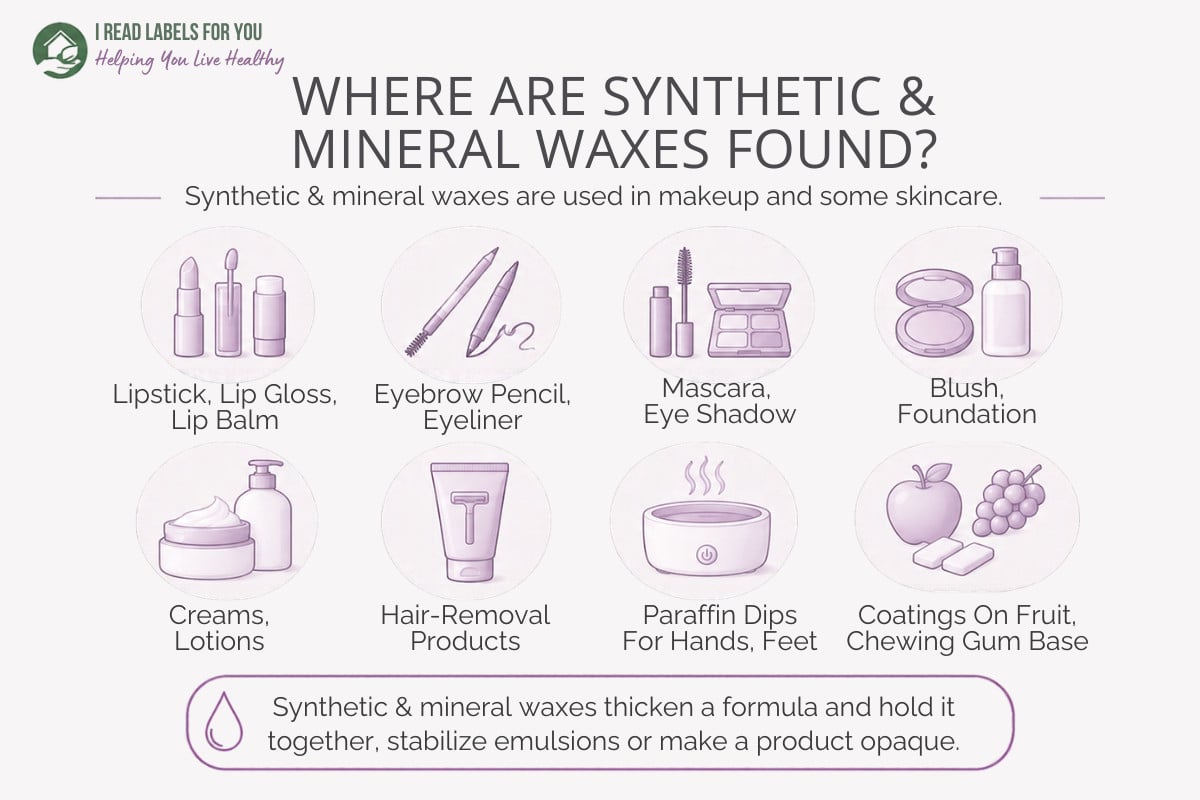
You’ll find these waxes most often in:
- lipstick, lip gloss and lip balm
- eyebrow pencil and eyeliner
- mascara and eye shadow
- blush and foundation
- creams and lotions (emulsifying waxes)
- hair-removal products
- paraffin dips for hands and feet
- coatings on some fresh fruit (microcrystalline wax E 905)
- chewing gum base (petroleum wax)
- processed foods that use polysorbate 60 as an emulsifier
How Are Paraffin And Microcrystalline Wax Made?
Both start in an oil refinery. According to the 1984 CIR report, Paraffin comes from a crude oil distillate that is cooled, filtered and pressed to squeeze out the oil.
Along the way, the wax passes through slack wax, an oily crude wax that the EU classifies as a presumed carcinogen. Further refining, either with hydrogen or with acid and clay, then strips out aromatic hydrocarbons.
Microcrystalline Wax comes from the heaviest part of crude oil, the residue left in the still after distillation. Next, concentrated sulfuric acid removes the asphalt, and the wax is de-oiled. Finally, acid and clay or high-pressure hydrogen finish it.
That last step matters most. Hydrogen treatment is the step that removes aromatics, yet one CAS number covers both the acid-finished and the hydrogen-treated grades.
How Are Ozokerite And Ceresin Made?
Natural ozokerite is a fossil wax. CIR states that most commercial wax is mined in Eastern Europe, melted in boiling water, purified with concentrated sulfuric acid and decolorized with charcoal.
However, CosIng ties the INCI name Ozokerite to a petroleum wax that has been chemically neutralized. In addition, Paramelt describes one of its INCI Ozokerite grades as “A balanced formulation of mineral hydrocarbon waxes.”
Ceresin is defined as ozokerite purified with sulfuric acid and filtered through bone black, a charcoal made by burning animal bones. In practice, the supplier Poth Hille makes its ceresin grades “mainly using paraffin and microcrystalline waxes.”
How Are Synthetic Wax, Synthetic Beeswax, And Montan Wax Made?
CosIng says Synthetic Wax comes from either the Fischer-Tropsch process or ethylene polymerization. The Fischer-Tropsch route joins hydrogen and carbon monoxide over a catalyst, and Shell makes its grade from natural gas.
No supplier names its catalyst, and cobalt is one possibility. The other route yields polyethylene, a plastic. NuCera’s safety sheet for one INCI Synthetic Wax lists “Ethene homopolymer” at 90% to 100%.
Synthetic Beeswax is a reaction product of blended fatty acids and fatty alcohols designed to imitate beeswax. CosIng says it also contains C22 to C34 alkanes, a hydrocarbon fraction.
Montan Wax is extracted from lignite with solvents. In one method that the European Food Safety Authority (EFSA) described, the solvent is about 85% benzene. The crude wax is then oxidized with chromic acid, according to CIR.
How Are Emulsifying Waxes Made?
Emulsifying Wax NF is a simple blend. The National Formulary, part of the US pharmacopeia, defines it as cetearyl alcohol blended with an ethoxylated ingredient. Supplier sheets show Cetearyl Alcohol at over 50% and Polysorbate 60 at 20% to 35%.
Polysorbate 60 is the ethoxylated part. FDA food rules describe it as stearic acid reacted with sorbitol and then with ethylene oxide. In contrast, a label reading only Emulsifying Wax names no fixed recipe at all.
Do Synthetic And Mineral Waxes Penetrate The Skin?
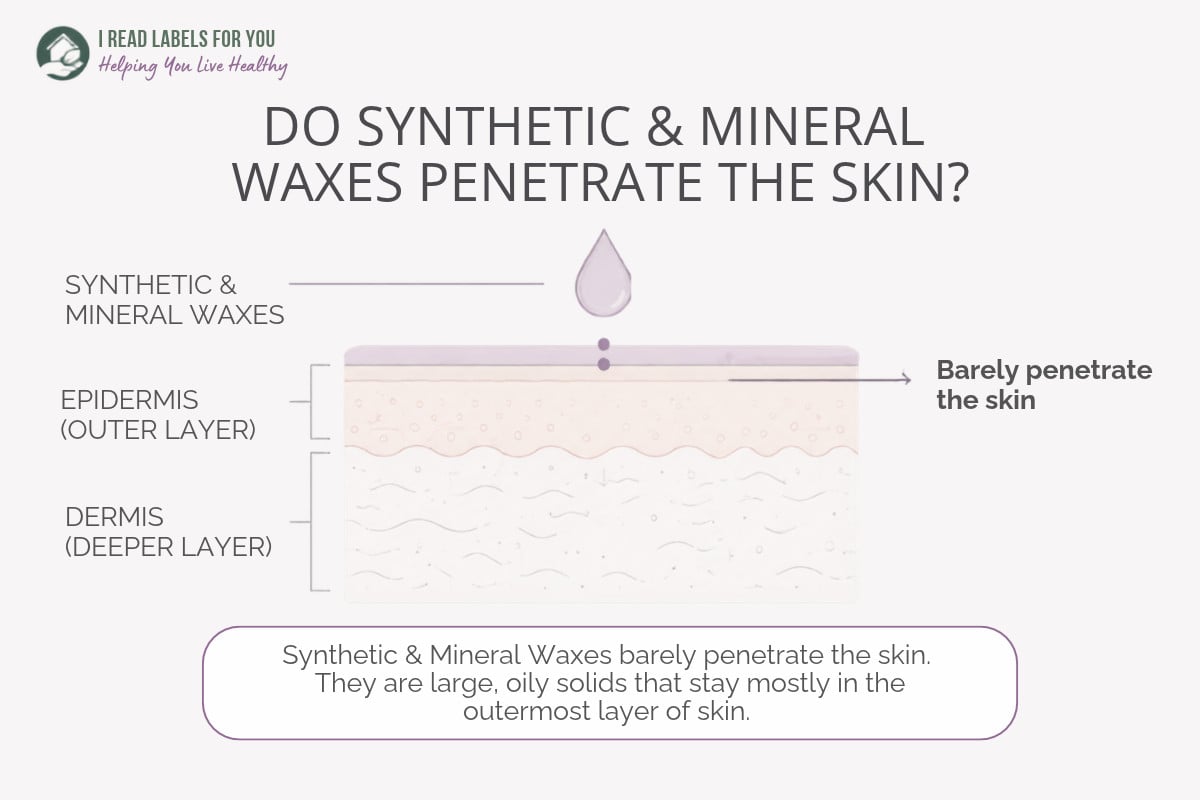
Barely. Synthetic and Mineral waxes are large, oily solids that stay mostly in the outermost layer of skin. Even so, nobody has directly measured skin uptake of any of the nine.
Size is the first gatekeeper. A dalton is a unit of molecular weight, and intact skin blocks most substances heavier than about 500 of these units. Microcrystalline Wax molecules weigh 580 to 700 daltons, and Synthetic Wax runs about 500 to 900.
Paraffin is the lightest, with chains of 18 to 36 carbons, and part of it falls below 500 daltons. Here, oiliness takes over. LogP measures how strongly something prefers oil to water, and the German Federal Institute for Risk Assessment (BfR) puts these waxes above 7.
That extreme oiliness keeps them from moving into the watery layers below. In BfR’s summary of skin tests, a 16-carbon hydrocarbon stayed 97.6% to 99.3% in the outer skin. However, EFSA notes these hydrocarbons can linger in skin after washing.
The route that really counts is your mouth. You swallow much of every lip product, and that is where most of the body’s exposure to these waxes comes from.
What Are Synthetic And Mineral Waxes Called On Labels?
On a label, these waxes can appear under any of these names:
- Synthetic Wax
- Synthetic Paraffin
- Fischer-Tropsch Wax
- Synthetic Beeswax
- Beeswax, Synthetic
- Ozokerite
- Ozocerite
- Ozokerite Wax
- Ceresin
- Ceresin Wax
- Ceresine
- Mineral Wax
- Earth Wax
- Paraffin
- Paraffin Wax
- Hard Paraffin
- Microcrystalline Wax
- Cera Microcristallina
- Microwax
- Montan Wax
- Montan Cera
- Lignite Wax
- Emulsifying Wax NF
- Emulsifying Wax
- Cetearyl Alcohol (And) Polysorbate 60
Watch for one trap. Cera Alba is real beeswax, not Synthetic Beeswax. Moreover, Avena Lab sells a “synthetic beeswax” whose INCI list is Paraffin, C10-18 Triglycerides, Cera Alba, and Stearic Acid.
Does The U.S. FDA Restrict Synthetic And Mineral Waxes In Food And Cosmetics?
No, the U.S. Food and Drug Administration (FDA) places no cosmetic limit on any of the nine. Its roster of banned and restricted cosmetic chemicals leaves all of them out.
Food rules are stricter. The FDA allows petroleum wax in or on food only if it passes an ultraviolet absorbance test, a check that limits aromatic hydrocarbons. Synthetic wax made from ethylene must pass the same test.
Other waxes have narrower roles. Fischer-Tropsch synthetic paraffin is allowed in food-packaging coatings, while Montan Wax and ceresin appear only in food-packaging rules, such as the list of allowed adhesives. Polysorbate 60, the ethoxylated part of Emulsifying Wax NF, is an approved food additive.
Here’s the catch. Nothing requires a cosmetic wax to meet the food-grade ultraviolet test, and no cosmetic supplier in my research published that test result.
I also give little weight to FDA silence on cosmetics. The agency does not approve formulas before they’re sold, and it last updated that restricted list in February 2022. Natural beeswax holds GRAS status, short for generally recognized as safe, a label I treat with caution because it often rests on industry judgment.
Europe works differently. Its precautionary principle lets regulators act on credible warning signs rather than waiting for harm to be proven.
EU Regulations On Synthetic And Mineral Waxes
None of the nine waxes appears in any annex of the EU Cosmetics Regulation. In addition, none has ever been reviewed by the Scientific Committee on Consumer Safety (SCCS), which gives the EU independent advice on cosmetic safety.
None carries a harmonized hazard classification under CLP, the EU’s chemical labeling law. For Emulsifying Wax NF, the relevant EU rules concern impurities: Europe prohibits ethylene oxide and 1,4-dioxane as cosmetic ingredients.
Why Europe’s Refining Rule Misses These Waxes
The EU bans petrolatum and slack wax in cosmetics unless their full refining history is known. The maker must also show the starting material is not a carcinogen. That condition is tied to their own CAS numbers.
Finished Paraffin, Microcrystalline Wax, Ozokerite and Ceresin have different CAS numbers; hence, the condition does not apply to them. In other words, a European label offers no extra refining assurance for these four.
Ozokerite shows the gap clearly. Its CosIng identity is a chemically neutralized petroleum wax, yet the EU classifies two chemically neutralized refinery oils as known carcinogens, category 1A.
Food Additive And Microplastics Rules
As a food additive, E 905 microcrystalline wax must contain no more than 50 micrograms of benzo(a)pyrene per kilogram. Benzo(a)pyrene is a carcinogenic aromatic hydrocarbon. Cosmetic grades, however, face no such limit.
Montan Wax derivatives, the montan acid esters once sold as E 912, are gone from the EU food additive list. EFSA said in 2013 that PAH data requested since the 1990s were never supplied.
Separately, the EU microplastics restriction, REACH Annex XVII entry 78, may catch polyethylene-type Synthetic Wax sold as solid particles. Its cosmetic deadlines run from October 17, 2027, for rinse-off products to October 17, 2035, for lip, nail and makeup products.
Canadian Regulations On Synthetic And Mineral Waxes
Canada restricts none of the nine waxes. The Cosmetic Ingredient Hotlist, where Health Canada names prohibited and restricted cosmetic substances, has no wax, paraffin or montan entry.
Similarly, Schedule 1 of the Canadian Environmental Protection Act, Canada’s toxic substances register, includes none of them. That schedule does list plastic microbeads of 5 mm or less, but it names no wax.
Can Synthetic And Mineral Waxes Cause Skin Allergy And Sensitization?
No, these waxes rarely cause skin allergy in most people, although one published case tied a lip allergy to Ceresin. None of the nine sits on the Core Allergen Series of the American Contact Dermatitis Society (ACDS), the starting panel dermatologists use.
What The Old Patch Tests Found
Most human data are industry tests of finished products from the 1970s and 1980s. A 6% Synthetic Wax lip product caused no reactions in 209 people, and a guinea pig test scored 0%.
Paraffin, at full strength and in 5% to 16% products, showed no allergy in about 500 people. Ozokerite was clean in a 300-person blush test and a 201-person lipstick test.
Furthermore, Montan Wax lipsticks tested negative in about 270 people, and a mouse test at up to 10% was negative. Emulsifying Wax NF showed no allergy in roughly 1,170 people.
Synthetic Beeswax has the thinnest record. Its only human test used a lipstick that also held 10% real beeswax, and CIR never states the sensitization result.
The Ceresin Lipstick Case
A 2012 case report describes a 37-year-old woman with recurring lip inflammation. Tested ingredient by ingredient, she reacted only to the Ceresin in her lipstick.
The report does not say which grade of ceresin was used. On top of that, a 2024 review of lip-care allergies names wax among the most common causes, without naming which waxes.
Hidden Allergens From Processing
Two hidden extras deserve a mention. Poth Hille sells a special BHT-free ozokerite, which suggests its standard grades may contain BHT, itself an ACDS core allergen.
Montan Wax is bleached with chromic acid, and chromium is also an ACDS core allergen. Even so, no supplier publishes how much chromium stays behind.
Are Synthetic And Mineral Waxes Hormone (Endocrine) Disruptors?
No, none of these waxes is a recognized hormone disruptor, but nobody has run a direct hormone test on any of them. None is on the endocrine disruptor assessment list of the European Chemicals Agency (ECHA).
PubMed searches for hormone studies on each of the nine turned up nothing relevant. The closest data concern a refined, low-viscosity paraffinic wax used in food packaging.
For that wax, a 2023 EFSA food-contact opinion concluded it “is devoid of endocrine activity.” It’s a related wax, though, not a cosmetic grade of any of the nine.
Are Synthetic And Mineral Waxes Safe To Use While Pregnant?
There’s no clear answer for these waxes during pregnancy, because none of the nine waxes has a reproductive or developmental study. None of the three CIR reports contains such data for any wax.
One finding is worth knowing. BfR reports that in 142 pregnant women, use of hand cream and lipstick correlated with mineral hydrocarbon levels in body fat.
For the emulsifying waxes, the polysorbate 60 part has one clean rat study on birth defects. However, EU law classifies ethylene oxide, used to make it, as a reproductive toxicant.
During pregnancy, a lip product with no petroleum waxes is an easy swap. If you’re unsure about a favorite lipstick or cream, you should consult with your medical provider.
Are There Any Cancer Concerns Linked To Synthetic And Mineral Waxes?
No, none of the nine waxes is itself a listed carcinogen, but the impurities they may carry are a real cancer concern. The International Agency for Research on Cancer (IARC), the U.S. National Toxicology Program and California’s Proposition 65 list none of them.
Aromatic Hydrocarbons Left From Petroleum
Petroleum waxes can carry mineral oil aromatic hydrocarbons (MOAH), including polycyclic aromatic hydrocarbons (PAH). The 1984 CIR report states that refined Paraffin “may contain trace impurities” of PAH “which have been shown to be carcinogenic.”
EFSA’s 2023 mineral oil opinion links genotoxicity and cancer to MOAH with three or more aromatic rings. It also describes one paraffin wax with MOAH as high as 1.14%, mostly with one or two rings.
BfR reports 1% to 1.7% MOAH in high-molecular crystalline waxes, and up to 3.9% in some German lip-care products. Meanwhile, a 2019 review by BfR scientists found no sign of cancer in animals given highly refined mineral oils and waxes.
The problem is simple. No supplier in my research publishes an aromatics result for any cosmetic grade. Therefore, you have no way to tell a highly refined batch from a poor one.
What Animal Studies Show
Paraffin has the strongest record. In a 2-year feeding study cited by CIR in 2026, five paraffin waxes at 10% of rat feed showed “No carcinogenic potential.”
Ozokerite is less clear. A 2013 two-year rat study found it “weakly carcinogenic in the liver of male F344 rats.” EFSA considers that rat strain a poor model for wax effects, and CIR’s 2026 review never mentions the study.
Similarly, a 2008 90-day rat study of Montan Wax found liver granulomas, small clusters of immune cells, and could not set a safe dose. Microcrystalline Wax has no chronic study of its own.
Manufacturing Chemicals
Montan Wax may be extracted with benzene and is bleached with chromic acid, which contains hexavalent chromium. The EU classifies both benzene and chromium trioxide as known carcinogens.
For Synthetic Wax, a cobalt catalyst would bring a presumed carcinogen into the process, but no supplier states which catalyst it uses.
For Emulsifying Wax NF, Polysorbate 60 is made with ethylene oxide and can carry 1,4-dioxane. One supplier caps 1,4-dioxane at under 10 ppm, while another allows up to 380 ppm.
Are Synthetic And Mineral Waxes Bad For The Environment?
Yes, mostly, because nearly all of them come from fossil sources. Petroleum, natural gas and lignite coal supply the bulk of these waxes.
Natural certifiers agree. The COSMOS standard excludes “fossil fuel-derived materials,” and neither COSMOS nor NATRUE approves any of the nine. By contrast, COSMOS approves many grades of plain Cetearyl Alcohol.
Polyethylene-type Synthetic Wax adds a plastic question, since it may count as a microplastic under the EU restriction. Shell, however, says its Fischer-Tropsch wax is not a synthetic polymer, and the label does not say which kind you have.
Montan Wax adds lignite mining plus refining with chromic, fuming sulfuric and chlorosulfonic acids, according to CIR.
Common Claims About Synthetic And Mineral Waxes: What’s True And What’s Not
Claim: Paraffin In Lipstick Causes Cancer
This claim is partly true. Some “toxic-free” makeup sellers lump paraffin wax together with petrolatum and say it’s linked to cancer, without citing a study.
The real issue is purity, not paraffin itself. Poorly refined petroleum waxes can carry carcinogenic PAH, while five paraffin waxes were negative in a 2-year rat study. Since no supplier publishes aromatics results, you have no way to confirm which kind is in your lipstick.
Claim: Ozokerite Is A Natural Mineral Wax
This claim is only partly true. Ingredient blogs and sellers often call ozokerite a natural, earth-derived wax, and a mined fossil wax by that name does exist.
Yet CosIng ties the INCI name to a petroleum wax, and CIR notes that commercial ozokerite may be mixed with Paraffin to cut costs. Neither COSMOS nor NATRUE accepts it.
Claim: Emulsifying Wax Is 100% Natural And Plant-Derived
This claim is misleading for Emulsifying Wax NF. Retail listings describe some emulsifying waxes as “100% natural” and plant-derived.
The fatty alcohol half may well come from coconut or other plant oils. The polysorbate half, however, is made with ethylene oxide. Croda even describes its NF-grade wax as both “Plant derived” and “Petrochemical derived.”
What I Think About Synthetic And Mineral Waxes, And What You Should Do
Across the nine waxes, I give Better (Not In My Top Picks) and Not A Fan ratings, and none earns Best. The reasons differ between the two groups.
For the seven hydrocarbon and ester waxes, the wax itself looks mild. What keeps them out of my Best products is what the label leaves out: origin, refining and aromatic content. I accept them in my Better products but keep them out of my Best products.
The emulsifying waxes are a different story. Emulsifying Wax NF must contain an ethoxylated ingredient, and my rule for every ethoxylated ingredient applies to it. Plain Emulsifying Wax falls under the same rule unless the brand discloses the blend.
To be clear, Cetearyl Alcohol on its own is not the problem. It’s not ethoxylated, and you’ll find it in many natural and organic creams.
My practical suggestions:
- for lip products, which you swallow, choose formulas with fewer petroleum waxes, especially for children
- treat “synthetic beeswax” on the front of a box as a marketing term and read the ingredient list
- when a label says only Emulsifying Wax, ask the brand which ingredients are in the blend
- if a lipstick irritates your lips, request patch testing of each of its ingredients from a dermatologist
- skip airbrush makeup with these waxes, since CIR found the airbrush safety data insufficient
Frequently Asked Questions About Synthetic And Mineral Waxes
Is Microcrystalline Wax Better Than Paraffin For Lips?
In one way, yes. BfR writes that “microcrystalline waxes are recommended for use in lip care products,” because heavier hydrocarbons are absorbed less from the gut. On the other hand, BfR also reports the highest aromatic levels in these heavier waxes.
Is Synthetic Beeswax Vegan?
Not necessarily. Synthetic Beeswax contains no bee material by definition. However, one leading supplier lists petrochemical, mineral and animal-derived origins. Consequently, the label alone cannot settle it.
Is Cetearyl Alcohol The Same As Emulsifying Wax?
No. Cetearyl Alcohol is a fatty alcohol that is not ethoxylated. Emulsifying Wax NF adds Polysorbate 60, and CIR notes that some polysorbates can help other ingredients pass into skin.
Are Paraffin Hand Dips Safe?
Salon dips use melted, low-melting paraffin on intact skin, which absorbs very little of it. The FDA even regulates paraffin baths as medical devices meant to relieve pain and stiffness.
Why Does EWG Rate These Waxes Differently?
The Environmental Working Group (EWG) gives Synthetic Wax, Synthetic Beeswax, Ozokerite, Ceresin, Paraffin, Microcrystalline Wax and Montan Wax its best score, 1. It scores Emulsifying Wax 4 to 5, depending on use.
My ratings weigh information those scores leave out. I count the unpublished aromatic content, the 2013 ozokerite rat study, the Ceresin lip case and the coal, benzene and chromium behind Montan Wax.
For Emulsifying Wax, EWG flags neither 1,4-dioxane nor ethylene oxide. Its description, plant or petroleum wax plus detergents, also does not match the NF definition. Interestingly, EWG Verified lists the main entry for every one of these waxes as Restricted.
Sources
EU SCCS / SCCP Opinions:
No SCCS, SCCP or SCCNFP opinion on Synthetic Wax, Synthetic Beeswax, Ozokerite, Ceresin, Paraffin, Microcrystalline Wax, Montan Wax, Emulsifying Wax NF, Cetearyl Alcohol or Polysorbate 60 (checked). SCCS opinions portal: SCCS opinions
Cosmetic Ingredient Review (CIR) Reports:
All CIR reports are funded by the Personal Care Products Council, the cosmetics industry trade group. Report database: cir-reports.cir-safety.org
Elder RL (ed.), 1984. Final Report on the Safety Assessment of Fossil and Synthetic Waxes. Journal of the American College of Toxicology 3(3):43 to 99. Manufacturing, composition, PAH note, patch tests: CIR 1984 report
Cosmetic Ingredient Review Expert Panel, 2005. Annual Review of Cosmetic Ingredient Safety Assessments, 2002/2003. International Journal of Toxicology 24(Suppl 1):1 to 102, fossil and synthetic waxes pp. 67 to 74. Not reopened: CIR 2005 re-review
Cosmetic Ingredient Review Expert Panel, 2026. Re-review summary, Fossil and Synthetic Waxes (Panel meeting September 2025). Use concentrations, ceresin case, paraffin 2-year study, airbrush data insufficient: CIR 2026 re-review
Cosmetic Ingredient Review Expert Panel, 2015. Safety assessment of polysorbates, including Polysorbate 60. Penetration enhancement and 1,4-dioxane cautions: cir-reports.cir-safety.org
European Union Regulatory Databases:
CosIng entry 80523, SYNTHETIC WAX, functions abrasive, binding, emulsion stabilising, fragrance and viscosity controlling; no annex restrictions: CosIng 80523
CosIng entry 38425, SYNTHETIC BEESWAX, functions binding, emulsion stabilising and viscosity controlling; no annex restrictions: CosIng 38425
The CosIng entry 78292, OZOKERITE, functions binding, emulsion stabilising, opacifying and viscosity controlling; no annex restrictions: CosIng 78292
CosIng entry 75087, CERESIN, functions antistatic, binding, emulsion stabilising, hair conditioning, opacifying and viscosity controlling; no annex restrictions: CosIng 75087
CosIng entry 91023, PARAFFIN, functions skin conditioning, viscosity controlling and perfuming; no annex restrictions: CosIng 91023
The CosIng entry 92425, MICROCRYSTALLINE WAX, functions binding, bulking, emulsion stabilising and viscosity controlling; no annex restrictions: CosIng 92425
CosIng entry 88725, CERA MICROCRISTALLINA; no annex restrictions: CosIng 88725
CosIng entry 92430, MONTAN WAX, functions binding and viscosity controlling; no annex restrictions: CosIng 92430
The CosIng entry 35395, MONTAN CERA; no annex restrictions: CosIng 35395
Emulsifying Wax NF has no CosIng entry (checked). Component CETEARYL ALCOHOL, CosIng entry 75132; no annex restrictions: CosIng 75132
Component POLYSORBATE 60, CosIng entry 79321; no annex restrictions: CosIng 79321
Impurities: Ethylene oxide, Annex II/182: CosIng 28401 and Dioxane, Annex II/343: CosIng 28680
Regulation (EC) No 1223/2009 on cosmetic products, consolidated text, Annex II entries 894 to 910 (slack wax and petrolatum, full refining history condition); none of the nine listed: EUR-Lex
Regulation (EU) No 231/2012, food additive specifications, E 905 microcrystalline wax (benzo(a)pyrene no more than 50 micrograms per kilogram): EUR-Lex
REACH Regulation (EC) No 1907/2006, Annex XVII entry 78, synthetic polymer microparticles: EUR-Lex
ECHA RAC and SEAC Background Document on the microplastics restriction: ECHA background document
CLP Annex VI harmonized classifications. No entry for any of the nine; slack wax and petrolatum Carc. 1B with Note N: CLP Annex VI
ECHA CHEM, paraffin waxes and hydrocarbon waxes (EC 232-315-6, shared by Paraffin and Synthetic Wax), no harmonized classification: ECHA CHEM, EC 232-315-6
ECHA CHEM, paraffin waxes, hydrotreated (EC 265-154-5), no harmonized classification: ECHA CHEM, EC 265-154-5
The ECHA CHEM, beeswax, synthetic (EC 275-286-5), no harmonized classification: ECHA CHEM, EC 275-286-5
ECHA CHEM, hydrocarbon waxes (petroleum), chemically neutralized (EC 265-134-6, CosIng ozokerite identity), no harmonized classification: ECHA CHEM, EC 265-134-6
ECHA CHEM, ceresin (EC 232-290-1), no harmonized classification: ECHA CHEM, EC 232-290-1
The ECHA CHEM, microcrystalline wax (EC 264-038-1), no harmonized classification: ECHA CHEM, EC 264-038-1
ECHA CHEM, montan wax (EC 232-313-5), no harmonized classification: ECHA CHEM, EC 232-313-5
ECHA CHEM, cetearyl alcohol (EC 267-008-6), no harmonized classification: ECHA CHEM, EC 267-008-6
The ECHA endocrine disruptor assessment list. None of the nine listed: ECHA ED assessment
EFSA ANS Panel, 2013. Scientific Opinion on the re-evaluation of montan acid esters (E 912) as a food additive. EFSA Journal 11(6):3236. Benzene extraction, chromic acid oxidation, PAH data not supplied: EFSA Journal
German Federal Institute for Risk Assessment (BfR), Updated Opinion No. 008/2018. Highly refined mineral oils in cosmetics. Lip-care recommendation, MOAH levels, skin absorption: BfR opinion
Cosmetics Europe Recommendation No. 14 on mineral hydrocarbons (industry guidance, 2018). Lip-care criteria and INCI definitions: Cosmetics Europe
Other Regulators:
U.S. FDA, prohibited and restricted cosmetic ingredients. None of the nine listed: FDA
U.S. FDA, 1,4-Dioxane in Cosmetics: A Manufacturing Byproduct: FDA
U.S. Code of Federal Regulations, 21 CFR 172.886, petroleum wax in food, ultraviolet absorbance limits: eCFR 172.886
21 CFR 172.888, synthetic petroleum wax made from ethylene: eCFR 172.888
21 CFR 175.250, synthetic paraffin made by the Fischer-Tropsch process, food-packaging coatings: eCFR 175.250
The 21 CFR 175.105, food-packaging adhesives, including ceresin wax and montan wax: eCFR 175.105
21 CFR 172.836, polysorbate 60 as a food additive: eCFR 172.836
21 CFR 184.1973, beeswax (natural only), GRAS: eCFR 184.1973
The 21 CFR 890.5110, paraffin bath, Class II medical device: eCFR 890.5110
Health Canada Cosmetic Ingredient Hotlist. None of the nine listed: Health Canada Hotlist
Environment Canada, CEPA Schedule 1. None of the nine listed: CEPA Schedule 1
International Agency for Research on Cancer (IARC), list of classifications. None of the nine classified: IARC classifications
U.S. National Toxicology Program, 15th Report on Carcinogens, listed substances. None of the nine listed: NTP listed substances
California Proposition 65 list. None of the nine listed: OEHHA
PubChem Records (Chemistry, Identifiers, Skin Penetration, Hazard Codes):
These waxes are mixtures, so PubChem has no valid single compound record (CID) for any of them. Substance records used:
Synthetic Wax, SID 135289582: PubChem SID 135289582
Synthetic Beeswax, SID 135280206: PubChem SID 135280206
Ozokerite (ozocerite), SID 135313597: PubChem SID 135313597
Ceresin, SID 472386011: PubChem SID 472386011
Do not use CID 21596125, a plant compound wrongly linked to the names ozokerite and ceresin: PubChem CID 21596125
Paraffin, SID 135286130: PubChem SID 135286130
Microcrystalline Wax, SID 135298556: PubChem SID 135298556
Montan Wax, SID 135285748: PubChem SID 135285748
Emulsifying Wax NF component Cetearyl Alcohol, CID 62238: PubChem CID 62238
Peer-Reviewed Studies:
Powell M, Moreau L, 2012. Case report: allergic contact cheilitis caused by ceresin wax. Contact Dermatitis 66(1):46 to 47. Reviewed in CIR 2026. PMID 22150902: PubMed 22150902
Pal et al., 2024. Systematic review, allergic contact dermatitis from lip care products. Cutaneous and Ocular Toxicology 43:13 to 21. PMID 37904533: PubMed 37904533
Kuroda K, Kijima A, Jin M, et al., 2013. 52-week chronic toxicity and 104-week carcinogenicity study of food-additive ozokerite in F344 rats. Food and Chemical Toxicology 55:476 to 483. Not reviewed in CIR 2026. PMID 23380203: PubMed 23380203
Ikeda M, Yamakawa K, Saoo K, et al., 2008. 90-day dietary study of food-additive montan wax in F344 rats, liver granulomas. Food and Chemical Toxicology 46(2):654 to 661. PMID 17950973: PubMed 17950973
EFSA CONTAM Panel, 2023. Update of the risk assessment of mineral oil hydrocarbons in food. EFSA Journal 21(9):8215. PMID 37711880: PubMed 37711880
Pirow R et al. (BfR authors), 2019. Review of mineral oil hydrocarbon toxicity, including MOAH and carcinogenicity. Critical Reviews in Toxicology. PMID 31939687: PubMed 31939687
EFSA CEP Panel, 2023. Food-contact opinion on FCM No. 93, refined low-viscosity paraffinic waxes; endocrine data. PMID 36743686: PubMed 36743686
Natural Cosmetic Standards:
COSMOS-standard approved raw materials. None of the nine found; many Cetearyl Alcohol grades approved: COSMOS-standard approved raw materials
COSMOS Standard, Version 4.2, September 1, 2025, excluding fossil fuel-derived materials: COSMOS Standard
NATRUE certified and approved raw materials. None of the nine found; Cetearyl Alcohol grades approved: NATRUE certified raw materials
Skin Allergy Resource:
American Contact Dermatitis Society (ACDS), Helpful References, including the Core Allergen Series 2020. None of the nine waxes listed; BHT and potassium dichromate (chromium) listed: ACDS Helpful References
Advocacy groups:
Environmental Working Group (EWG) Skin Deep entries, all Restricted in EWG Verified. Synthetic Wax, score 1: EWG Synthetic Wax
Synthetic Beeswax, score 1: EWG Synthetic Beeswax
Ozokerite, score 1: EWG Ozokerite; separate Ozokerite Wax entry, score 1, not restricted: EWG Ozokerite Wax
Ceresin, score 1: EWG Ceresin
Paraffin, score 1: EWG Paraffin
Microcrystalline Wax, score 1: EWG Microcrystalline Wax
Montan Wax, score 1: EWG Montan Wax
Emulsifying Wax, score 4 to 5 depending on use: EWG Emulsifying Wax
Last verified: 11-13-2026

Download The Free Guide!
5 Powerful Steps To A Non-Toxic Home
Join our informed consumer community and get our free guide the “5 Powerful Steps To A Non-Toxic Home”.

Before commenting, please read our Comment Policy.