
Are Isoparaffins And Isoalkanes Safe? A Simple Answer You Can Trust
 Written by Irina Webb
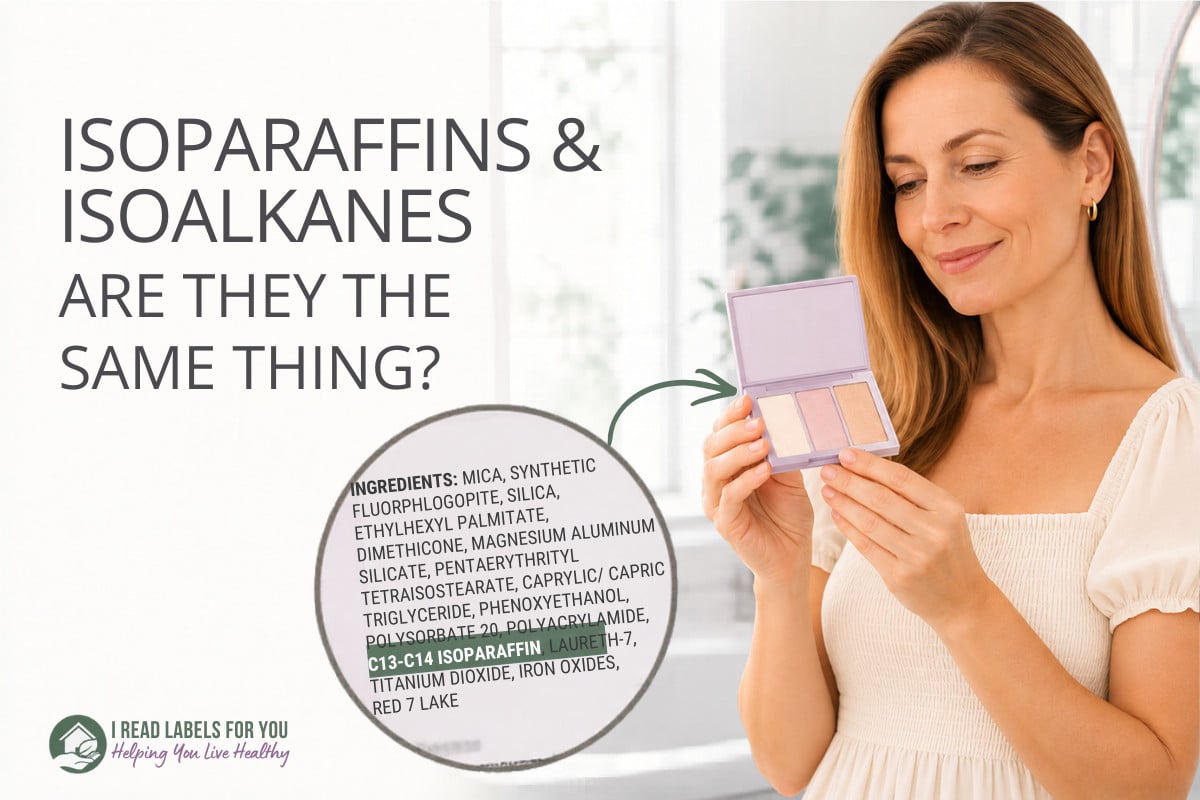
Yes, petroleum-derived Isoparaffins and Isoalkanes, such as C13-14 Isoalkane, are acceptable in skin care, makeup and hair care, but they’re not my first choice. Isoparaffin and Isoalkane are the same thing; Isoalkane is simply the newer label name. These 19 ingredients are branched hydrocarbon liquids and oils made from refinery streams, and they help formulas spread, dry down or feel silky. Their short-term record looks reassuring, with few allergy reports and no regulatory cancer classification. Still, the label never shows how well a batch was purified, and the longer chains may linger in the body. I rate all 19 Better (Not In My Top Picks).
My Rating For Each Isoalkane
Below, I’ve grouped the 19 ingredients by chain length. Each group shows the wording from my ingredient ratings. Five close relatives have their own reviews: see my review of Isododecane, Isohexadecane and Isoeicosane and see my review of C7-8 Isoalkane and Isooctane.
Short-Chain Isoalkanes That Evaporate
- C8-9 Isoalkane
- C9-11 Isoalkane
- C9-12 Isoalkane
- C9-13 Isoalkane
- C9-14 Isoalkane
- C10-11 Isoalkane
- C10-12 Isoalkane
- C10-13 Isoalkane
- C11-12 Isoalkane
- C11-13 Isoalkane
- C11-14 Isoalkane
C8-9 Isoalkane, C9-11 Isoalkane, C9-12 Isoalkane, C9-13 Isoalkane, C9-14 Isoalkane, C10-11 Isoalkane, C10-12 Isoalkane, C10-13 Isoalkane, C11-12 Isoalkane, C11-13 Isoalkane and C11-14 Isoalkane: Better (Not In My Top Picks). A petroleum-based liquid that helps products spread and then evaporates from your skin. Some grades can carry aromatic hydrocarbons, a group that includes cancer-causing benzene. The label does not tell you which grade is in your product.
Middle-Chain Isoalkanes With A Silky Feel
- C12-14 Isoalkane
- C13-14 Isoalkane
- C9-16 Isoalkane
C12-14 Isoalkane, C13-14 Isoalkane and C9-16 Isoalkane: Better (Not In My Top Picks). A petroleum-based liquid that makes skin care, makeup and hair products feel light and silky. Some grades can carry aromatic hydrocarbons, a group that includes cancer-causing benzene. The label does not tell you which grade is in your product.
Long-Chain Isoalkanes That Soften Skin
- C12-20 Isoalkane
- C13-16 Isoalkane
- C18-70 Isoalkane
- C20-40 Isoalkane
- C15-35 Isoparaffin/Isoalkylcycloalkanes
C12-20 Isoalkane, C13-16 Isoalkane, C18-70 Isoalkane, C20-40 Isoalkane and C15-35 Isoparaffin/Isoalkylcycloalkanes: Better (Not In My Top Picks). A petroleum-based oil that softens skin and helps products glide on. Some grades can carry aromatic hydrocarbons, a group that includes cancer-causing benzene. The label does not tell you which grade is in your product. These longer molecules can also build up in the body, like mineral oil.
C13-14 Isoalkane and the other 18 petroleum Isoalkanes carry no restriction under the European Union (EU) Cosmetics Regulation. Moreover, no opinion on these ingredients has come from the Scientific Committee on Consumer Safety (SCCS), Europe’s independent cosmetics advisors. The one harmonized EU hazard classification I found covers a refinery stream sold as C13-14 Isoalkane, and it warns about liquid entering the lungs. Likewise, neither the U.S. Food and Drug Administration (FDA) nor Health Canada restricts them in cosmetics.
Keep reading to discover:
- which Isoalkane grade its maker allows to carry 500 times the aromatic hydrocarbons of a lab-made cousin
- why the pore-clogging tests often quoted for Isoalkanes were run on different ingredients
- which popular cream thickener hides C13-14 Isoalkane inside its name, and what one skin clinic found
What Are Isoparaffins And Isoalkanes?
Isoparaffins and Isoalkanes are the same ingredients under two names. “Isoparaffin” is the older name and “Isoalkane” the newer one, and both mean branched-chain hydrocarbons: chains of carbon and hydrogen with side branches. The numbers in each name, such as C13-14, tell you how many carbon atoms the chains hold.
All 19 in this post come from petroleum. The short and middle chains are thin, clear liquids, while the long chains, such as C20-40 Isoalkane, behave as skin-softening oils. In addition, C15-35 Isoparaffin/Isoalkylcycloalkanes contains branched ring-shaped hydrocarbons alongside the branched chains.
That definition comes from the Cosmetic Ingredient Review (CIR), an industry-funded panel whose budget comes from the Personal Care Products Council. Its 2012 group report covered 24 Isoparaffins at once, and it lists trade names such as Isopar, Soltrol, and Shellsol for many of them.
What Do Isoalkanes Do In Cosmetics?
Most work as solvents, which dissolve other ingredients and thin a formula. Many also act as emollients that soften skin, according to CIR. CosIng, the EU ingredient database, lists C13-14 Isoalkane as both a solvent and a skin conditioner.
Amounts vary widely. In a 2010 industry survey, C13-14 Isoalkane appeared in 847 products, at up to 75% in hair products. Meanwhile, C11-12 Isoalkane reached 67% in eye-area products, and a mascara tested on 48 women held 48.28% of it.
The same 2010 data found no use at all for nine of the 19, including C20-40 Isoalkane and C15-35 Isoparaffin/Isoalkylcycloalkanes. Current use may differ, because nobody has published newer counts.
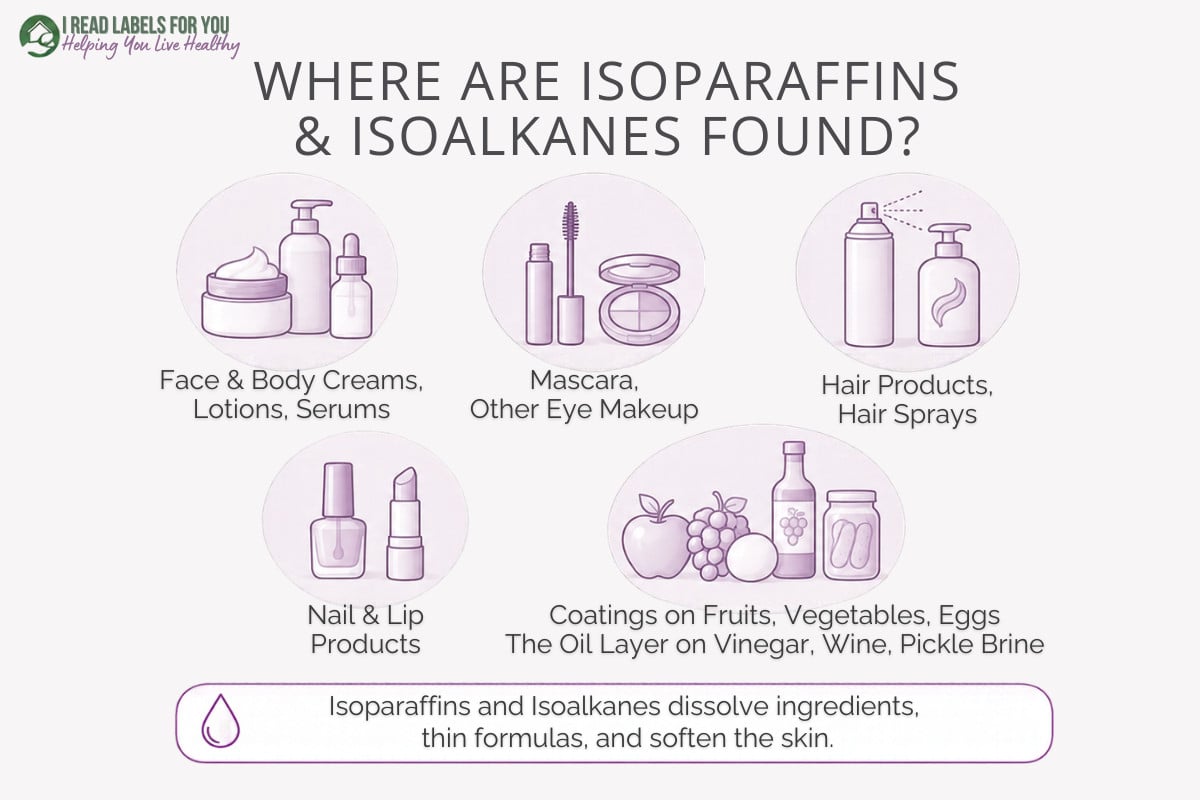
You’ll find Isoalkanes most often in:
- face and body creams, lotions, and serums
- mascara and other eye makeup
- hair products, including hair sprays
- nail products
- a few lip products
- cream thickener blends with polyacrylamide
- coatings on some fresh fruits, vegetables, and shell eggs (as a food additive family called “synthetic Isoparaffinic petroleum hydrocarbons”)
- the oil layer floated on vinegar, wine and pickle brine during processing
How Are Isoalkanes Made?
CIR describes two refinery routes. In alkylation, two small hydrocarbon molecules join into a larger branched one, helped by a strong acid such as sulfuric or hydrofluoric acid. In isomerization, a platinum catalyst rearranges the straight chains in light naphtha, a gasoline-range refinery cut, into branched ones.
Other grades begin as broader refinery fractions. For example, one Chemical Abstracts Service (CAS) registry number listed for C13-14 Isoalkane belongs to a hydrotreated light distillate. That’s a kerosene-range stream treated with hydrogen over a catalyst. The European Chemicals Agency (ECHA) says that stream holds chains of 9 to 16 carbons.
Because the starting oil varies, the product varies too. Isopar G and Isopar H are sold for C10-11 and C11-12 Isoalkane. Producers told CIR that their makeup can change from batch to batch and between producers. They also reported that 5% to 15% of these fluids are ring-shaped alkanes.
Do Isoalkanes Penetrate The Skin?
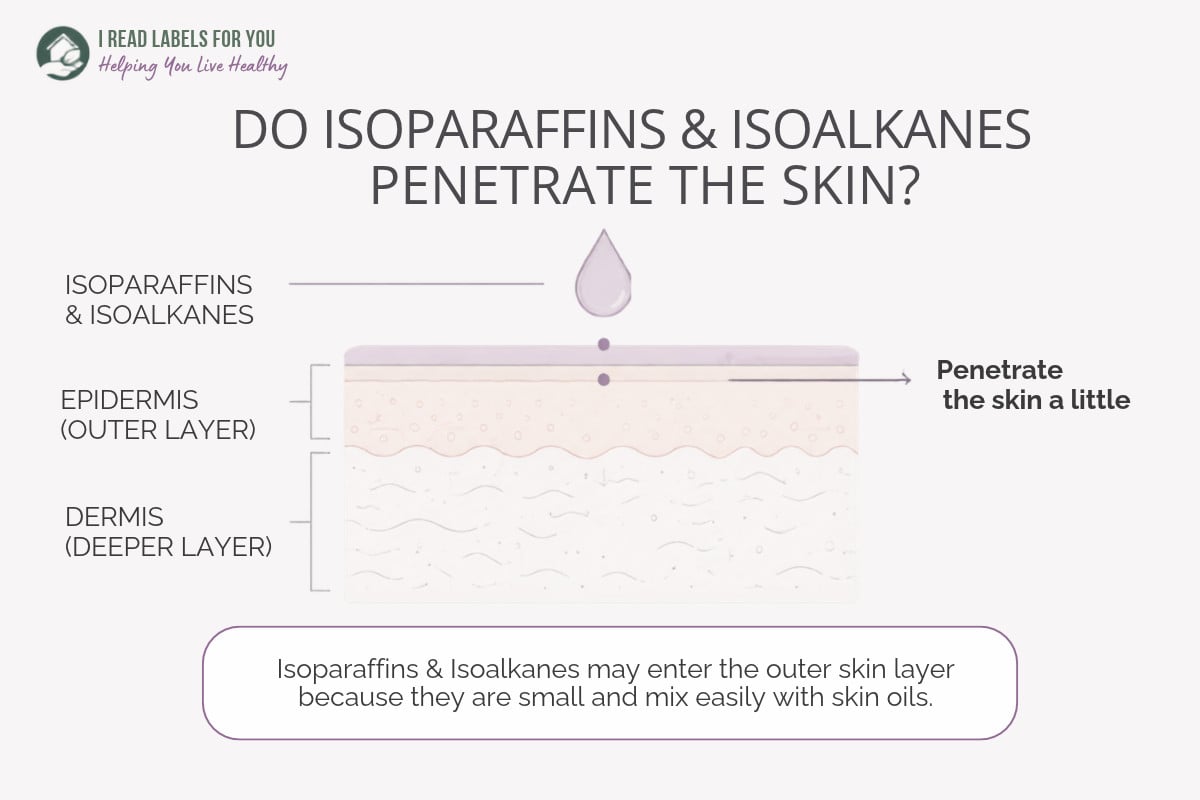
Probably a little, but nobody has measured skin uptake for any of the 19. Size is no barrier here; instead, oiliness and evaporation decide how far they get.
Scientists weigh molecules in daltons, and healthy skin tends to block anything heavier than roughly 500 of them. Chains of 8 to 14 carbons weigh roughly 114 to 198 daltons, and even a 35-carbon chain stays just under 500. Only the longest grades, such as C18-70 Isoalkane, run well above that line.
LogP is a score for how much a chemical favors oil compared with water. ECHA’s registration file for the C13-14 refinery stream gives a LogP of 6.3, which is extremely oily. Molecules like that settle readily into the outer skin layer but move slowly into the watery layers beneath it.
Evaporation changes the picture for the short chains. Most of each dose leaves the skin as vapor, which makes your lungs their likelier entry route.
For the longer chains, the European Food Safety Authority (EFSA) adds a caution about mineral oil hydrocarbons in general. EFSA writes that they can sink into skin beyond the reach of washing. Slow uptake, it adds, could still raise the amount in your body.
What Are Isoalkanes Called On Labels?
The official International Nomenclature of Cosmetic Ingredients (INCI) names switched from Isoparaffin to Isoalkane. CosIng now shows records such as C13-14 Isoalkane (Formerly C13-14 Isoparaffin), and it keeps the old name as a separate record. As a result, older packaging and many websites still use the Isoparaffin form.
Watch for either name on a label:
- C8-9 Isoalkane or C8-9 Isoparaffin
- C9-11 Isoalkane or C9-11 Isoparaffin
- C9-12 Isoalkane or C9-12 Isoparaffin
- C9-13 Isoalkane or C9-13 Isoparaffin
- C9-14 Isoalkane or C9-14 Isoparaffin
- C10-11 Isoalkane or C10-11 Isoparaffin
- C10-12 Isoalkane or C10-12 Isoparaffin
- C10-13 Isoalkane or C10-13 Isoparaffin
- C11-12 Isoalkane or C11-12 Isoparaffin
- C11-13 Isoalkane or C11-13 Isoparaffin
- C11-14 Isoalkane or C11-14 Isoparaffin
- C12-14 Isoalkane or C12-14 Isoparaffin
- C13-14 Isoalkane or C13-14 Isoparaffin
- C9-16 Isoalkane or C9-16 Isoparaffin
- C12-20 Isoalkane or C12-20 Isoparaffin
- C13-16 Isoalkane or C13-16 Isoparaffin
- C18-70 Isoalkane or C18-70 Isoparaffin
- C20-40 Isoalkane or C20-40 Isoparaffin
- C15-35 Isoparaffin/Isoalkylcycloalkanes
One near-twin is a different ingredient. C13-14 Alkane, without the “iso,” is a straight-chain alkane, and the versions in natural-cosmetics databases are plant-derived.
Does The U.S. FDA Restrict Isoalkanes In Food And Cosmetics?
No, Isoalkanes face no FDA cosmetic limit, and none shows up among the substances the agency bans or restricts in cosmetics. I put little weight on that gap, because federal reviewers rarely see a cosmetic ingredient before it goes on sale.
Food rules exist for related materials. FDA regulations allow synthetic Isoparaffinic petroleum hydrocarbons, made from petroleum gases, as coatings on fruits, vegetables and shell eggs. They also allow them as a float on fermenting vinegar and wine.
These rules cap ultraviolet light absorbance, which indirectly limits aromatic hydrocarbons. However, they name no cosmetic ingredient, and nothing requires a cosmetic Isoalkane to meet them. The main rule also dates to 1977.
I read FDA food clearances with some caution in general. The GRAS pathway, short for Generally Recognized As Safe, even lets companies declare an ingredient safe without telling the agency.
European law begins elsewhere. Under its precautionary principle, officials can step in on credible warning signs before harm is fully proven.
EU Regulations On Isoalkanes
C13-14 Isoalkane and its relatives appear nowhere in the annexes of the EU Cosmetics Regulation, the lists that ban or limit ingredients. A CosIng search for Isoparaffin returns 73 records, and none carries a restriction.
The SCCS has never assessed an Isoparaffin or Isoalkane. Instead, the EU position comes from chemical hazard law, known as CLP, short for Classification, Labelling and Packaging.
Under CLP, the refinery stream sold under one C13-14 Isoalkane CAS number carries a harmonized aspiration hazard classification. In plain words, liquid that is swallowed and slips into the airways may be fatal. ECHA also began evaluating a new testing proposal for that same stream on February 20, 2025.
Food law is quieter still. The EU list of approved food additives names no Isoparaffin or Isoalkane.
A Gap In Europe’s Lip Product Guidance
Cosmetics Europe, the industry trade group, publishes a voluntary purity recommendation for mineral hydrocarbons in lip care. Its covered list includes paraffin, petrolatum, and mineral oil names, yet no Isoalkane INCI name.
In practice, then, an Isoalkane in a lip product falls outside even the industry’s own lip-care guidance. Any purity check depends entirely on the supplier and the brand.
Canadian Regulations On Isoalkanes
Canada restricts none of the 19. Health Canada’s Cosmetic Ingredient Hotlist, its register of prohibited and restricted cosmetic substances, has no Isoparaffin, Isoalkane or petroleum entry.
Similarly, Canada’s register of toxic substances, Schedule 1 under the Canadian Environmental Protection Act, includes no Isoalkane.
Can Isoalkanes Cause Skin Allergy And Sensitization?
No, Isoalkanes rarely cause skin allergy in most people, but they can irritate skin when trapped under a covering or used undiluted.
CIR summarized patch tests of three Isopar grades sold for C10-11, C11-13, and C13-14 Isoalkane. Each was tested at 50% on panels of more than 100 volunteers, with no allergy and no light-triggered reactions.
Irritation is the real issue. CIR states that under closed or semi-closed patches, where the fluid cannot evaporate, these grades can strip skin oils and irritate. A 1990 DuPont review, written by industry scientists, adds that “occasional rare idiosyncratic sensitization reactions in humans have been reported.”
Workplaces show the irritation pattern too. In a 2002 study of 74 workers handling C9 to C14 Isoparaffin lubricating fluids, 35 developed dermatitis typical of primary skin irritation.
A Thickener Blend Case And A Dropped Condition
In 2019, dermatologists in Montpellier, France, reported contact dermatitis from a thickener blend, Polyacrylamide/C13-14 Isoparaffin/Laureth-7, in an emollient cream for eczema-prone skin. The published record does not say which part of the blend caused it.
Interestingly, CIR’s December 2010 draft called Isoparaffins safe “when formulated to be non-irritating.” The published 2012 report dropped that condition, and the documents I reviewed do not explain why.
None of the 19 is an American Contact Dermatitis Society (ACDS) core allergen.
Are Isoalkanes Hormone (Endocrine) Disruptors?
No, there’s no evidence that Isoalkanes disrupt hormones, but nobody has actually tested them for it.
CIR’s 2012 report contains no hormone study at all. Its only related note comes from seven volunteers who breathed an Isoparaffin solvent for five days.
After that exposure, CIR recorded shifts in follicle-stimulating hormone, a reproductive hormone, and in a muscle enzyme. It also noted wide natural swings in both values and drew no conclusion.
In addition, no Isoalkane appears on the European Commission’s list of suspected endocrine disruptors in cosmetics. ECHA has no hormone assessment underway for any of them either.
Are Isoalkanes Safe To Use While Pregnant?
Whether Isoalkanes are safe during pregnancy remains unknown, because no study has tested them on skin in pregnant animals or women.
The animal data come from breathing studies only. For instance, Isopar G, a C10-11 grade, harmed neither fetal growth nor development in rats inhaling up to 900 parts per million (ppm). On the other hand, a German indoor-air guideline for dearomatized hydrocarbon solvents named developmental toxicity among the effects that set its limit.
Build-up is the other open question. In a 2011 study of 142 women, mineral oil hydrocarbons in fat and breast milk tracked with sun cream use during pregnancy. Hand cream and lipstick use mattered too.
That study measured mineral oil, not Isoalkanes. Even so, EFSA reports that the body selectively holds on to branched and ring-shaped hydrocarbons.
While you’re pregnant, it’s reasonable to favor products without the long-chain grades, especially lip products. For anything you apply daily, you should consult with your medical provider.
Are There Any Cancer Concerns Linked To Isoalkanes?
No, none of the 19 Isoalkanes has a regulatory cancer classification, but some grades can carry aromatic hydrocarbons, a group that includes benzene.
Aromatic Traces In Refinery Grades
Benzene is a known human carcinogen. In data given to CIR, Exxon and Texaco reported benzene below 0.1 ppm in all their Isoparaffin products. Later, ExxonMobil told CIR that this figure was really a statement of regulatory compliance.
Specifications show a wider range. ExxonMobil’s sales sheet for Isopar M, a C13-14 Isoalkane trade name according to CIR, allows aromatics up to 0.05% by weight. That equals 500 milligrams per kilogram, against 1 milligram per kilogram for a lab-made isobutene oil.
None of these numbers are measurements of products you can buy. Indeed, I found no published test of aromatics or benzene in any cosmetic made with these ingredients.
What The Animal And Lab Studies Show
Gene-damage tests on C10-11, C10-13, and C11-13 grades were all negative, according to CIR. Male rats developed kidney damage, but it works through alpha2u-globulin, a protein humans lack.
A 13-week Shell study of Isoparaffin solvents reached the same verdict on the kidney changes. However, no lifetime cancer study has tested any of the 19 on skin.
The International Agency for Research on Cancer (IARC) lists none of them. Neither the Report on Carcinogens from the U.S. National Toxicology Program (NTP) nor California’s Proposition 65 includes them.
Are Isoalkanes Bad For The Environment?
Isoalkanes come from crude oil, a non-renewable resource, and some routes rely on hydrofluoric or sulfuric acid catalysts. That footprint alone keeps them out of natural cosmetics.
For one ECHA identity linked to C13-14 Isoalkane, about half of company notifications classify it as harmful to water life, with effects that persist. Nobody has harmonized that classification, however, and the substance’s name is not public.
COSMOS, the leading natural and organic cosmetics standard, does not allow any Isoalkane. NATRUE’s ingredient database lists none of them either.
Common Claims About Isoalkanes: What’s True And What’s Not
Claim: Isoparaffins Are Non-Comedogenic
Beauty sites often say Isoparaffins will not clog pores, and some ingredient pages score each grade 1 out of 5. Yet the only pore-clogging tests in the CIR report were rabbit-ear tests on Isododecane and Isohexadecane.
Neither of those is among the 19 in this post. In other words, the claim is untested for these ingredients, not proven false. If you’re acne-prone, judge the whole formula on your own skin.
Claim: CIR Proved C13-14 Isoparaffin Safe From 0.0001% To 75%
Partly true. CIR did conclude that Isoparaffins are safe “in the present practices of use and concentration.” The 0.0001% to 75% figure is simply the range companies reported in 2010.
Nobody, however, tested C13-14 Isoalkane on skin at 75%. Most of CIR’s toxicity data come from breathing and feeding studies of industrial solvent grades, and no skin absorption study exists.
Claim: Isoparaffins Are Contaminated With 1,4-Dioxane
Mostly false. According to the FDA’s page on 1,4-dioxane, this contaminant forms during ethoxylation, a process that Isoalkanes never go through. CIR’s Isoparaffin report never mentions it.
The one exception is a blend such as Polyacrylamide/C13-14 Isoparaffin/Laureth-7, because Laureth-7 is ethoxylated. For plain Isoalkanes, aromatic hydrocarbons are the impurity worth asking about.
What I Think About Isoparaffins And Isoalkanes, And What You Should Do
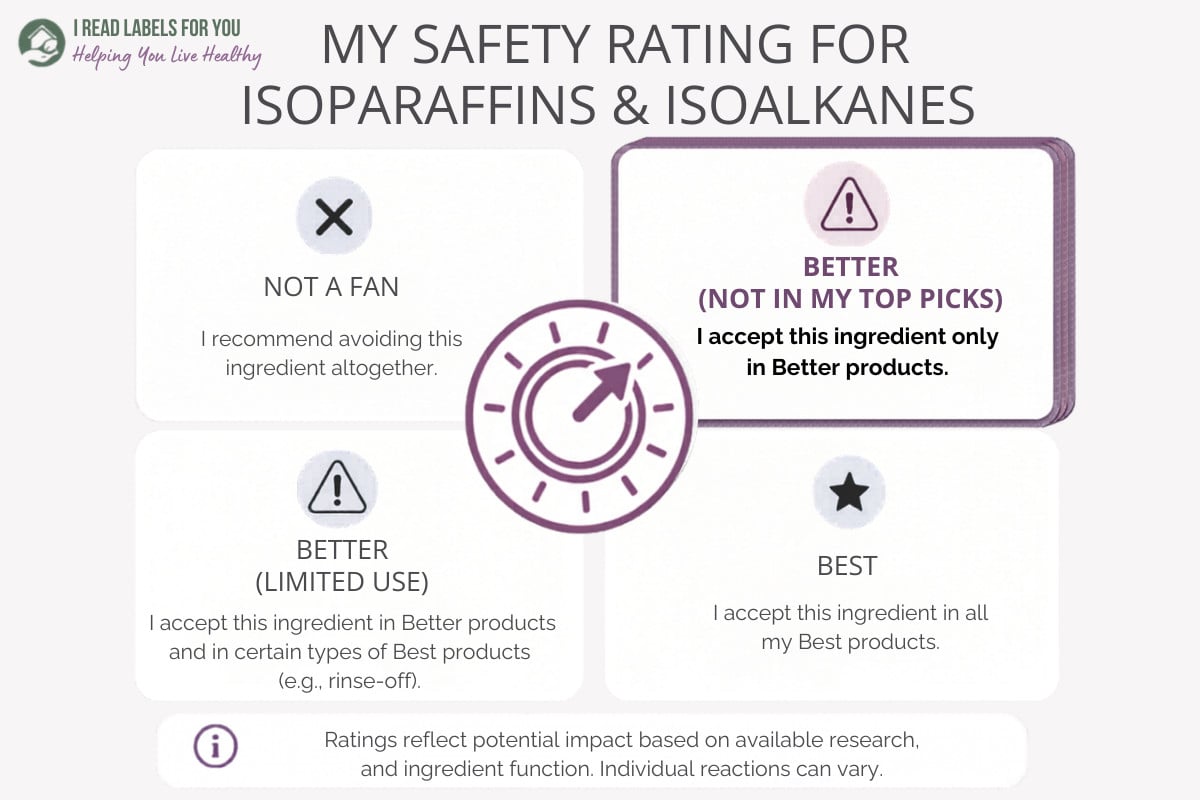
My rating for all 19 petroleum-derived Isoparaffins and Isoalkanes is Better (Not In My Top Picks). They test as mild on skin, yet four open questions hold them back.
First, the label never tells you the grade. One supplier sheet allows 500 times the aromatics of a lab-made relative, and no brand publishes test results. Second, the long chains sit in the size range that EFSA links to build-up in human tissue.
Third, the short and middle chains are small, oily and never measured for skin uptake. Fourth, CIR cleared hair sprays because the droplets are too large to breathe deeply, an argument that ignores solvent vapor.
Vapor does reach the body. In a CIR-cited study, seven volunteers inhaled an Isoparaffin solvent for five days and carried 41.1 milligrams per kilogram in their fat.
Taken together, I accept them in my Better products but keep them out of my Best products. My practical suggestions:
- skip lip products that list C12-20, C13-16, C18-70 or C20-40 Isoalkane, since you swallow part of every lip product
- choose creams or pump sprays over aerosol hair sprays made with Isoalkanes, and use any spray in a ventilated room
- favor products without Isoalkanes for babies and during pregnancy
- if you want certainty, look for COSMOS-certified products, which cannot contain them
- if a cream stings or itches, stop using it, since these solvents irritate most under covered skin
An Isoalkane cream is no emergency. I simply reach for a better-documented option when one exists.
Frequently Asked Questions About Isoparaffins And Isoalkanes
Are Isoparaffins And Isoalkanes The Same Thing?
Yes. Isoalkane is the newer official ingredient name, and Isoparaffin is the older one. For example, CosIng records C13-14 Isoalkane as “formerly C13-14 Isoparaffin.” The ingredient itself did not change.
What Is Polyacrylamide/C13-14 Isoparaffin/Laureth-7?
It’s a ready-made thickener sold to brands as one ingredient, best known under the trade name Sepigel 305. It combines a polymer, C13-14 Isoalkane and Laureth-7, an ethoxylated emulsifier.
Consequently, the blend brings two concerns: the Isoalkane grade and the ethoxylation. Moreover, it’s the blend named in the 2019 French dermatitis report.
Is C13-14 Isoalkane The Same As Mineral Oil?
Not quite. Both are petroleum hydrocarbons, but mineral oil mixes straight, branched and ring-shaped chains, while Isoalkanes are mostly branched and often lighter.
Still, EFSA counts branched alkanes within the saturated mineral oil hydrocarbons that build up in the body. For the mineral oil evidence itself, see my review of Mineral Oil.
Are Isoalkanes In Hair Spray Safe To Breathe?
Nobody has run a spray exposure assessment for them. CIR listed C11-13 and C13-14 Isoalkane among the Isoparaffins used in hair sprays and approved that use based on droplet size alone.
Droplet size says nothing about solvent vapor, though. As the five-day volunteer study showed, inhaled Isoparaffin vapor does reach human body fat.
Why Does EWG Rate Isoparaffins Differently?
The Environmental Working Group (EWG) gives C13-14 Isoparaffin a hazard score of 1, its lowest-concern tier, with “Good” data. Its listed concerns are mild irritation and organ effects in animal studies at moderate doses. C20-40 Isoalkane has no EWG entry at all.
My rating weighs information that score leaves out. EWG does not account for the hidden grade, the 0.05% aromatic allowance in one C13-14 supplier sheet or the absence of any skin absorption study.
It also misses EFSA’s 2023 finding that the body selectively retains branched hydrocarbons, with cosmetics named among the sources. Finally, most data behind the low score come from breathing studies of industrial solvents.
Sources
EU SCCS / SCCP Opinions:
No SCCS, SCCP or SCCNFP opinion on any Isoparaffin or Isoalkane (checked): SCCS opinions portal
Cosmetic Ingredient Review (CIR) Reports:
CIR Expert Panel, 2012. Johnson W Jr, Bergfeld WF, Belsito DV, et al. Safety Assessment of Isoparaffins as Used in Cosmetics. International Journal of Toxicology 31(Suppl 3):269S to 295S. Covers all 19 plus 5 relatives; manufacturing, impurities, use data, toxicity: CIR reports database; PubMed 23283704: PubMed 23283704
CIR, 2010. Draft Final Report on Isoparaffins, Expert Panel meeting of December 13 to 14, 2010, with the “non-irritating” wording and supplier comments: CIR 2010 draft final report
European Union Regulatory Databases:
CosIng, C13-14 Isoalkane, solvent and skin conditioning, no Annex entry: CosIng C13-14 Isoalkane; formerly record: CosIng C13-14 Isoalkane (Formerly C13-14 Isoparaffin); old name: CosIng C13-14 Isoparaffin
The CosIng, C20-40 Isoalkane, emollient and solvent, no Annex entry: CosIng C20-40 Isoalkane; formerly record: CosIng C20-40 Isoalkane (Formerly C20-40 Isoparaffin); old name: CosIng C20-40 Isoparaffin
CosIng name search “Isoparaffin,” 73 records, none with an Annex restriction (checked). CosIng, C13-14 Alkane, a different straight-chain ingredient: CosIng C13-14 Alkane
EU Cosmetics Regulation (EC) No 1223/2009, consolidated text, Annexes II to VI; no Isoparaffin or Isoalkane named: EUR-Lex Regulation 1223/2009
EU food additive specifications, Regulation (EU) No 231/2012; no Isoparaffin or Isoalkane listed: EUR-Lex Regulation 231/2012
ECHA CHEM, Distillates (petroleum), hydrotreated light, CAS 64742-47-8, a CAS listed for C13-14 Isoalkane; CLP Annex VI harmonized Asp. Tox. 1, H304: ECHA harmonised classification
ECHA CHEM, same substance, regulatory activities, testing proposal evaluation started February 20, 2025: ECHA activities; registration dossier, LogP 6.3: ECHA dossier
ECHA CHEM, list number 680-821-4, CAS 246538-79-4, a CAS listed for C13-14 Isoalkane; notified classifications only, no harmonized entry: ECHA industry classifications
European Commission, endocrine disruptors in cosmetics; no Isoparaffin or Isoalkane listed: European Commission endocrine disruptor page
Cosmetics Europe Recommendation No. 14, Mineral Hydrocarbons in Cosmetic Lip Care Products, September 17, 2018; no Isoalkane INCI in scope: Cosmetics Europe Recommendation 14
Other Regulators:
U.S. FDA, Prohibited and Restricted Ingredients in Cosmetics; no Isoparaffin or Isoalkane listed: FDA prohibited and restricted ingredients
U.S. FDA, 1,4-Dioxane in Cosmetics, a manufacturing byproduct of ethoxylation: FDA 1,4-dioxane page
21 CFR 172.882, synthetic Isoparaffinic petroleum hydrocarbons in food: 21 CFR 172.882; 21 CFR 172.884, odorless light petroleum hydrocarbons: 21 CFR 172.884; 21 CFR 178.3530, food-contact use: 21 CFR 178.3530
German Federal Institute for Risk Assessment (BfR) Opinion No. 008/2018, highly refined mineral oils in cosmetics; names no Isoalkane INCI: BfR Opinion 008/2018
EFSA CONTAM Panel, 2023. Update of the risk assessment of mineral oil hydrocarbons in food. EFSA Journal 21(9):8215; branched hydrocarbon retention, cosmetics as a source, skin uptake caution: EFSA 2023 full text; PubMed 37711880: PubMed 37711880
Health Canada, Cosmetic Ingredient Hotlist; not listed: Health Canada Hotlist
Environment and Climate Change Canada, CEPA Schedule 1; not listed: CEPA Schedule 1
IARC List of Classifications; not listed: IARC classifications
NTP, Report on Carcinogens, Fifteenth Edition, listed substances; not listed: NTP Report on Carcinogens
California Proposition 65 list; not listed: Proposition 65 list
ExxonMobil, Isopar M sales specification, effective July 1, 2014; aromatic content 0.05 wt% maximum, about 10 ppm BHT: Isopar M sales specification
PubChem Records (Chemistry, Identifiers, Skin Penetration, Hazard Codes):
These ingredients are mixtures with no single PubChem CID (checked). C13-14 Isoparaffin, FDA GSRS SID 472405849: PubChem SID 472405849; ChemIDplus SID 135353926: PubChem SID 135353926
C20-40 Isoalkane, SID 505568835: PubChem SID 505568835; EPA DSSTox SID 472217001: PubChem SID 472217001
Peer-Reviewed Studies:
Mullin LS, Ader AW, Daughtrey WC, Frost DZ, Greenwood MR, 1990. Toxicology update: Isoparaffinic hydrocarbons: a summary of physical properties, toxicity studies and human exposure data. Journal of Applied Toxicology 10(2):135 to 142. DuPont authors. PMID 2193978: PubMed 2193978
Industrial Health, 2002. Dermatitis among 74 workers using C9 to C14 Isoparaffinic lubricating fluids. PMID 12141380: PubMed 12141380
Jaulent C, Dereure O, Raison-Peyron N, 2019. Contact dermatitis caused by polyacrylamide/C13-4 Isoparaffin/laureth-7 mix in an emollient cream for atopic skin. Contact Dermatitis 81:70 to 71. PMID 30684286: PubMed 30684286
Carrillo JC et al. (Shell authors), 2013. 13-week inhalation study of a C10 to C12 Isoparaffinic solvent and four related solvents; male rat kidney effects. Regulatory Toxicology and Pharmacology. PMID 24044944: PubMed 24044944
Concin N et al., 2011. Mineral oil hydrocarbons in fat tissue and breast milk of 142 women, linked to cosmetic use. PMID 21970597: PubMed 21970597
German indoor air guide values for dearomatized hydrocarbon solvents C9 to C14, including CAS 64742-47-8; mixtures, not Isoalkanes alone. PMID 16003576: PubMed 16003576
Natural Cosmetic Standards:
COSMOS-standard approved raw materials; no Isoparaffin or Isoalkane found: COSMOS-standard approved raw materials
COSMOS Standard, Version 4.2, September 1, 2025, Appendix V; no Isoalkane among allowed petrochemical ingredients: COSMOS Standard
NATRUE certified and approved raw materials; no Isoalkane found, only plant-derived alkanes: NATRUE certified raw materials
Skin Allergy Resource:
American Contact Dermatitis Society (ACDS), Helpful References, including the Core Allergen Series 2020; no Isoparaffin or Isoalkane listed: ACDS Helpful References
Advocacy groups:
Environmental Working Group (EWG) Skin Deep entry for C13-14 Isoparaffin, score 1, data “Good”; no entry found for C20-40 Isoalkane: EWG C13-14 Isoparaffin
Last verified: 11-14-2026
Download The Free Guide!
5 Powerful Steps To A Non-Toxic Home
Join our informed consumer community and get our free guide the “5 Powerful Steps To A Non-Toxic Home”.
Before commenting, please read our Comment Policy.