
Is Lanolin Safe? A Simple Answer You Can Trust
 Written by Irina Webb
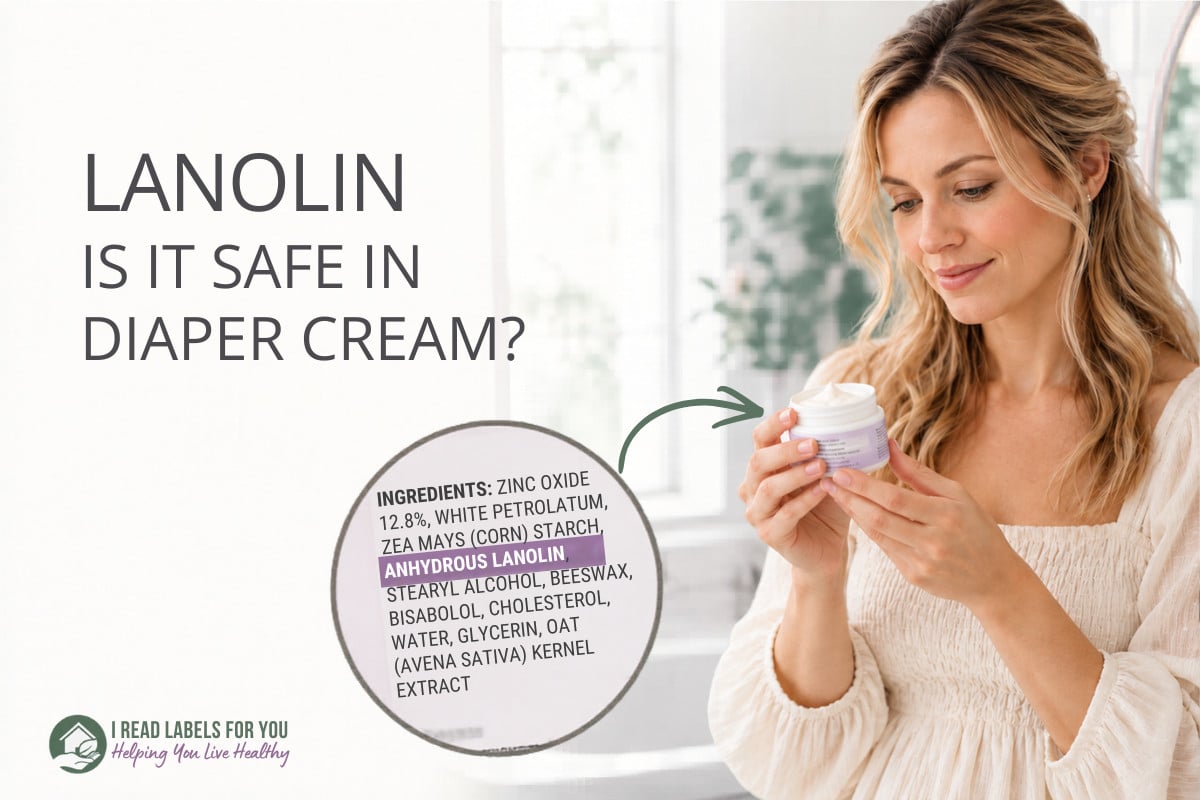
Yes, Lanolin is safe for most people on healthy skin, but it’s a known skin allergen, especially on broken or irritated skin. This softening wax from sheep’s wool is not toxic, but about 2 to 5% of patients tested for skin allergies react to it. That’s why it lands in my Better (Not In My Top Picks) tier.
In the European Union, Lanolin is free of any cosmetic restrictions, and the bloc’s safety committee has not reviewed it. Regulators in the United States, Canada and Europe all leave it unclassified as a hazard. The U.S. Food and Drug Administration (FDA) even approves it as an active ingredient in skin protectants.
Keep reading to learn:
- why Lanolin can pass a patch test and still cause a rash
- what testers found in lanolin nipple creams for breastfeeding
- which skin types and ages are most likely to react
What Is Lanolin?
Lanolin is the natural wax that sheep make to protect their wool from rain and weather. Sheared wool is about 10 to 25% lanolin by weight. Factories wash it out of the fleece and refine it into the yellow, sticky salve sold in stores.
Chemically, Lanolin is a wax rather than a fat. About 87% consists of large molecules called esters, built from fatty acids joined to waxy alcohols and sterols, such as cholesterol. The rest is mostly loose alcohols, sterols and fatty acids, and these loose parts matter for allergy.
What Does Lanolin Do In Cosmetics?
First, Lanolin is an emollient that softens rough skin. Second, it forms a water-resistant film that slows moisture loss, which is why it soothes chapped lips and cracked heels. Third, it can hold about twice its weight in water, helping creams blend oil and water.
Lanolin use has dropped sharply over time. The Cosmetic Ingredient Review (CIR), the industry-funded safety panel, counted it in 285 U.S. products in 2023, down from 782 in 2002. Brands use it at up to 40% in nail creams and up to 20.7% in lipsticks.
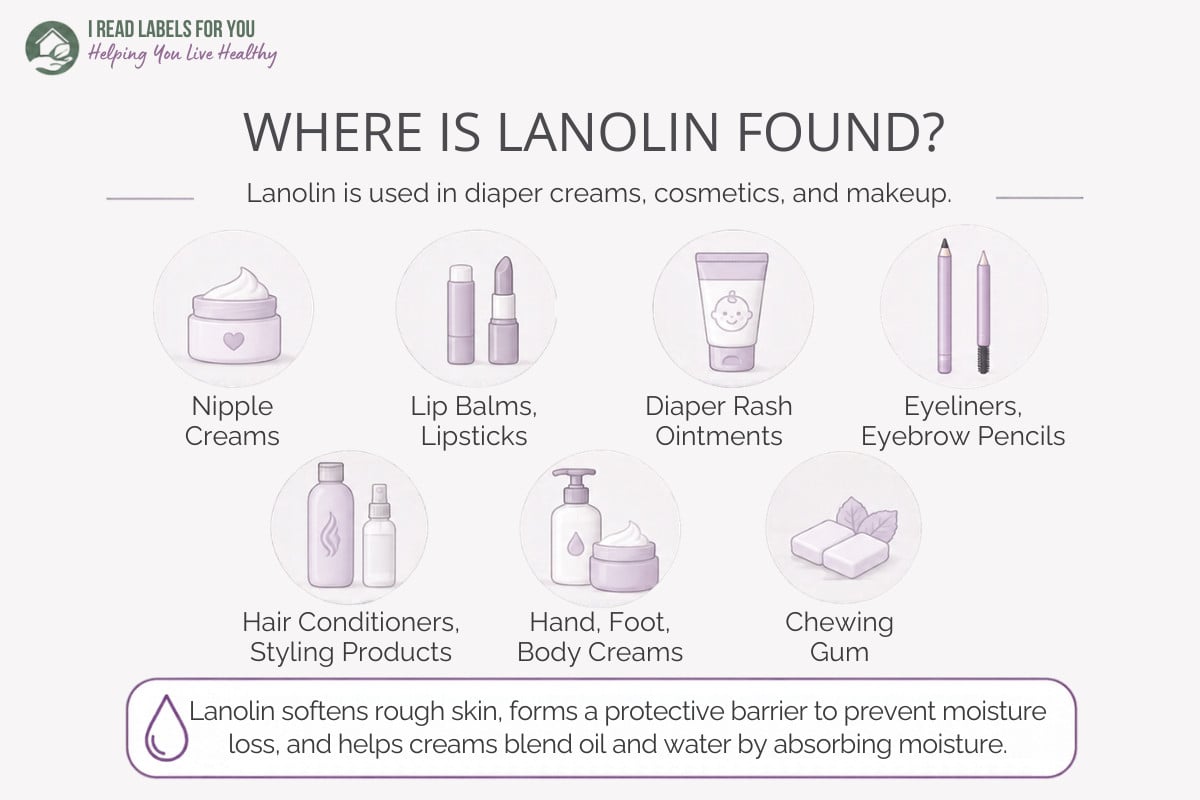
You’ll find Lanolin most often in:
- nipple creams for breastfeeding
- lip balms and lipsticks
- hand, foot, and body creams
- diaper rash ointments
- eyeliners and eyebrow pencils
- hair conditioners and styling products
- chewing gum (as a softener in the gum base)
How Is Lanolin Made?
To begin with, workers scour fresh fleece with soap or detergent or extract it with a solvent. Next, a centrifuge spins the greasy wash water to separate the wool wax. Finally, refiners bleach and purify the wax to remove color, smell, and residues.
Refining matters more than for most ingredients, because the raw wax carries whatever was on the sheep. The 2024 CIR report lists possible leftovers: detergents, the added preservative BHT, trace metals such as nickel and chromium, and pesticides from the fleece.
Pesticides are the biggest worry. Farmers dip or spray sheep against lice and flies, and the CIR report notes that at least 28 different pesticides have been used on sheep. As a result, how well a batch is refined decides how clean Lanolin will be.
Does Lanolin Penetrate The Skin?
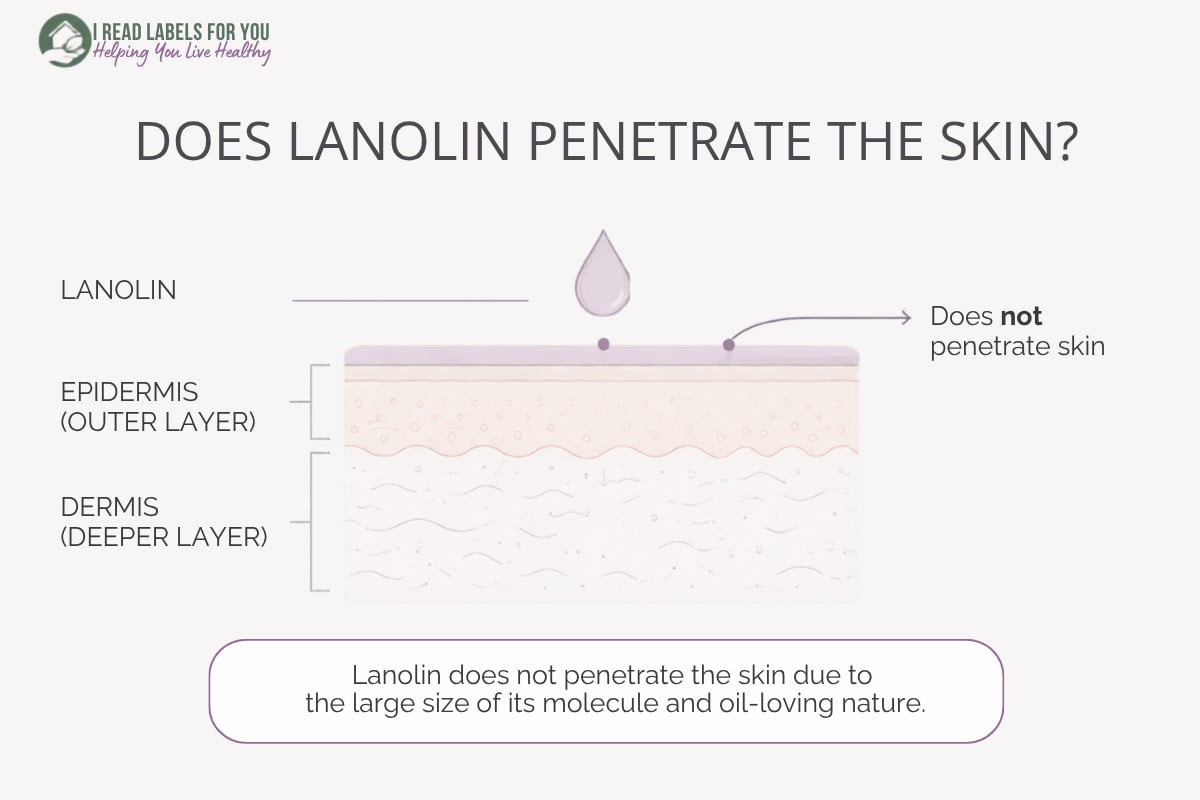
No, most Lanolin stays on and in the outer skin layer, although nobody has measured it directly. Its size is the main reason. Most of it consists of large wax esters, well above the roughly 500-dalton size where skin starts blocking molecules.
A second barrier is its love of oil: Lanolin does not dissolve in water at all. Still, the smaller loose parts, such as cholesterol at about 387 daltons, can slip into the outer layer. Those loose alcohols happen to be the main allergens.
Damaged skin changes the picture. Cracks, rashes and ulcers let more of those small parts reach the immune cells underneath, which explains why reactions concentrate on broken skin.
What Is Lanolin Called On Labels?
Watch for these names in an ingredient list:
- Lanolin
- Anhydrous Lanolin
- Adeps Lanae
- Wool Wax
- Wool Fat
- Wool Grease
- Purified Lanolin
- HPA Lanolin
Related ingredients, such as Lanolin Alcohol, Lanolin Oil, Lanolin Wax, and Acetylated Lanolin, come from the same wax. Lanolin Alcohol is the fraction dermatologists use to test for lanolin allergy, so treat it with the same caution.
Does The U.S. FDA Restrict Lanolin In Food And Cosmetics?
No, Lanolin faces no FDA limits in cosmetics. In fact, it approves Lanolin as an over-the-counter skin protectant at 12.5 to 50%, and it allows it as a softener in chewing gum base.
That approval says little about allergy or purity, though. The FDA sets no lanolin-specific pesticide limit for cosmetics, and its list of restricted cosmetic ingredients is short. Under U.S. law, brands themselves decide most ingredients are safe before selling them.
Europe takes a more cautious approach. It applies the precautionary principle, which allows regulators to act on a credible risk before harm is fully proven.
EU Regulations On Lanolin
The European Union does not restrict Lanolin in cosmetics. CosIng entry 34857 lists it as a skin conditioner and emulsifier, and it’s absent from every annex that bans or limits ingredients.
Furthermore, Europe’s cosmetic safety experts, the Scientific Committee on Consumer Safety (SCCS), have never written an opinion on it. The European Chemicals Agency (ECHA) shows no official hazard label and no open review, and every company report to its inventory calls Lanolin “not classified.”
Europe does control purity indirectly, through its pharmacopoeia, the official drug standards book. Medical-grade Lanolin must meet strict pesticide limits, but cosmetic labels never say which grade a product uses.
Canadian Regulations On Lanolin
Canada does not restrict Lanolin in cosmetics. The Cosmetic Ingredient Hotlist, Health Canada’s list of banned and limited ingredients, never mentions it or any wool wax.
In addition, Environment Canada has not listed it among the toxic substances on Schedule 1. That fits its natural origin and its lack of any hazard classification.
Can Lanolin Cause Skin Allergy And Sensitization?
Yes, Lanolin can cause skin allergy, mainly in people with damaged skin, children, and older adults. Dermatologists test for it routinely, as Lanolin Alcohol, in the Core Allergen Series of the American Contact Dermatitis Society (ACDS). The society also named it its 2023 Allergen of the Year.
Overall, it’s a weak allergen. A 2023 review by dermatologists Blair Jenkins and Donald Belsito reports that about 0.4% of Europeans are allergic. Among North American patients tested for skin allergies, though, the North American Contact Dermatitis Group found 4.63% reacted between 2011 and 2018.
Children react more often than adults, 4.5% versus 3.2% in that same group. Moreover, reactions cluster in eczema, leg ulcers, and rashes around the diaper or genital area, where skin is already broken.
There’s also a twist called the “lanolin paradox.” Someone can react to Lanolin on irritated skin yet show nothing when patch tested on healthy skin. Consequently, this allergy is easy to miss. The good news is that refining helps. The CIR report notes that removing the loose alcohols and detergents “reduced the incidence of detectable hypersensitivity by 96%” in sensitive patients.
What Patch-Test Studies Show About Lanolin Allergy
A 2024 Italian study of 30,269 patients patch tested between 1997 and 2021 found that 1.64% reacted to Lanolin. Patients with rashes on their legs reacted more often, at 3.07%. Moreover, people over 60 with leg rashes were about four times as likely to test positive.
Rates may be climbing. A 2018 Danish study of 9,577 patients found that lanolin allergy rose from 0.45% in 2004 to 1.81% in 2015. It also found a weak link between lanolin allergy and eczema.
How dermatologists test makes a difference. A 2019 Dutch study found that testing with both Lanolin Alcohol and Amerchol L101, a lanolin extract, works best for diagnosis. Its authors note that rates in earlier studies of skin patients ranged from 1.2% to 6.9%.
Not every positive test means a real-life rash, though. In a small 2021 Swedish study, 12 people who tested positive applied lanolin creams twice a day for four weeks.
None of them reacted on healthy skin, and skin that researchers had irritated on purpose healed normally. With only 12 people, that study cannot rule out reactions, but it suggests many positive tests matter little day to day.
Is Lanolin A Hormone (Endocrine) Disruptor?
No, Lanolin is not a known hormone disruptor. The three CIR reports on it are silent on hormones, and Europe has not screened it for such effects.
Interestingly, plant scientists use Lanolin paste as a neutral carrier for applying plant hormones in experiments, precisely because it does not react. Nonetheless, nobody has tested it directly for effects on human hormones.
Is Lanolin Safe To Use While Pregnant?
Yes, Lanolin is considered safe to use during pregnancy and breastfeeding, and it’s not classified as harmful to fertility or a developing baby. Rat studies on two of its parts, Lanolin Acid and Lanolin Alcohol, found no birth defects even at very high doses.
Breastfeeding is where it’s used most, on sore and cracked nipples. The National Library of Medicine’s LactMed database notes that highly purified grades have pesticide and detergent residues removed. Still, it advises avoiding even those if you’re allergic to wool.
Because babies swallow whatever is on the nipple, purity counts here more than anywhere. Before starting any nipple cream, you should consult with your medical provider, who can also suggest options such as expressed breast milk.
Are There Any Cancer Concerns Linked To Lanolin?
No, Lanolin is not linked to cancer. Neither the International Agency for Research on Cancer (IARC) nor the U.S. National Toxicology Program lists it, and it’s absent from California’s Proposition 65.
In addition, gene-damage tests on Lanolin Acid and Lanolin Alcohol came back negative. In fact, old mouse studies found that a known carcinogen dissolved in Lanolin was less potent than the same chemical in benzene, a solvent.
Is Lanolin Bad For The Environment?
Not that we know of, since Lanolin is a natural by-product of the wool industry that would otherwise be waste. COSMOS and NATRUE, the two main natural-beauty certifiers, both approve it, and one supplier even holds organic certification.
The environmental cost sits upstream, in sheep farming and the pesticides used on flocks. Notably, Lanolin is not vegan, and some people avoid it for animal welfare reasons, even though shearing does not kill the sheep.
Common Claims About Lanolin: What’s True And What’s Not
Claim: Lanolin Is Full Of Pesticides
This claim is partly true. In a 2023 test of lanolin nipple creams, one brand’s cream carried traces of several pesticides, while another’s had none detected. All levels stayed within official purity limits.
There’s an important catch, though. Lansinoh, the company whose cream tested clean, sponsored that study, and its employees wrote it. Even so, the results confirm that purity varies widely and that labels do not reveal it.
Claim: Lanolin Allergy Is A Myth
This claim is false. A famous 1998 paper by dermatologist Albert Kligman called lanolin allergy a myth, and the debate continues. Still, recent large patch-test studies in Italy, Denmark and North America find reactions in about 2 to 5% of patients tested.
The kernel of truth is that most people with healthy skin never react. The allergy is real, but it concentrates in people whose skin barrier is already damaged.
Claim: Lanolin Clogs Pores
This claim is unproven either way. The 1980 CIR report noted that “Comedogenic effects from cosmetics incorporating Lanolin and related materials have been reported.” By contrast, a later 15-person trial of one Lanolin product found no clogged pores.
In practice, its heavy, waxy feel suits dry skin, lips, and heels far better than oily, acne-prone faces.
What I Think About Lanolin — And What You Should Do
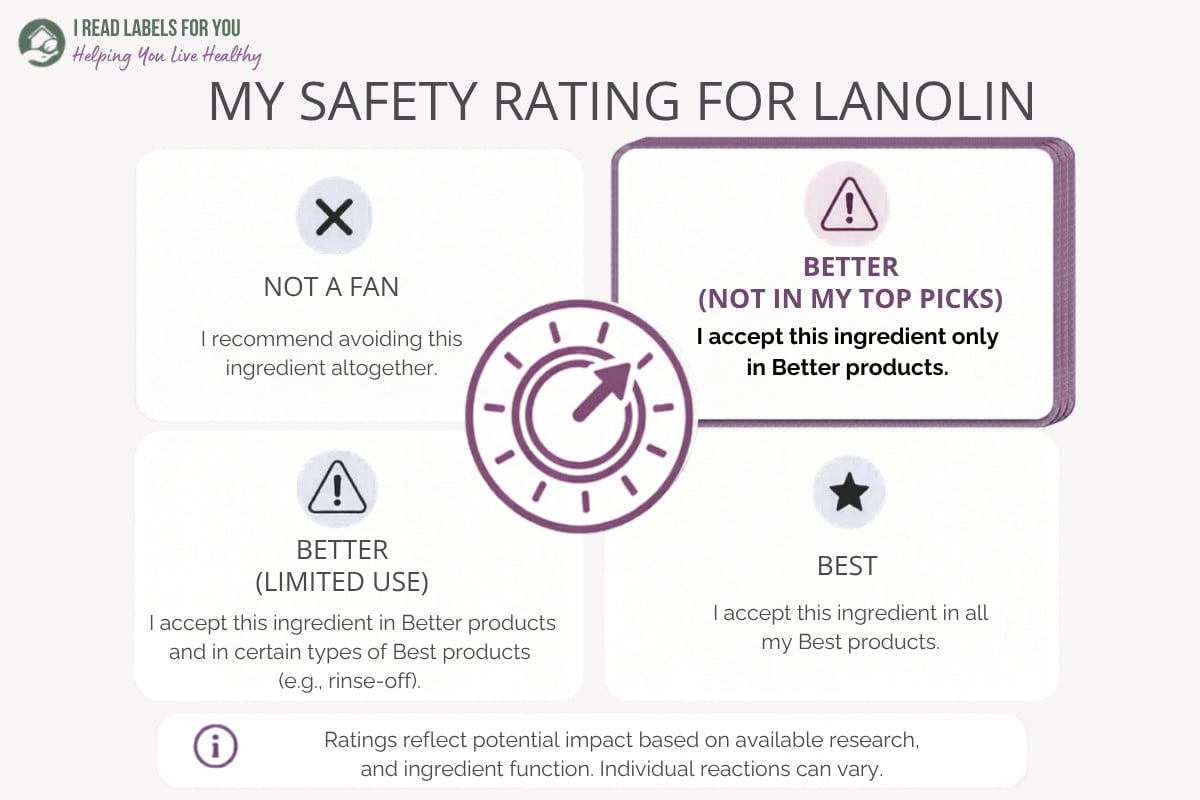
My rating for Lanolin is Better (Not In My Top Picks). I accept it in my Better products, but I keep it out of my Best ones because it’s a recognized skin allergen.
On the plus side, it’s not toxic, not linked to cancer, and gentle on healthy skin for most people. My concern is that its most popular uses – nipple, diaper, and dry-skin creams – go straight onto the damaged skin where allergy strikes. Pesticide traces in less refined grades add a second reason for caution.
Here’s what I suggest:
- skip Lanolin on eczema, rashes, leg ulcers, and broken skin
- choose a highly purified grade, labeled USP, Ph. Eur. or HPA, if you use a lanolin nipple cream
- pick lanolin-free balms made with plant butters or plant oils for babies and sensitive skin
- avoid Lanolin entirely if you’ve ever reacted to wool or lanolin
Frequently Asked Questions About Lanolin
Is Lanolin Safe On Nipples While Breastfeeding?
For most mothers, yes, if it’s a highly purified grade. Studies found Lanolin about as effective as expressed breast milk for sore nipples. Stop using it if your nipples get redder or itchier, which can signal allergy.
Is Lanolin Safe For Babies?
It’s well tolerated in studies of premature babies, yet children develop lanolin allergy more often than adults. Since diaper rash is broken skin, I prefer lanolin-free diaper creams.
Is Lanolin The Same As Lanolin Alcohol?
No. Lanolin Alcohol is the fraction left after the wax is split apart, and it holds most of the allergens. Dermatologists use it to patch test for lanolin allergy.
Is Lanolin Vegan?
No. It comes from sheep’s wool, so it’s an animal ingredient, although collecting it does not harm the sheep. Vegan alternatives include shea butter, candelilla wax, and plant oils.
Why Does EWG Rate Lanolin Differently?
The Environmental Working Group (EWG) rates Lanolin 1, its lowest hazard score. Its low toxicity is not in dispute. However, that score ignores the patch-test studies that keep finding lanolin allergy as well as the pesticide traces found in some products.
Sources
EU SCCS / SCCP Opinions:
No SCCS or SCCP opinion on Lanolin (checked). SCCS opinions portal: SCCS opinions
Cosmetic Ingredient Review (CIR) Reports:
Cosmetic Ingredient Review, 1980. Final Report of the Safety Assessment for Acetylated Lanolin Alcohol and Related Compounds. Funded by the Personal Care Products Council. CIR database: cir-reports.cir-safety.org
Cosmetic Ingredient Review, 2005. Annual Review of Cosmetic Ingredient Safety Assessments 2002/2003, lanolin re-review. International Journal of Toxicology 24(Suppl 1):1 to 102. CIR database: cir-reports.cir-safety.org
Burnett C (writer), Bergfeld WF, et al., 2024. Amended Safety Assessment of Lanolin and Lanolin-Derived Ingredients as Used in Cosmetics, Final Amended Report, November 21, 2024. Covers impurities, pesticides, use levels and patch test data: cir-reports.cir-safety.org
European Union Regulatory Databases:
CosIng entry 34857, LANOLIN, functions skin conditioning, emollient, emulsifying and antistatic; no annex restrictions: CosIng 34857
CosIng Annexes II, III, IV, V and VI (2026 versions), checked; Lanolin not listed. CLP Annex VI harmonized classifications (2026 table), checked; no harmonized classification: ECHA CHEM
ECHA CHEM, EC 232-348-6. Not REACH-registered; all company notifications report it as not classified; no regulatory activities: ECHA CHEM activities
Other Regulators:
U.S. FDA, prohibited and restricted cosmetic ingredients. Not listed: FDA
U.S. FDA, 21 CFR 347.10, Lanolin as a skin protectant active ingredient at 12.5 to 50%: eCFR 347.10
U.S. FDA, 21 CFR 172.615, Lanolin as a softener in chewing gum base: eCFR 172.615
Health Canada Cosmetic Ingredient Hotlist. Not listed: Health Canada Hotlist
Environment Canada, CEPA Schedule 1. Not listed: CEPA Schedule 1
International Agency for Research on Cancer (IARC). Not classified: IARC list
U.S. National Toxicology Program, Report on Carcinogens. Not listed: NTP Report on Carcinogens
California Proposition 65 list. Not listed: OEHHA
U.S. EPA Integrated Risk Information System. No assessment: IRIS A to Z list
National Library of Medicine, Drugs and Lactation Database (LactMed), Lanolin, updated September 15, 2026: LactMed
PubChem Records (Chemistry, Identifiers, Skin Penetration, Hazard Codes):
Lanolin has no PubChem compound record (CID), because it’s a natural mixture. CAS 8006-54-0; FDA substance record UNII 7EV65EAW6H.
Peer-Reviewed Studies:
Jenkins BA, Belsito DV, 2023. Lanolin. Dermatitis 34(1):4 to 12. PMID 36917502: PubMed 36917502
Johnson H, Norman T, Adler BL, Yu J, 2023. Lanolin: the 2023 American Contact Dermatitis Society Allergen of the Year. Cutis 112(2):78 to 81. PMID 37820332: PubMed 37820332
North American Contact Dermatitis Group, 2022. Lanolin allergy in patients patch tested 2001 to 2018. Dermatitis. PMID 35481824: PubMed 35481824
Bourdillon K, McCausland T, McCabe M, 2023. Multi-residue analysis of certain lanolin nipple care products for trace contaminants. BMC Chemistry 17(1):8. Sponsored by Lansinoh Laboratories; authors are company employees. Free full text. PMID 36849952: PubMed 36849952
Kligman AM, 1998. The myth of lanolin allergy. Contact Dermatitis 39(3):103 to 107. PMID 9771981: PubMed 9771981
Cegolon L, Larese Filon F, North-East Research Group on Contact Dermatitis, 2024. Sensitization to Lanolin in North-Eastern Italy, 1997 to 2021: Prevalence, Risk Factors and the Impact of Occupation. Life (Basel) 14(8):916. Free full text. PMID 39202659: PubMed 39202659
Fransen M, Overgaard LEK, Johansen JD, Thyssen JP, 2018. Contact allergy to lanolin: temporal changes in prevalence and association with atopic dermatitis. Contact Dermatitis 78(1):70 to 75. PMID 28940210: PubMed 28940210
Knijp J, Bruynzeel DP, Rustemeyer T, 2019. Diagnosing lanolin contact allergy with lanolin alcohol and Amerchol L101. Contact Dermatitis 80(5):298 to 303. Authors report no conflicts of interest. PMID 30624788: PubMed 30624788
Uldahl A, Engfeldt M, Svedman C, 2021. Clinical relevance of positive patch test reactions to lanolin: A ROAT study. Contact Dermatitis 84(1):41 to 49. Authors report no conflicts of interest. PMID 32844454: PubMed 32844454
Natural Cosmetic Standards:
COSMOS-standard approved raw materials. Twelve Lanolin materials approved, one certified organic: COSMOS-standard approved raw materials
NATRUE certified and approved raw materials. Nine Lanolin materials approved or certified: NATRUE certified raw materials
Skin Allergy Resource:
American Contact Dermatitis Society (ACDS), Helpful References, including the Core Allergen Series 2020. Lanolin alcohol (Amerchol L-101) is on the series, and Lanolin was the 2023 Allergen of the Year: ACDS Helpful References
Advocacy groups:
Environmental Working Group (EWG) Skin Deep entry for Anhydrous Liquid Lanolin, which lists Lanolin as a synonym. Hazard score 1, data fair: EWG Skin Deep
Last verified: 10-17-2026
Download The Free Guide!
5 Powerful Steps To A Non-Toxic Home
Join our informed consumer community and get our free guide the “5 Powerful Steps To A Non-Toxic Home”.
Before commenting, please read our Comment Policy.