
Is Aminomethyl Propanol Safe? A Simple Answer You Can Trust
 Written by I Read Labels For You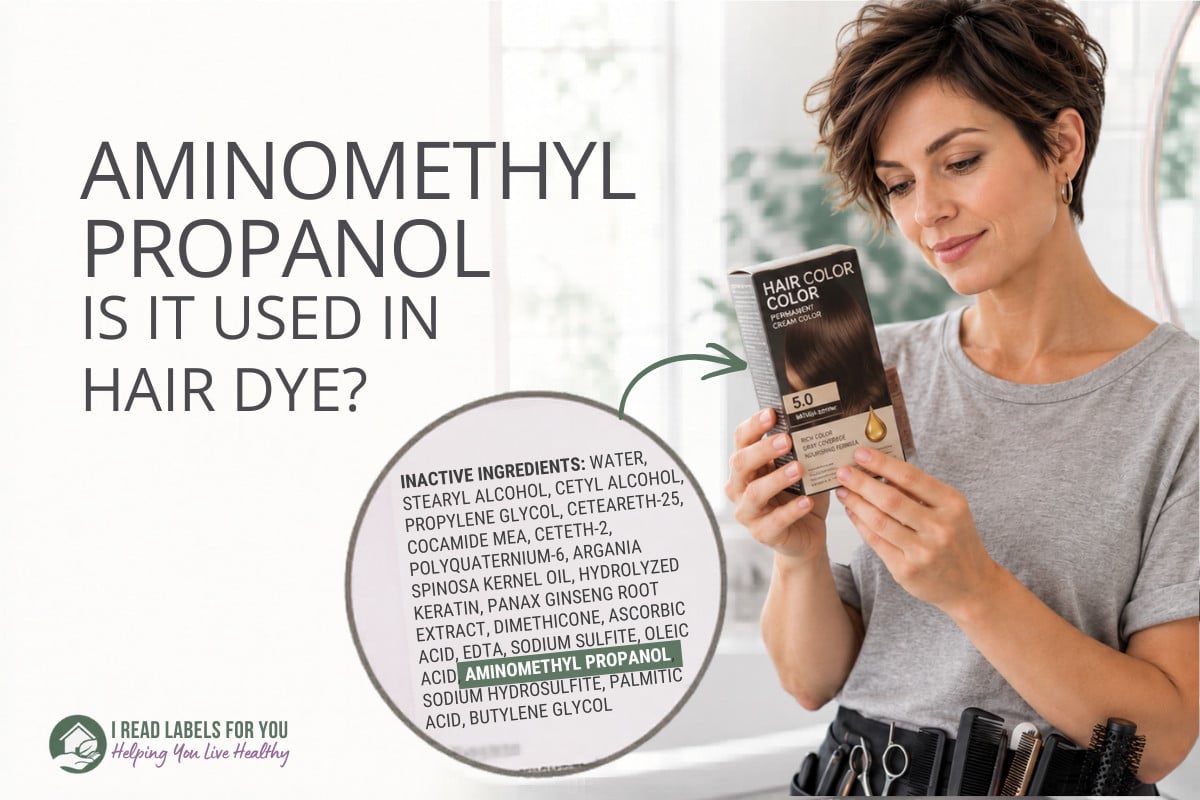
No, Aminomethyl Propanol is not safe enough for everyday cosmetics in my view, especially if you’re pregnant or planning to be. It’s a small lab-made chemical that adjusts the pH of hair sprays, styling gels, skin care, and makeup. Europe’s risk assessors concluded in 2025 that it may damage an unborn child, and it crosses skin easily. My rating is Not A Fan.
Aminomethyl Propanol is still allowed in European Union cosmetics, under purity rules meant to prevent cancer-causing nitrosamines. However, the European Chemicals Agency’s Committee for Risk Assessment voted on December 4, 2025 to classify it as a reproductive toxicant. Once the European Commission makes that law, the EU cosmetics rules ban it unless experts grant a specific exemption.
Keep reading to learn what Europe’s risk assessors found in pregnant rats and rabbits, why the U.S. industry panel called Aminomethyl Propanol safe anyway, and how much of it gets through your skin.
What Is Aminomethyl Propanol?
Aminomethyl Propanol is a small, man-made amino alcohol. Each molecule carries an amine group, which makes it strongly alkaline, and an alcohol group, which helps it mix completely with water. In fact, a weak water solution of this chemical has a pH of about 11, close to household ammonia.
Chemists often shorten the name to AMP. It belongs to a family called alkanolamines, which also includes triethanolamine and diethanolamine.
What Does Aminomethyl Propanol Do In Cosmetics?
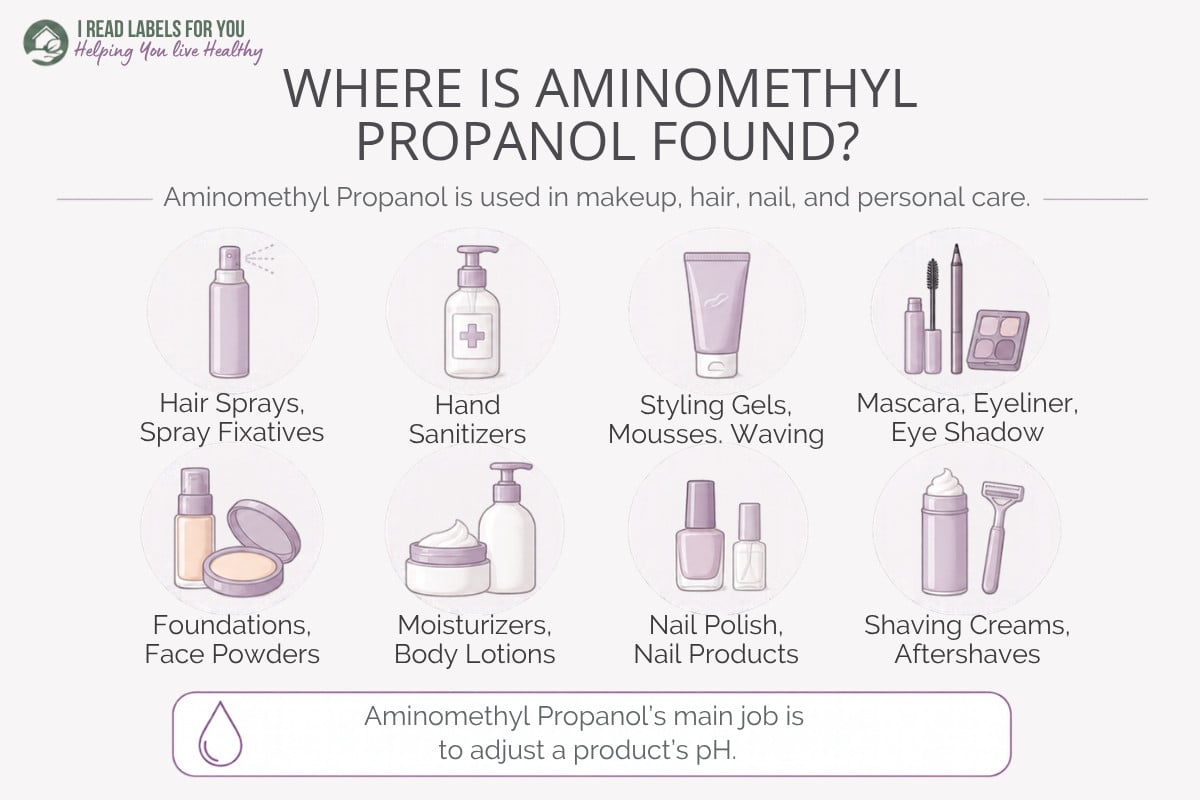
Its main job is raising pH. Many hair spray and styling resins are acidic, and AMP neutralizes them, which lets the resin dissolve and hold your style. Consequently, it often sits in a finished product as a salt rather than as free AMP.
According to the 2009 report from the Cosmetic Ingredient Review (CIR), an industry-funded panel, AMP appeared in 853 products, mostly hair sprays and hair dyes. Hair dyes have since moved on: in my review of 71 hair colors, only two listed this ingredient.
You’ll find Aminomethyl Propanol most often in:
- hair sprays and spray fixatives
- hand sanitizers
- styling gels, mousses, waving gels
- mascara, eyeliner, eye shadow
- foundations, face powders
- moisturizers, body lotions
- nail polish, nail products
- shaving creams, aftershaves
Aminomethyl Propanol is not a food ingredient. Still, the U.S. Food and Drug Administration (FDA) allows it in food-packaging adhesives and in coatings for paper that touches food, which can leave tiny traces in food.
How Is Aminomethyl Propanol Made?
Factories start from petroleum-based chemicals. First, they react a nitroparaffin, a small nitrogen-containing chemical, with formaldehyde. Next, they add hydrogen using a nickel catalyst, and finally they purify the product by distillation.
The CIR report does not name the nitroparaffin, but the one that fits AMP’s structure is 2-nitropropane. Europe classifies 2-nitropropane as a presumed human carcinogen, and the International Agency for Research on Cancer (IARC) lists formaldehyde as a known human carcinogen.
The CIR panel reports that one supplier’s AMP “may have up to 6.8% of secondary amine impurity.” Only its premium cosmetic grade meets Europe’s 0.5% limit. Moreover, nobody has published tests for leftover formaldehyde, nitroparaffin or nickel.
AMP can also react with formaldehyde, whether leftover from manufacturing or released by certain preservatives, to form a formaldehyde-releasing compound called an oxazolidine. No study has measured how often this happens in finished products.
Does Aminomethyl Propanol Penetrate The Skin?
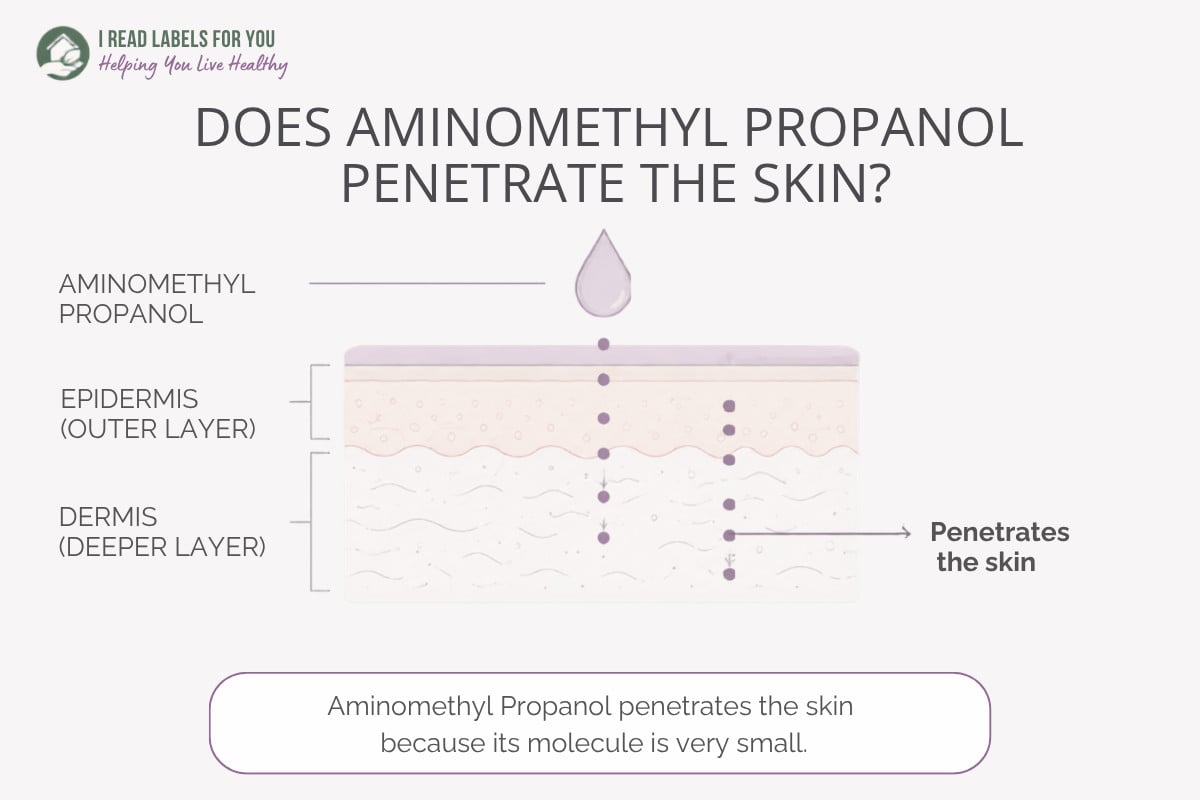
Yes, Aminomethyl Propanol penetrates the skin. Size is no barrier at all. AMP weighs 89 daltons, the unit for molecule size, while skin only begins holding molecules back at around 500 daltons.
Its LogP, which tells you whether a chemical favors fat or water, sits near -0.8. That slightly negative value means it leans toward water, which slows it down a little in the skin’s oily outer layer. For a molecule this small, however, that’s a weak brake.
Measurements confirm it. In a 2008 rat study, 42% of a dose spread on the skin was absorbed. I could not confirm who funded it, and its authors concluded that harmful blood levels in people are unlikely.
What Is Aminomethyl Propanol Called On Labels?
Ingredient lists may show it under these names:
- Aminomethyl Propanol
- AMP
- AMP-95
- AMP-Regular
- 2-Amino-2-Methyl-1-Propanol
- 2-Amino-2-Methylpropanol
- Isobutanolamine
- 2-Aminoisobutanol
Do not confuse it with Aminomethyl Propanediol, sometimes shortened to AMPD. That’s a related but different ingredient with one extra alcohol group, and Europe’s 2025 vote did not cover it.
Does The U.S. FDA Restrict Aminomethyl Propanol In Food And Cosmetics?
No, Aminomethyl Propanol faces no FDA limits in cosmetics. The agency’s short list of banned and restricted cosmetic ingredients leaves it out, and brands need no FDA approval before using it.
The agency’s food rules work on a similar honor system. Under the Generally Recognized As Safe (GRAS) system, a company may declare its own food ingredient safe, and it often need not notify the agency. For AMP, the FDA allows only indirect food uses, such as packaging glues and paper coatings.
Europe looks at chemicals differently. It follows the precautionary principle: when credible evidence suggests harm, regulators may act before the harm is fully proven in people.
EU Regulations On Aminomethyl Propanol
Today, the European Union allows Aminomethyl Propanol with strict purity rules. It falls under Annex III entry 61 of the Cosmetics Regulation, which covers this group of amines. The rules require at least 99% purity, no more than 0.5% secondary amines, and no more than 50 micrograms of nitrosamines per kilogram.
Brands also may not combine it with nitrosating ingredients, which could turn amine impurities into nitrosamines. Notably, the rules set no cap on how much AMP a product contains.
On December 4, 2025, Europe’s Committee for Risk Assessment concluded that “classification as Repr. 1B, H360D is warranted for AMP,” meaning it may damage an unborn child. It also added liver damage from repeated exposure and skin burns from strong solutions.
Great Britain’s Health and Safety Executive reviewed the same evidence in July 2026 and agreed. However, the classification becomes law only when the European Commission adopts it, and a Polish trade journal reports it is slated for the next update. Once that happens, the EU’s cosmetics rules ban reproductive toxicants of this kind unless the Scientific Committee on Consumer Safety finds a safe use.
U.S. And EU Disagreements On Aminomethyl Propanol
The two sides read the same animal studies very differently. In 2009, the CIR panel wrote that AMP “did not produce significant toxicity to the reproductive systems or development of fetuses in animal studies.”
Yet that same report describes a rat feeding study where embryo loss reached 70% at the middle dose and 100% at the top dose. The CIR panel has not published a new review since Europe’s 2025 vote.
Canadian Regulations On Aminomethyl Propanol
Canada does not restrict Aminomethyl Propanol. It’s missing from Health Canada’s Cosmetic Ingredient Hotlist, which bans the related diethanolamine family but not AMP. Similarly, Environment Canada does not treat it as toxic; it actually appears in Schedule 1 only on a list of chemicals excluded from smog-forming compounds.
Can Aminomethyl Propanol Cause Skin Allergy And Sensitization?
No, Aminomethyl Propanol is not a known skin allergen at the levels used in cosmetics. Two guinea pig tests and seven human patch tests of products containing 0.22% to 7% AMP found no allergic reactions. Most of those tests were unpublished studies that industry groups submitted to the CIR panel.
Irritation is a different story. Undiluted AMP left rabbit skin “severely irritated and black in color” within a day, and in one eye test it destroyed vision in every rabbit. Finished products are far weaker, and most caused only mild eye irritation.
In a 1997 report from Italy, two employees making hair dye developed itchy, red skin around the eyes from airborne AMP. AMP is absent from the American Contact Dermatitis Society (ACDS) Core Allergen Series. The society has never picked it as Allergen of the Year.
Is Aminomethyl Propanol A Hormone (Endocrine) Disruptor?
No, Aminomethyl Propanol is not a known hormone disruptor. In a 2021 extended reproduction study in rats, “Thyroid hormones were also not affected,” Britain’s Health and Safety Executive reports. Sperm counts and quality were normal too.
Its harm to pregnancy seems to work another way. Europe’s risk assessors point to choline, a nutrient for building cell membranes. They also suspect the vitamin A signals that guide heart development.
Is Aminomethyl Propanol Safe To Use While Pregnant?
No, Aminomethyl Propanol is not a smart choice while pregnant or trying to conceive. Europe’s risk assessors presume it may damage an unborn child. They based that on embryo loss in four rat studies and a rare heart defect in rabbit babies.
In the rabbit study, that heart defect appeared at the two lowest doses given by mouth, while the top dose killed most of the mothers. Embryo loss in rats was worst when exposure began before mating.
To be fair, two rat studies that applied AMP to the skin during pregnancy found no harm to the babies. Still, AMP crosses skin, and no one has measured how much reaches a pregnant woman. Meanwhile, you should consult with your medical provider, and picking AMP-free products is a simple precaution.
Are There Any Cancer Concerns Linked To Aminomethyl Propanol?
No, Aminomethyl Propanol itself is not linked to cancer, but nobody has ever tested it for cancer in a long-term animal study. It’s not listed by IARC, the U.S. National Toxicology Program or California’s Proposition 65.
Gene tests came back clean. AMP did not damage DNA in bacteria, in mouse cells or in a mouse bone marrow test.
The real cancer question involves impurities. AMP itself cannot form nitrosamines, but its secondary amine impurities can, and many nitrosamines cause cancer in animals. That’s why Europe sets purity limits and why the CIR panel warns against mixing it with nitrosating ingredients.
Is Aminomethyl Propanol Bad For The Environment?
Aminomethyl Propanol is mildly concerning for water life. For now, the European Union’s hazard label warns of lasting harm to fish and other aquatic creatures. However, the Committee for Risk Assessment recommended dropping that label in its 2025 opinion.
In addition, companies make or import 1,000 to 10,000 tonnes a year in Europe, for paints, metalworking fluids, and gas cleaning besides cosmetics. Neither COSMOS nor NATRUE, two natural cosmetic standards, lists it as an approved ingredient.
Common Claims About Aminomethyl Propanol: What’s True And What’s Not
Claim: AMP Is Safe Below 2%
This claim is unproven. The manufacturer’s own technical data sheet says AMP has “a low potential for toxicity” below 2% in finished products. Yet Europe’s risk assessors set no safe level for pregnancy effects, and the 2% figure comes from the seller.
Claim: It’s Neutralized In The Product, So It Cannot Hurt You
This claim is false. In a hair spray, AMP mostly ends up as a salt. Yet most pregnancy studies behind Europe’s 2025 vote used AMP hydrochloride, itself a salt, and the committee found it harmful.
Claim: AMP Creates Cancer-Causing Nitrosamines
This claim is partly true, since AMP itself cannot turn into a nitrosamine. Its secondary amine impurities can, though, especially in lower-purity grades or next to nitrosating ingredients. Europe’s purity rules exist to prevent exactly that.
What I Think About Aminomethyl Propanol — And What You Should Do
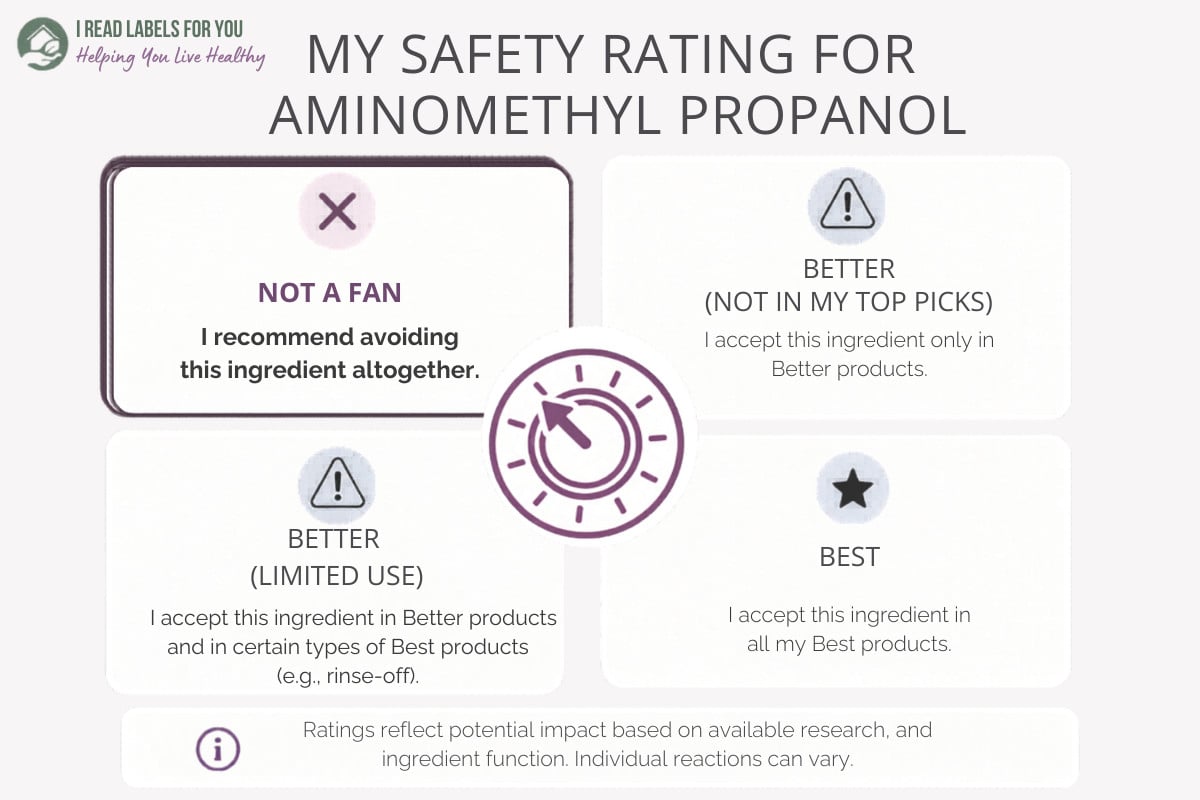
I rate Aminomethyl Propanol Not A Fan. It’s not in my Best or my Better products, and I suggest you avoid it, above all during pregnancy.
My reasons stack up quickly. Europe’s risk assessors presume it can damage an unborn child, and it crosses the skin. On top of that, it’s made from formaldehyde and a likely carcinogen, and it can carry impurities that form nitrosamines.
There’s real counter-evidence, and you deserve to see it. The skin-applied pregnancy studies in rats were clean, the patch tests showed no allergy, and it’s not genotoxic. Even so, an ingredient whose job is simply raising pH has gentler replacements.
Here’s what I suggest:
- check hair sprays, styling gels, and mascara first
- switch to AMP-free products if you’re pregnant, breastfeeding or trying to conceive
- use hair spray in a ventilated room and keep it away from your eyes
- watch for news on the European Union’s final decision, expected with its next classification update
Frequently Asked Questions About Aminomethyl Propanol
Is Aminomethyl Propanol Banned In Europe?
Not yet. Europe’s Committee for Risk Assessment adopted a reproductive toxicant classification in December 2025, but it applies only after the European Commission adopts it into law. After that, cosmetics may use it only if the Scientific Committee on Consumer Safety approves a safe use.
Is Aminomethyl Propanol Still Used In Hair Dye?
Less than it used to be. The CIR panel’s 2009 survey found it in hair dyes at up to 7% before mixing. Out of the 71 hair colors I reviewed, only two listed this ingredient, and hair sprays, styling gels and mascaras are now likelier places to find it.
Is Aminomethyl Propanol Worse Than Ammonia In Hair Dye?
They raise different concerns. Ammonia mainly irritates your eyes, nose, and scalp, while AMP adds the pregnancy question Europe raised. An “ammonia-free” label can simply mean AMP or another amine replaced it.
Why Did The CIR Panel Remove Its 1% Limit?
In 1990, the CIR panel limited AMP to 1% because that was the highest level tested. By 2009, it had patch tests of products up to 7% showing no irritation or allergy, and it lifted the limit. Those tests looked at skin reactions, not pregnancy effects.
Why Does EWG Rate Aminomethyl Propanol Differently?
The Environmental Working Group (EWG) scores Aminomethyl Propanol 1 to 4, a low to moderate hazard depending on use. It marks irritation, use restrictions and nitrosamine contamination as high concerns. I land on a harsher rating since EWG’s score does not yet reflect Europe’s 2025 reproductive toxicity conclusion.
Sources
EU SCCS / SCCP Opinions:
No SCCS or SCCP opinion on Aminomethyl Propanol (checked). SCCS opinions portal: SCCS opinions
SCCNFP opinion concerning dialkyl- and dialkanolamines and their salts, adopted June 12, 2001, the basis of the nitrosamine purity rules in Annex III entries 60 to 62: SCCNFP opinion
Cosmetic Ingredient Review (CIR) Reports:
Burnett CL, Bergfeld WF, Belsito DV, et al., 2009. Final Amended Report on Safety Assessment on Aminomethyl Propanol and Aminomethyl Propanediol. International Journal of Toxicology 28(6 Suppl):141S to 161S. Sponsored by CIR, which is funded by the Personal Care Products Council. PMID 19966147: PubMed 19966147; CIR database: cir-reports.cir-safety.org
Elder RL (ed.), 1990. Final Report on the Safety Assessment of Aminomethylpropanol and Aminomethylpropanediol. Journal of the American College of Toxicology 9(2):203 to 228: cir-reports.cir-safety.org
European Union Regulatory Databases:
CosIng entry 74367, AMINOMETHYL PROPANOL, function buffering, Annex III entry 61: CosIng 74367
The CosIng Annex III entry 61, monoalkylamines, monoalkanolamines and their salts, with purity and nitrosamine conditions: CosIng III/61
CosIng Annexes II, III, IV, V and VI (2026 versions), checked; covered only by the Annex III entry 61 group listing: CosIng
CLP Regulation Annex VI harmonized classification (2026 table), Index 603-070-00-6: Skin Irrit. 2, Eye Irrit. 2, Aquatic Chronic 3: ECHA CHEM
ECHA Committee for Risk Assessment opinion CLH-O-0000007598-58-01/F, adopted December 4, 2025: Repr. 1B, H360D; STOT RE 2, H373 (liver); Skin Corr. 1, H314; Eye Dam. 1, H318: ECHA CHEM CLH process
ECHA CHEM, EC 204-709-8. REACH-registered at 1,000 to 10,000 tonnes per year; regulatory activities: ECHA CHEM overview; ECHA CHEM activities
Other Regulators:
Great Britain Health and Safety Executive, Agency technical report on the classification and labelling of 2-amino-2-methylpropanol, July 2026. Agrees with the RAC opinion, including Repr. 1B, H360D: HSE technical report
U.S. FDA, prohibited and restricted cosmetic ingredients. Not listed: FDA
U.S. FDA indirect food additives: 21 CFR 175.105, adhesives: eCFR 175.105; 21 CFR 176.170, paper and paperboard coatings: eCFR 176.170
Health Canada Cosmetic Ingredient Hotlist. Not listed: Health Canada Hotlist
Environment Canada, Canadian Environmental Protection Act Schedule 1. Not listed as toxic; named only among compounds excluded from the volatile organic compound entry: CEPA Schedule 1
International Agency for Research on Cancer (IARC) classifications. Not classified: IARC list
U.S. National Toxicology Program, Report on Carcinogens. Not listed: NTP Report on Carcinogens
California Proposition 65 list. Not listed: OEHHA
U.S. EPA Integrated Risk Information System. No assessment: IRIS A to Z list
Trade press on the planned 25th update to the CLP classification list (secondary source): Wiadomości Kosmetyczne
PubChem Records (Chemistry, Identifiers, Skin Penetration, Hazard Codes):
2-Amino-2-methyl-1-propanol, PubChem CID 11807, CAS 124-68-5. Molecular weight 89.14; XLogP3-AA -0.8: PubChem CID 11807
Peer-Reviewed Studies:
Saghir SA, Clark AJ, McClymont EL, Staley JL, 2008. Pharmacokinetics of aminomethylpropanol in rats following oral and a novel dermal study design. Food and Chemical Toxicology 46(2):678 to 687. PMID 17961896: PubMed 17961896
Cipolla C, Belisario A, Sassi C, 1997. Airborne contact dermatitis from 2-amino-2-methyl-1-propanol in a cosmetic company. Arhiv za Higijenu Rada i Toksikologiju 48:205 to 209. PMID 9434432: PubMed 9434432
Manufacturer technical data sheet, ANGUS AMP-ULTRA PC: ANGUS data sheet
Natural Cosmetic Standards:
COSMOS-standard approved raw materials. Aminomethyl Propanol not listed: COSMOS-standard approved raw materials
NATRUE certified and approved raw materials. Aminomethyl Propanol not listed: NATRUE certified raw materials
Skin Allergy Resource:
American Contact Dermatitis Society (ACDS), Helpful References, including the Core Allergen Series 2020. Aminomethyl Propanol is not on the series and has never been Allergen of the Year: ACDS Helpful References
Advocacy groups:
Environmental Working Group (EWG) Skin Deep entry for Aminomethyl Propanol. Hazard score 1 to 4 depending on use, data fair; irritation, use restrictions and contamination concerns listed as high: EWG Skin Deep
Last verified: 10-10-2026
Download The Free Guide!
5 Powerful Steps To A Non-Toxic Home
Join our informed consumer community and get our free guide the “5 Powerful Steps To A Non-Toxic Home”.

Before commenting, please read our Comment Policy.