
Is Diazolidinyl Urea Safe? A Simple Answer You Can Trust
 Written by Irina Webb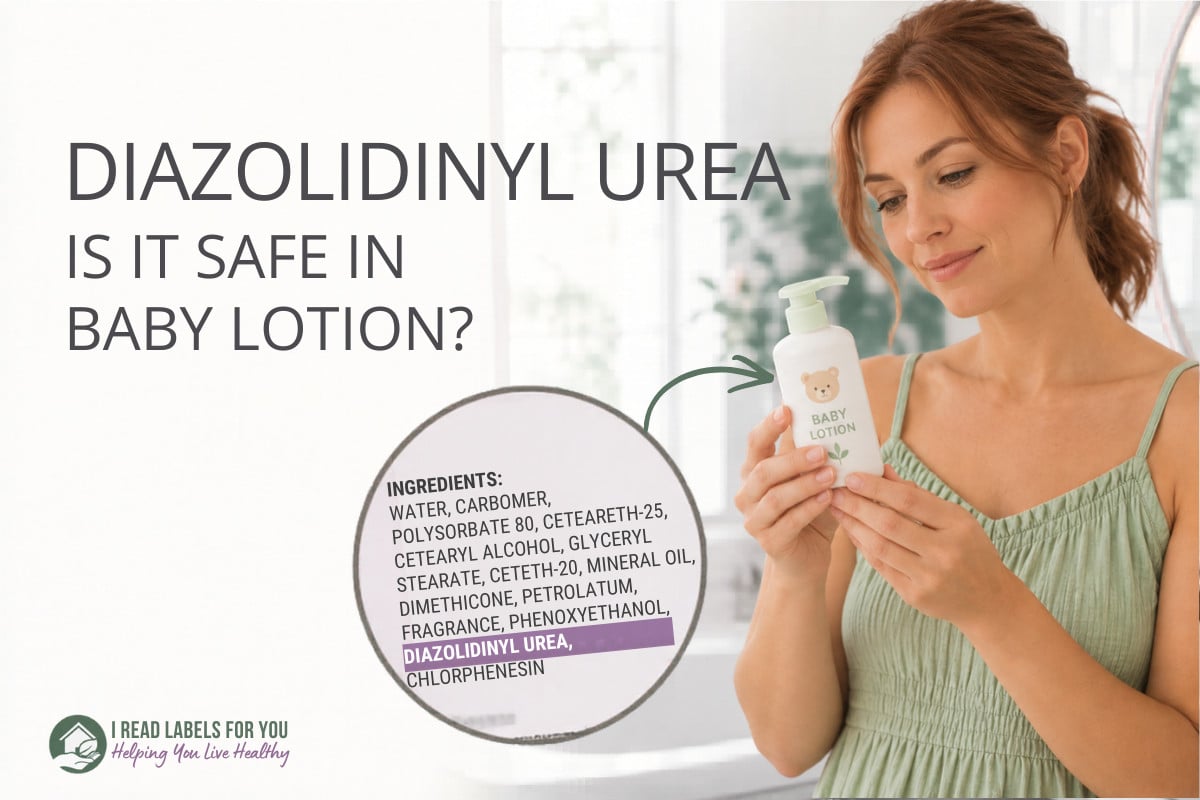
No, I keep Diazolidinyl Urea out of everything I recommend. It’s a laboratory-made preservative that works by slowly giving off formaldehyde. Europe banned formaldehyde from cosmetics in 2019, then kept permitting the ingredients that release it. My verdict is Not A Fan.
Diazolidinyl Urea is allowed in Europe at up to 0.5 percent, under entry 46 of the preservatives list. Since July 2026, products must warn you when released formaldehyde passes 10 parts per million. The United States sets no limit and requires no warning.
Ahead, you will see the measured figures for how much formaldehyde Diazolidinyl Urea actually gives off. You’ll learn why dermatologists screen for it on their standard allergy panel. You’ll also find the one study that shows what concentration stops causing reactions.
What Is Diazolidinyl Urea?
Diazolidinyl Urea is a white powder used to stop bacteria and mold growing in water-based products. It belongs to a group called “formaldehyde releasers.”
The name describes how the molecule is built, not what it does. Four formaldehyde units are attached to a urea-type ring. Put the powder in water and those units start coming off again.
That release is the whole point. Free formaldehyde kills microbes, which is why the preservative works.
It Has Nothing To Do With Urine
This is the question people ask most, so let me answer it plainly. Cosmetic urea of every kind is made in a laboratory, never collected from anyone.
The word “urea” names a chemical shape. Chemists use it for any molecule built around that particular arrangement of atoms.
Plain Urea and Diazolidinyl Urea are also different ingredients. Plain Urea is a moisturizer that pulls water into skin. If a label lists Urea on its own, that is the moisturizer.
What Does Diazolidinyl Urea Do In Cosmetics?
It preserves. Every source I checked gives it that single function, with no second role.
Water-based products need a preservative, and that part is not optional. Without one, a lotion grows bacteria and mold within weeks. The question is which preservative a brand picks, not whether it uses one.
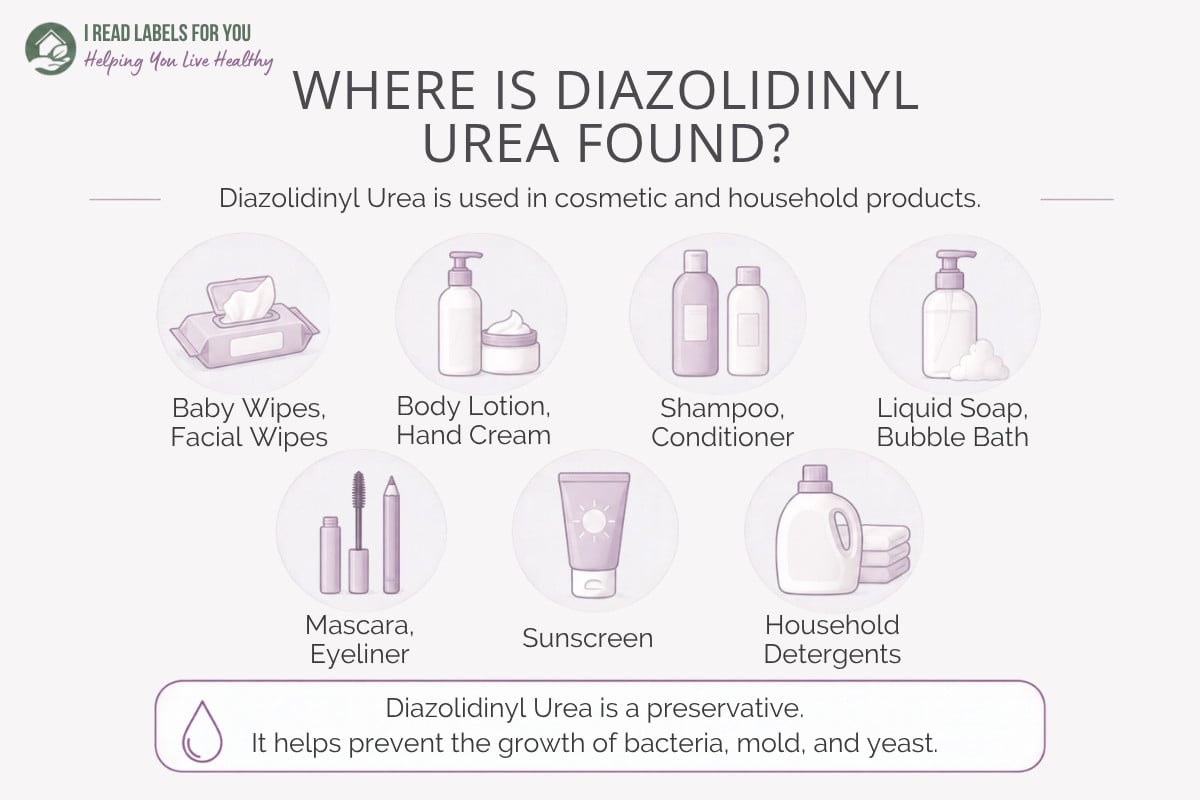
You’ll find Diazolidinyl Urea most often in:
- baby wipes and facial wipes
- body lotion and hand cream
- shampoo and conditioner
- liquid soap and bubble bath
- mascara and eyeliner
- sunscreen
- household detergents
It appears in no food at all. The United States Food and Drug Administration (FDA) keeps no record of it in any food inventory.
How Is Diazolidinyl Urea Made?
It’s built in a laboratory, and formaldehyde is one of the building blocks. That’s the part worth knowing.
A 2002 European committee report describes the chemistry clearly. One molecule can release four molecules of formaldehyde under forceful conditions. At the 0.5 percent legal maximum, that works out to 0.215 percent formaldehyde.
Treat that figure as a ceiling rather than a measurement. It describes the total locked inside, not what a product gives off day to day.
Does Diazolidinyl Urea Penetrate The Skin?
The honest answer has two halves, because the question misses what matters here.
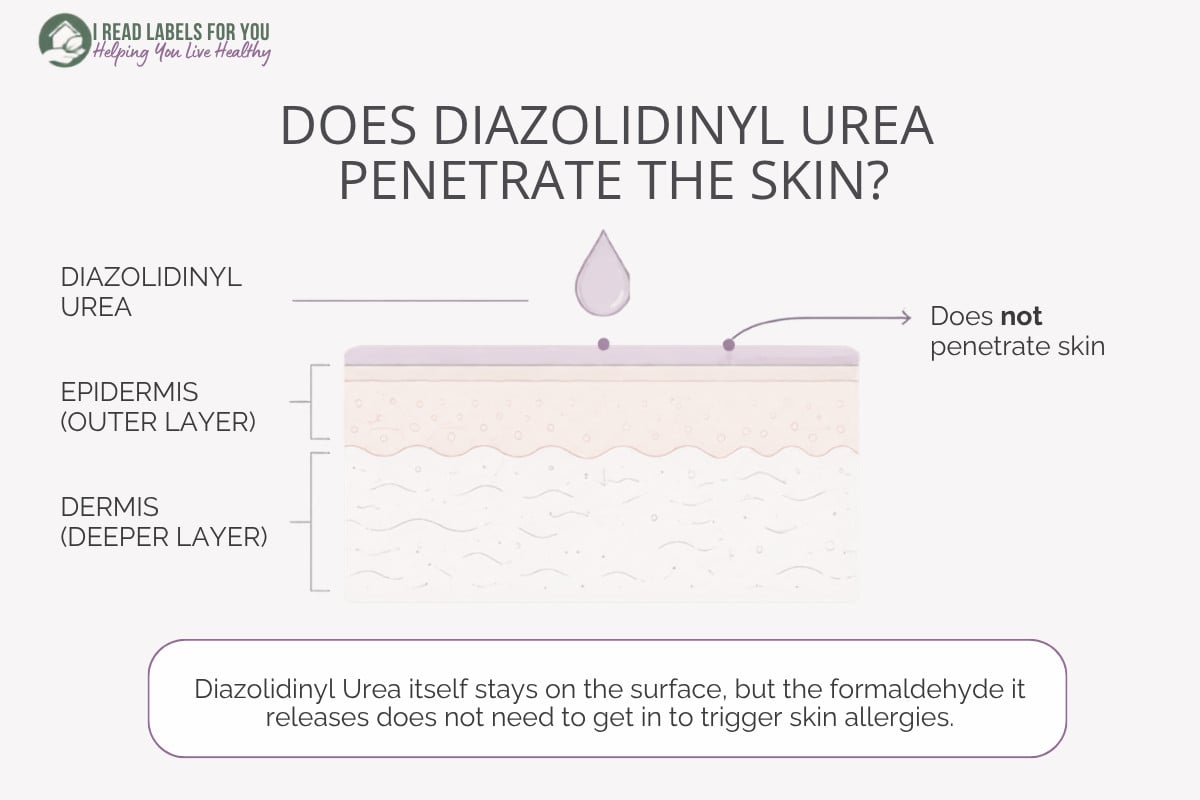
The preservative molecule itself probably stays put. It weighs 278, under the roughly 500 dalton ceiling where size blocks entry. Its strong preference for water works against crossing a fatty barrier.
A European committee reached the same view in 1990. It wrote that the compound is likely poorly absorbed through skin, while noting little data existed.
Formaldehyde needs no help getting in, though. It’s tiny, reactive, and it causes its main harm right at the skin surface. An allergic rash starts in the skin, not after a trip through the bloodstream. Consequently a low absorption figure for the preservative would settle nothing. The risk travels by a different route.
Bottom line: Diazolidinyl Urea itself likely stays on the surface, but the formaldehyde it releases does not need to get in to cause trouble, because it can trigger skin allergies right where you apply it.
What Is Diazolidinyl Urea Called On Labels?
It appears as Diazolidinyl Urea. Its registry number is 78491-02-8.
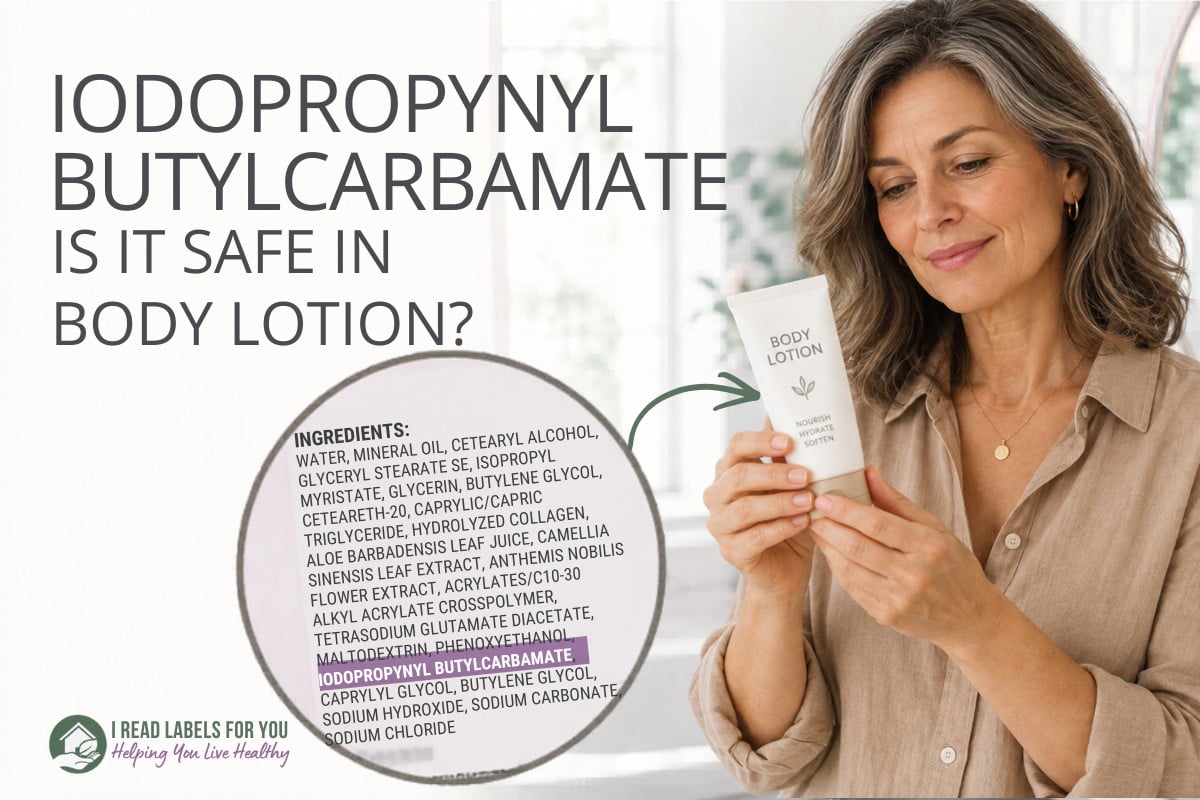
Blended preservatives hide it behind trade names, and Germall II and Germall Plus are the common ones. Germall Plus pairs it with Iodopropynyl Butylcarbamate.
Other formaldehyde releasers travel under names that look nothing alike:
- Imidazolidinyl Urea
- DMDM Hydantoin
- Quaternium-15
- 2-Bromo-2-Nitropropane-1,3-Diol, Or Bronopol
- Sodium Hydroxymethylglycinate
- Benzylhemiformal
Does The U.S. FDA Restrict Diazolidinyl Urea In Food And Cosmetics?
No, the agency places no limit on Diazolidinyl Urea in cosmetics and does not prohibit it. No warning label is required, at any release level.
American oversight of cosmetic preservatives is thin. The agency’s list of banned or restricted cosmetic ingredients runs to eleven entries. Everything else reaches shelves without pre-market review.
As far as food additives are concerned, the Generally Recognized As Safe route invites skepticism. Companies may judge their own ingredients safe and tell nobody. This preservative has no food use, so that pathway never applied to it.
Europe starts from the opposite assumption, called the precautionary principle. An ingredient must be shown safe before it goes on sale. Manufacturers carry that burden instead of the public.
EU Regulations On Diazolidinyl Urea
Europe permits Diazolidinyl Urea as a preservative, capped at 0.5 percent. It sits at entry 46 of Annex V, the list of allowed preservatives.
Formaldehyde itself tells a very different story. Europe classified it as a category 1B carcinogen and a category 1A skin sensitizer. That classification forced its removal, and it now sits on the banned list at entry 1577.
So one document bans the substance while another permits the ingredients that produce it. Europe closed that gap with a warning label rather than a second ban.
The Label Warning Changed In 2026
A safety committee looked at the old warning rule in May 2021 and rejected it. The old threshold of 0.05 percent, it concluded, fails to protect people already allergic to formaldehyde.
The evidence was direct. Concentrations of 20 to 40 parts per million still triggered reactions in a large share of allergic volunteers. Ten parts per million did not.
Europe acted on that advice. Products must now carry the warning “releases formaldehyde” once released formaldehyde passes 0.001 percent, which is 10 parts per million. That rule counts every releaser in the formula together.
The change took full effect on July 31, 2026. If you’ve seen that phrase on a label recently, this is why.
Canadian Regulations On Diazolidinyl Urea
Health Canada neither prohibits nor restricts Diazolidinyl Urea. It appears nowhere on the Cosmetic Ingredient Hotlist.
Formaldehyde is restricted there, and one condition comes close to catching releasers. Canada caps non-aerosol products that release formaldehyde vapors at 0.01 percent. That entry names no releaser by name, so its reach is unclear.
Canada also leaves the preservative off its toxic substances list. Formaldehyde appears on that list; Diazolidinyl Urea does not.
Can Diazolidinyl Urea Cause Skin Allergy And Sensitization?
Yes, and the allergy evidence is the strongest part of this ingredient’s file. Dermatologists screen for it as a matter of routine.
It holds place 25 on the American Contact Dermatitis Society core allergen panel, tested at 1 percent. Roughly 90 substances make that panel. Formaldehyde, DMDM Hydantoin, Quaternium-15, and Imidazolidinyl Urea all sit alongside it.
How common is the reaction? The North American group tested 4,238 patients in 2011 and 2012, and 2.1 percent reacted. Reassuringly, rates for every formaldehyde releaser fell significantly against the previous decade.
The reaction is mostly formaldehyde’s doing rather than Diazolidinyl Urea’s. A review of 708 consecutive patch tests found 58 people sensitive to this preservative. Of those, 81 percent also reacted to formaldehyde, and only 12 percent reacted to the preservative alone.
One study pins down the level that matters. Volunteers already allergic to formaldehyde used a face cream preserved at 0.05 to 0.6 percent. It found 0.05 percent caused no reaction, and that skin grew more reactive from arm to neck to face.
Compare that 0.05 percent with the 0.5 percent Europe permits. The level that provokes nothing is one tenth of the legal cap.
A Japanese analysis raises a further doubt. The breakdown products in real cosmetics differed from those in patch test materials. If that holds, standard testing may understate the true rate.
Is Diazolidinyl Urea A Hormone (Endocrine) Disruptor?
No evidence says Diazolidinyl Urea disrupts hormones, and I want to be exact about why. Nobody has tested it.
The European Chemicals Agency has never brought it before its endocrine expert group. Neither industry safety review examines the question. Nor does the European committee opinion on formaldehyde releasers.
Searching the published literature returns the same emptiness. The few papers pairing this preservative with hormone terms are allergy studies caught by indexing.
An untested endpoint and a cleared one are different things. Anyone claiming Diazolidinyl Urea disrupts hormones is going beyond the evidence, in either direction.
Is Diazolidinyl Urea Safe To Use While Pregnant?
The limited evidence available raises no pregnancy concern, though the file is thin. One relevant study exists, and it dates from 1990.
A European committee reviewed a skin study in pregnant animals. Its conclusion was that Diazolidinyl Urea seems unlikely to raise any concern about birth defects.
Read the rest of that same paragraph, though. The committee had asked for a feeding study instead and never received one. It also noted how little data existed on absorption.
My own reason for avoiding Diazolidinyl Urea during pregnancy has nothing to do with birth defects. Pregnancy is a poor time to acquire a lifelong contact allergy. For daily choices while expecting, you should consult with your medical provider.
Are There Any Cancer Concerns Linked To Diazolidinyl Urea?
Diazolidinyl Urea carries no cancer classification of its own, anywhere. The concern belongs to the substance it releases (formaldehyde).
No cancer authority has classified Diazolidinyl Urea itself. That covers the International Agency for Research on Cancer, the Report on Carcinogens, and California’s Proposition 65. No cancer study of it exists in either industry safety review.
Formaldehyde is a different matter entirely. Europe classifies it as a category 1B carcinogen, meaning presumed to cause cancer in people. It also appears in the United States Report on Carcinogens.
Most of that cancer evidence involves breathing formaldehyde over years, not meeting traces in a lotion. Keeping the two apart matters for an honest answer.
One Laboratory Finding The Industry Panel Set Aside
A 2002 genotoxicity study tested Diazolidinyl Urea in three systems. It damaged genetic material in all three, and the authors called for the risk to be reassessed. The industry panel dismissed that result in 2008. Its reason was that the test method let the preservative release extra formaldehyde.
Read that reasoning twice. Releasing formaldehyde is exactly what this ingredient does inside a product.
Two cautions keep this in proportion. The study was done in test tubes rather than in animals or people. It also shares both authors with the one supporting paper, so this rests on a single research group.
Is Diazolidinyl Urea Bad For The Environment?
No regulator treats Diazolidinyl Urea as an environmental problem. Europe gives it no hazard classification of any kind.
It’s absent from Europe’s substances of very high concern list and from Canada’s toxic substances list. Production volume is modest, at 100 to 1,000 tonnes a year in Europe.
Formaldehyde is the one with the environmental file, and Europe restricted it in furniture and other articles in 2023. Cosmetics were handled separately, through the label warning above.
Common Claims About Diazolidinyl Urea: What’s True And What’s Not
Claim: Baby Wipes Hide Formaldehyde
Partly true, and the wording matters. Formaldehyde will not appear on the label, because no brand adds it directly.
What does appear is the releaser, listed by its own name. These are the ones you’re most likely to see on baby wipes and other personal care products:
- DMDM Hydantoin
- Diazolidinyl Urea
- Imidazolidinyl Urea
- Quaternium-15
- Bronopol (May Be Listed As 2-Bromo-2-Nitropropane-1,3-Diol)
- Sodium Hydroxymethylglycinate
For example, if a wipe lists “DMDM hydantoin” near the end of the ingredients, that’s your formaldehyde releaser. Nothing is concealed, but you do need to recognize the names to spot it.
Claim: Germall Plus Is A Gentle Natural Preservative
Misleading, and this one circulates in home-formulating groups. Germall Plus is a trade name combining Diazolidinyl Urea with Iodopropynyl Butylcarbamate. Both components are synthetic. One releases formaldehyde, and the other is a separate preservative I also avoid.
Claim: Diazolidinyl Urea Is Safe Because Regulators Approved It
Partly true, and worth unpacking. The U.S. industry panel calls it safe to 0.5 percent, and Europe permits the same level.
Approval rests on thinner evidence than most people assume. No cancer study, no feeding study in pregnancy, and no absorption measurement exist for this ingredient. A 2002 European report also found the decomposition products had never been identified.
What I Think About Diazolidinyl Urea
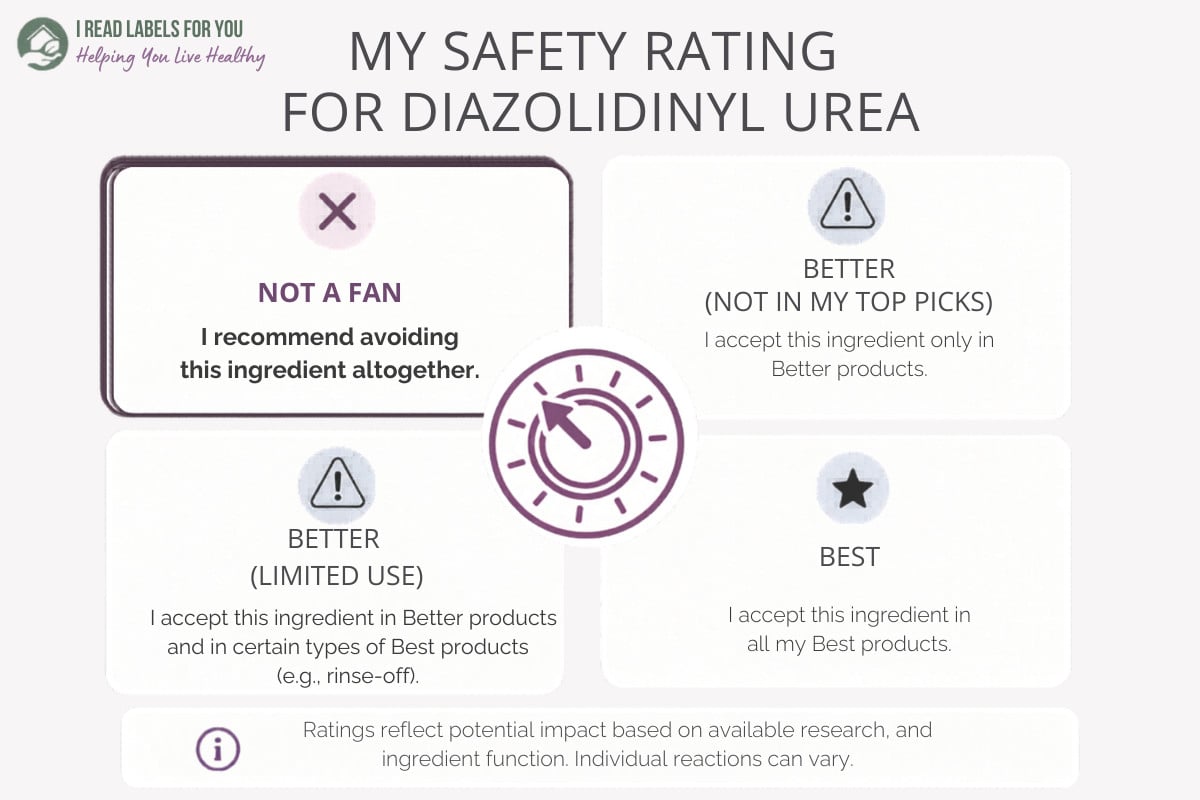
My rating for Diazolidinyl Urea is Not A Fan. This one needed less deliberation than most ingredients I review. The case against it is short and holds together.
Five Reasons I Avoid It
First, Diazolidinyl Urea delivers formaldehyde which is a banned substance. Europe prohibited formaldehyde in cosmetics, and this preservative reintroduces it by design.
Second, the amounts are not trivial. A 1990 industry report measured 150 parts per million released from a shampoo base at 0.1 percent. At 0.8 percent it measured 740 parts per million, against a warning threshold of 10.
Third, Diazolidinyl Urea releases more formaldehyde than its rivals. A comparison of eight preservatives ranked it first among those Europe actually permits. Release also climbs with warmth and time, which describes any bathroom shelf.
Fourth, it’s a proven allergen rather than a theoretical one. Dermatologists screen for Diazolidinyl Urea, and an allergy acquired once tends to last.
Fifth, the evidence behind its clearance has real holes. No cancer study, no absorption measurement, and breakdown products nobody has identified.
What Should You Do?
Seeing Diazolidinyl Urea on a label is reason enough to choose something else. Preservation is a solved problem, and gentler options fill the shelves.
Watch for its relatives too, since they work the same way:
- Imidazolidinyl Urea
- DMDM Hydantoin
- Quaternium-15
- Bronopol
- Sodium Hydroxymethylglycinate
Pay closest attention to baby wipes, face creams, and anything used near the eyes. Wipes are the case I feel strongest about. They are used many times daily, on thin skin, often already irritated.
If a rash keeps returning and you cannot explain it, ask a dermatologist about patch testing. This preservative is on the standard panel, so confirming it takes no special request.
Frequently Asked Questions About Diazolidinyl Urea
Is Diazolidinyl Urea Harmful To Your Skin?
For some people, it causes no visible problems at the levels used. For the minority already sensitized to formaldehyde, Diazolidinyl Urea can trigger an itchy rash. Leave-on products carry more risk than rinse-off ones, simply because contact lasts longer.
What Are The Symptoms Of A Diazolidinyl Urea Allergy?
Look for redness, itching, and sometimes flaking or small blisters where the product touched you. The rash often appears a day or two later, which makes the cause hard to trace. Stopping the product usually clears it, and a patch test confirms the diagnosis.
Is Urea The Same As Formaldehyde?
No, and plain Urea releases no formaldehyde at all. It works as a moisturizer instead. Diazolidinyl Urea and Imidazolidinyl Urea do release it, because formaldehyde was built into them.
Is Diazolidinyl Urea Safe For Babies?
I would skip it in wipes, diaper creams, and baby lotion. These products go on thin skin several times a day, often where skin is already sore. Plenty of wipes are made without formaldehyde releasers, so there’s little to give up.
What Is The Difference Between Diazolidinyl Urea And Imidazolidinyl Urea?
Both release formaldehyde and both sit on the standard allergy panel. Diazolidinyl Urea is the stronger preservative and gives off more formaldehyde. React to one and you may well react to the other.
Is Diazolidinyl Urea Banned?
Not in Europe, the United States or Canada. Europe permits it to 0.5 percent and requires the warning “releases formaldehyde” above 10 parts per million. Some U.S. states have passed their own cosmetic ingredient laws, so check your state if that matters to you.
Why Does EWG Rate Diazolidinyl Urea Differently?
The Environmental Working Group (EWG) scores it 4 out of 10 in Skin Deep, in the moderate band. My rating is stricter than that. Their own page marks data availability as limited, which holds the score down.
Their two systems disagree with each other, which is the interesting part. The score says moderate, yet EWG marks the ingredient Unacceptable for its Verified program.
So a product carrying Diazolidinyl Urea can never be EWG Verified, whatever the number suggests. On that point their program and my rating land in the same place.
Sources
EU SCCS / SCCP Opinions:
SCCS/1632/21, Scientific Advice on the threshold for the warning ‘contains formaldehyde’ in Annex V, preamble point 2 for formaldehyde-releasing substances, adopted May 7, 2021. Recommended cutting the warning threshold to 0.001 percent: SCCS opinions portal
SCCNFP/586/02, Opinion concerning the Determination of Certain Formaldehyde Releasers in Cosmetic Products, adopted December 17, 2002. Source of the 0.215 percent formaldehyde equivalent at 0.5 percent: SCCNFP/586/02
SCCNFP/587/02, Opinion concerning a Clarification on the Formaldehyde and para-Formaldehyde Entry in Directive 76/768/EEC, adopted December 17, 2002. Records that the decomposition products have never been characterized: SCCNFP/587/02
No SCCS opinion exists on Diazolidinyl Urea as an individual ingredient (checked).
Cosmetic Ingredient Review (CIR) Reports:
Elder RL, ed. Final Report on the Safety Assessment of Diazolidinyl Urea. Journal of the American College of Toxicology. 1990;9(2):229 to 245. Concluded safe to 0.5 percent, and the source of the shampoo formaldehyde measurements: cir-reports.cir-safety.org
Annual Review of Cosmetic Ingredient Safety Assessments: 2005/2006. International Journal of Toxicology. 2008;27(Suppl 1):77 to 142. Reaffirmed the 0.5 percent conclusion without reopening the assessment: cir-reports.cir-safety.org
European Union Regulatory Databases:
CosIng entry for Diazolidinyl Urea, function listed as preservative, provisions V/46: CosIng ingredient record
Annex V, entry 46, maximum 0.5 percent, with no product type restriction: CosIng Annex V
Annex II, entry 1577, Formaldehyde, prohibited in cosmetics: CosIng Annex II
Commission Regulation (EU) 2022/1181, which replaced Annex V preamble point 2 with the “releases formaldehyde” warning at 0.001 percent: Regulation (EU) 2022/1181
CLP Annex VI harmonized classifications, checked. Diazolidinyl Urea has none; formaldehyde is Carc. 1B, Muta. 2 and Skin Sens. 1A: ECHA CLP Annex VI
ECHA registration record, tonnage band 100 to 1,000 tonnes, not a substance of very high concern: ECHA substance record
Other Regulators:
U.S. FDA, prohibited and restricted ingredients in cosmetics, checked; Diazolidinyl Urea not listed: FDA cosmetics ingredient restrictions
Health Canada Cosmetic Ingredient Hotlist, checked; not listed, while formaldehyde is restricted: Health Canada Hotlist
Environment Canada, CEPA Schedule 1, checked; not listed, while formaldehyde is: CEPA Schedule 1
IARC Monographs classifications, checked; Diazolidinyl Urea has no classification: IARC classifications
NTP Report on Carcinogens, Fifteenth Edition, checked; not listed, while formaldehyde is: NTP Report on Carcinogens
California Proposition 65 list, checked; not listed, while formaldehyde is: Proposition 65 list
PubChem Records (Chemistry, Identifiers, Skin Penetration, Hazard Codes):
Diazolidinyl Urea, PubChem CID 62277, molecular weight 278.22, CAS 78491-02-8: PubChem CID 62277
Peer-Reviewed Studies:
Hectorne KJ, Fransway AF. Diazolidinyl urea: incidence of sensitivity, patterns of cross-reactivity and clinical relevance. Contact Dermatitis. 1994;30(1):16 to 19. PMID 8156757: PubMed 8156757
Warshaw EM, Maibach HI, Taylor JS, et al. North American contact dermatitis group patch test results: 2011-2012. Dermatitis. 2015;26(1):49 to 59. PMID 25581671: PubMed 25581671
Zachariae C, Hall B, Cottin M, Cupferman S, Andersen KE, Menne T. Experimental elicitation of contact allergy from a diazolidinyl urea-preserved cream in relation to anatomical region, exposure time and concentration. Contact Dermatitis. 2005;53(5):268 to 277. PMID 16283905: PubMed 16283905
Doi T, Kajimura K, Taguchi S. The different decomposition properties of diazolidinyl urea in cosmetics and patch test materials. Contact Dermatitis. 2011;65(2):81 to 91. PMID 21309789: PubMed 21309789
Pfuhler S, Wolf HU. Effects of the formaldehyde releasing preservatives dimethylol urea and diazolidinyl urea in several short-term genotoxicity tests. Mutation Research. 2002;514(1-2):133 to 146. PMID 11815252: PubMed 11815252
Lv C, Hou J, Xie W, Cheng H. Investigation on formaldehyde release from preservatives in cosmetics. International Journal of Cosmetic Science. 2015;37(5):474 to 478. PMID 25704726: PubMed 25704726
Glaz P, Rosinska A, Wozniak S, Boguszewska-Czubara A, Biernasiuk A, Matosiuk D. Effect of Commonly Used Cosmetic Preservatives on Healthy Human Skin Cells. Cells. 2023;12(7):1076. PMID 37048149: PubMed 37048149
Natural Cosmetic Standards:
COSMOS-standard approved raw materials, checked; Diazolidinyl Urea not listed: COSMOS-standard approved raw materials
NATRUE certified and approved raw materials, checked; not listed: NATRUE certified world
Skin Allergy Resource:
American Contact Dermatitis Society (ACDS), Helpful References including the Core Allergen Series 2020, where Diazolidinyl Urea is entry 25 at 1 percent in petrolatum: ACDS Helpful References
Advocacy groups:
Environmental Working Group (EWG) Skin Deep entry for Diazolidinyl Urea, hazard score 4 with limited data, and marked Unacceptable for EWG Verified: EWG Skin Deep, Diazolidinyl Urea
Last verified: 09-23-2026
Download The Free Guide!
5 Powerful Steps To A Non-Toxic Home
Join our informed consumer community and get our free guide the “5 Powerful Steps To A Non-Toxic Home”.
Before commenting, please read our Comment Policy.