
Are Chemical Sunscreen Filters Safe? A Simple Answer You Can Trust
 Written by Irina Webb
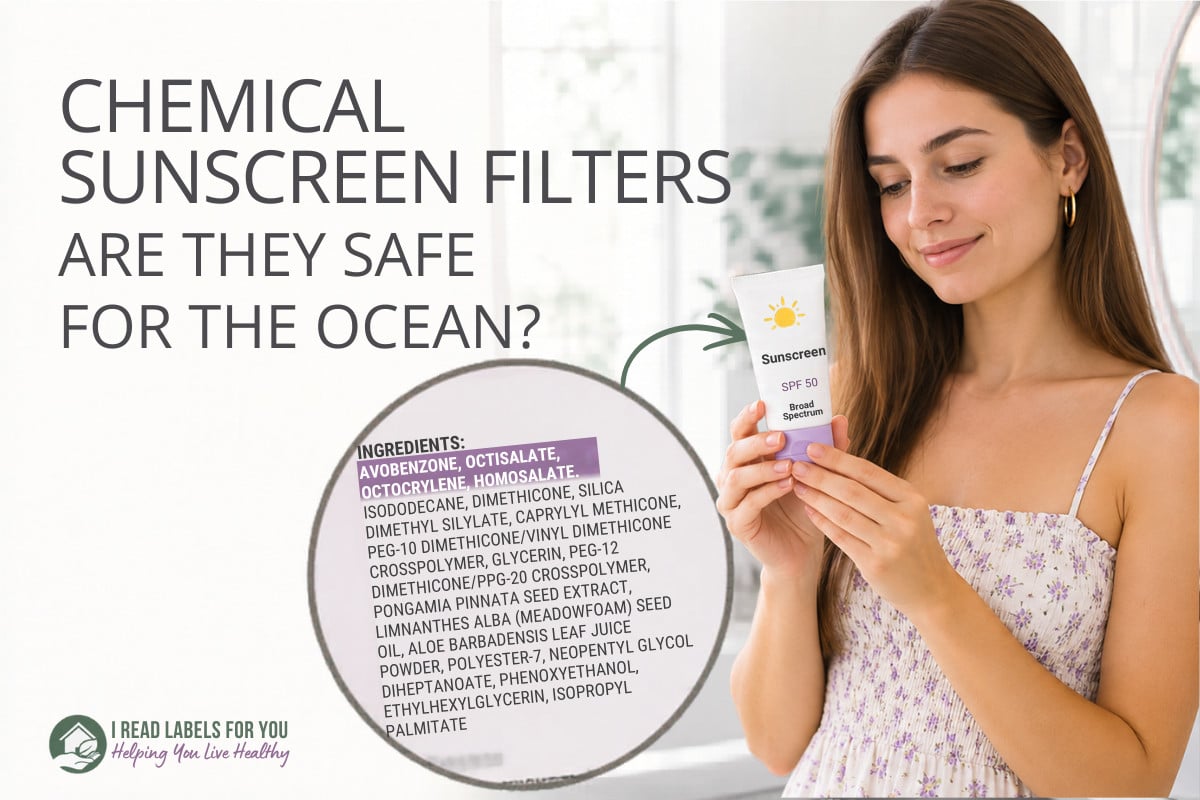
No, most chemical sunscreen filters are not safe in my view, because most of them reach your blood and raise unanswered hormone questions. These filters are man-made molecules, such as Oxybenzone and Avobenzone, that soak up ultraviolet light before it can burn your skin. Trials by the U.S. Food and Drug Administration (FDA) found all six filters reviewed here in the blood of volunteers. Since then, European regulators have cut the legal limits for three of them. My rating for most of these filters is Not A Fan.
My Rating For Each Chemical Filter
Below is the plain-language description I use for each filter in my Label Verdict. Bemotrizinol is a chemical filter too, and I cover it in a separate full review.
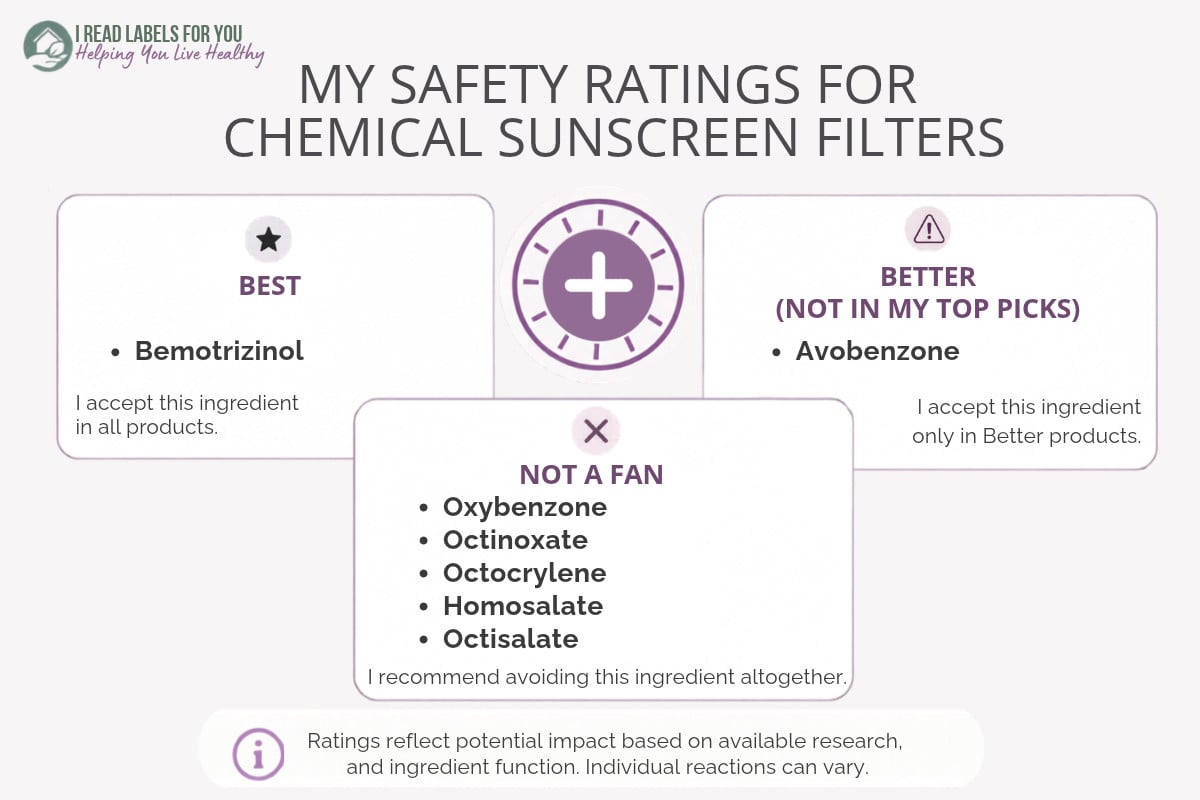
Oxybenzone – Not A Fan
A man-made chemical that absorbs ultraviolet light. It passes through skin into the bloodstream in measurable amounts and has been found in urine, breast milk and placental tissue. In 2025 a Danish review under EU chemicals law concluded it disrupts hormones in people and wildlife, and Europe had already lowered the amount allowed after the EU’s Scientific Committee on Consumer Safety judged the old level unsafe for whole-body use. It is also a known cause of allergic reactions triggered by sunlight.
Octinoxate – Not A Fan
A man-made chemical that absorbs UVB light, the rays that cause sunburn. Small amounts pass through skin into the blood and have been measured in children’s urine. The EU’s Scientific Committee on Consumer Safety calls it endocrine-active and likely an endocrine disruptor, though it judged 10% safe. In 2024 the EU’s Committee for Risk Assessment also found it very toxic to aquatic life with long-lasting effects.
Octocrylene – Not A Fan
A man-made chemical that absorbs UVB light and protects other UV filters from breaking down in sunlight. Small amounts pass through skin into the blood. It slowly breaks down into benzophenone, a carcinogen banned from EU cosmetics. France’s 2022 review under EU chemicals law flagged possible thyroid disruption in wildlife, and in 2026 the EU’s chemical risk committees backed restricting it to protect water life.
Homosalate – Not A Fan
A man-made salicylate that absorbs UVB light, the rays that cause sunburn. It passes through skin into the blood, where US Food and Drug Administration researchers measured it for up to three weeks. The EU’s Scientific Committee on Consumer Safety found it unsafe at the old 10% limit and raised concerns about possible hormone effects. In 2022 the European Commission cut the limit from 10% to 7.34% and allowed it only in face products. The full reproductive studies the European Chemicals Agency ordered in 2018 have never been done.
Octisalate – Not A Fan
A man-made UVB filter made from salicylic acid and 2-ethylhexanol, and the EU caps it at 5%. In its own rat study it prolonged pregnancy and increased embryo loss. The European Chemicals Agency ordered full reproductive studies in 2018, but the makers replaced them with lab tests, and one flagged it as a possible cause of birth defects. Germany’s Human Biomonitoring Commission warned that a single full-body application can exceed its urine guidance values.
Avobenzone – Better (Not In My Top Picks)
A man-made UVA filter that absorbs long-wave ultraviolet light, but it breaks down in sunlight unless another filter stabilizes it. US Food and Drug Administration trials measured it in the blood of everyone tested. The European Chemicals Agency found thyroid and anti-androgen activity in lab tests, though rat studies showed no hormone effects. A wildlife hormone study it ordered from the makers is not due until September 2027.
Bemotrizinol – Best
A broad-spectrum sunscreen filter that barely penetrates skin, with no hormone, allergy or genetic-damage concerns in testing.
What Regulators Say About Chemical Sunscreen Filters
Oxybenzone, Octinoxate, Octocrylene, Homosalate, Avobenzone, and Octisalate are all still allowed in European Union (EU) cosmetics, but several now face tighter rules. Europe’s cosmetics safety advisors, the Scientific Committee on Consumer Safety (SCCS), found the old Oxybenzone and Homosalate limits unsafe. The European Commission lowered both in 2022. In 2026, two committees of the European Chemicals Agency (ECHA) backed a near-ban on Octocrylene in finished cosmetics to protect water life. Meanwhile, the FDA says it needs more safety data on all six before it can call them safe and effective.
Keep reading to discover:
- which filter Canada’s government proposed in 2020 to call a danger to human health
- what the “reef safe” claim on your sunscreen actually guarantees, and what it leaves out
- which chemical filter European risk assessors rank as a likely lower concern for water life, and which mineral filter surprised them
What Are Chemical Sunscreen Filters?
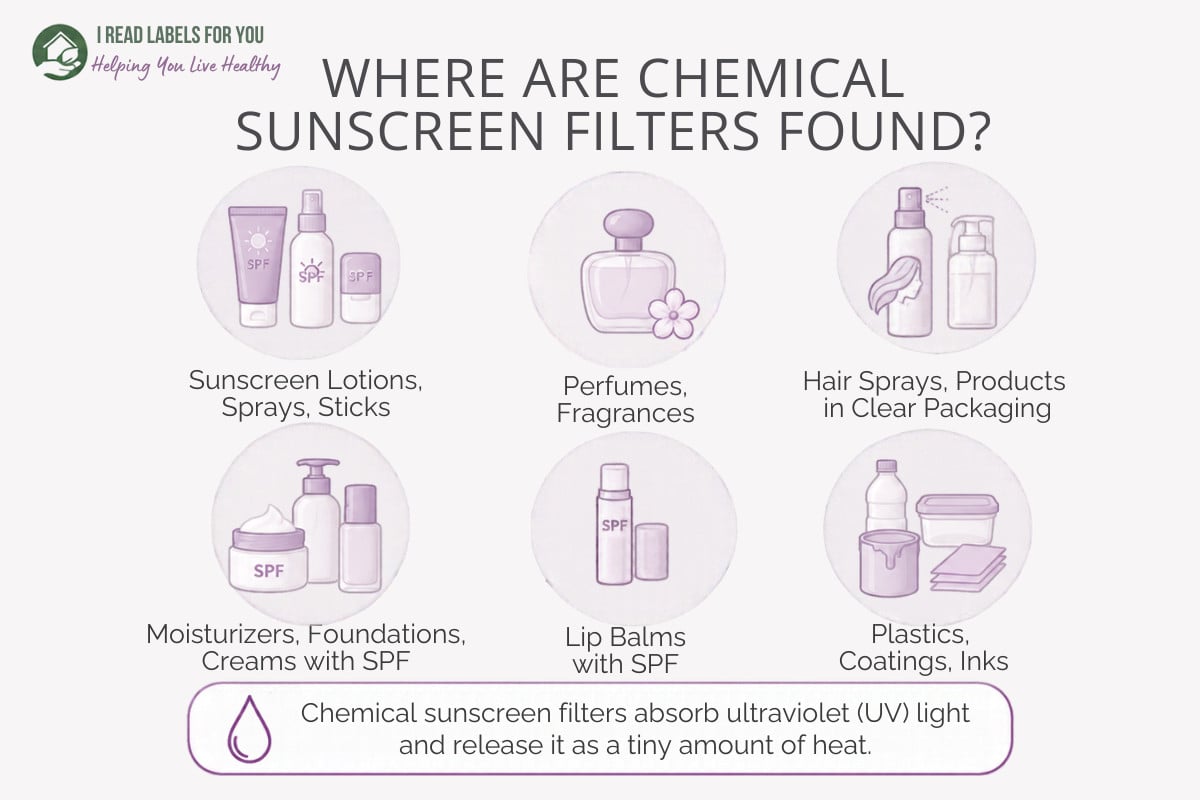
Chemical sunscreen filters, also called organic filters, are carbon-based molecules that absorb ultraviolet (UV) light and release it as a tiny amount of heat. In contrast, mineral filters such as zinc oxide are metal compounds that mostly sit on the skin’s surface.
Each chemical filter covers a different slice of the UV range. Octinoxate, Octocrylene, Homosalate, and Octisalate mainly block UVB, the rays behind sunburn. Avobenzone, on the other hand, covers long-wave UVA, which reaches deeper into skin. Oxybenzone and Bemotrizinol absorb across both ranges.
What Do Chemical Filters Do In Cosmetics?
Brands usually combine three to five filters, because no single one covers the whole UV range well. Some filters also do a second job inside the formula.
For example, the SCCS notes that Octocrylene is often paired with Avobenzone to stabilize it. Avobenzone breaks down in sunlight when it works alone. Likewise, small amounts of Oxybenzone and Octinoxate protect a product itself from light, even when it’s not a sunscreen.
You’ll find chemical filters most often in:
- sunscreen lotions, sprays, and sticks
- daily moisturizers, foundations, and CC creams with SPF
- lip balms with SPF
- perfumes and fragrances (some filters protect the scent from light)
- hair sprays and other products sold in clear packaging
- plastics, coatings, and inks (Oxybenzone)
None of these six filters is an approved food additive. However, Oxybenzone also enters the body from household dust, according to the SCCS.
How Are Chemical Filters Made?
All six are man-made in chemical plants rather than extracted from plants or minerals.
Octinoxate and Octisalate both use 2-ethylhexanol, a fatty alcohol. Octinoxate joins it to a cinnamic acid made from anise-type chemicals, while Octisalate joins it to salicylic acid. Homosalate is also a salicylic acid ester, built on a ring-shaped alcohol called trimethylcyclohexanol.
Oxybenzone production starts with benzoyl chloride, a corrosive chemical used to make many aromatic compounds. For Octocrylene and Avobenzone, none of the regulatory files I reviewed describe the manufacturing route.
Impurities matter more than the recipe here. The SCCS reports benzophenone in pure Octocrylene straight from manufacturing, and it keeps forming as products age.
Do Chemical Filters Penetrate The Skin?
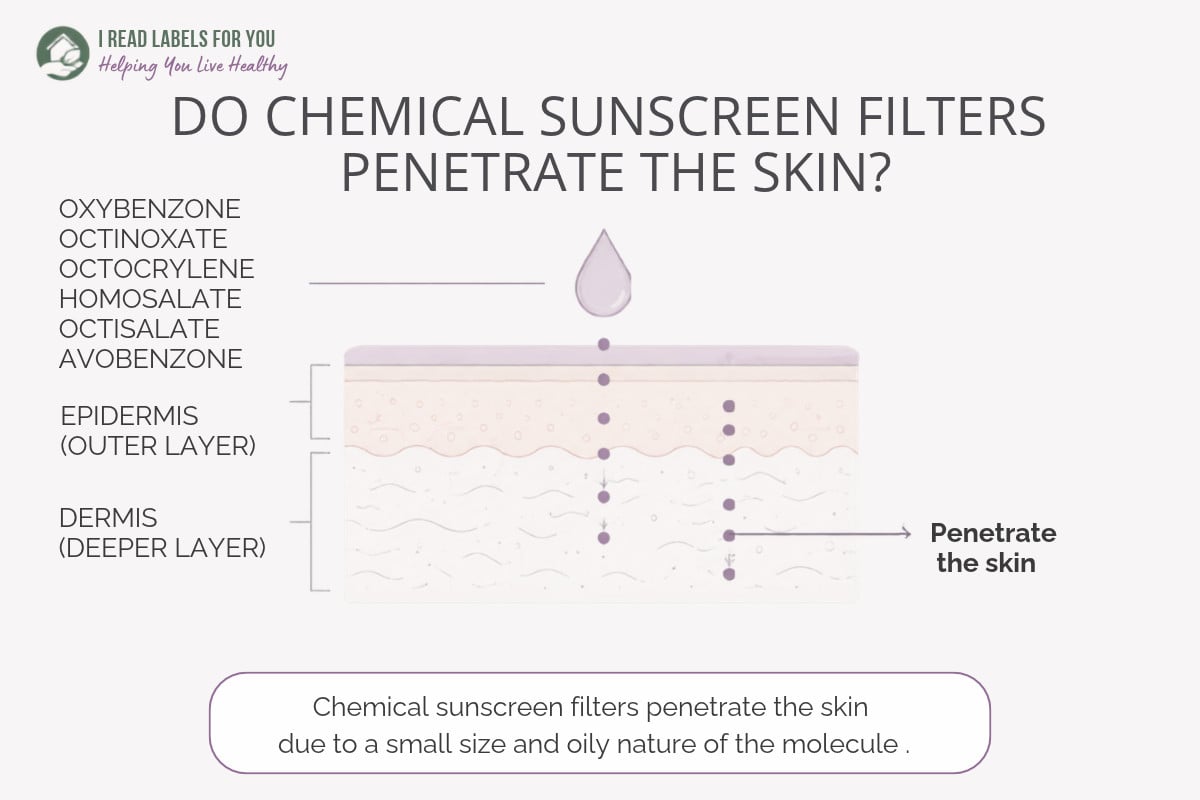
Yes, all six chemical filters in this post pass through skin and reach your bloodstream. Their small size and oily nature explain why.
Scientists measure molecules in daltons, and skin tends to block molecules heavier than about 500 daltons. These six weigh between 228 daltons (Oxybenzone) and 362 daltons (Octocrylene), well under that line.
LogP is a score that shows how much a chemical prefers oil over water. Values above 3 favor oil. Oxybenzone scores about 3.8, while Octocrylene, Homosalate and Avobenzone score above 6. Oily, small molecules dissolve easily into the fatty outer layer of skin.
Bemotrizinol shows the opposite pattern. At 628 daltons, it’s too large to slip through easily, and an early EU review rated its absorption “very low.”
Absorption varies widely between the six. In one human study cited by the SCCS, about 4% of the Oxybenzone applied was absorbed into the body. By contrast, a 1992 study found only 0.013% to 0.08% of applied Avobenzone in urine.
What The FDA Blood Studies Found
FDA scientists ran two trials in which volunteers applied sunscreen to 75% of their body four times a day. The 2019 FDA trial of 24 volunteers tested Avobenzone, Oxybenzone and Octocrylene. The 2020 FDA trial of 48 adults added Homosalate, Octinoxate and Octisalate.
Every filter crossed 0.5 nanograms per milliliter of blood, the level at which the FDA asks for extra safety studies. In 2020, all six crossed it after a single application.
Average peak blood levels in the 2020 trial looked like this:
- Oxybenzone: 180.1 to 258.1 nanograms per milliliter
- Homosalate: 13.9 to 23.1
- Octocrylene: 6.6 to 7.8
- Octinoxate: 5.2 to 7.9
- Octisalate: 4.6 to 5.8
- Avobenzone: 3.3 to 7.1
That 0.5 figure is a trigger for more testing, not a harm level. The authors also wrote that their results do not mean you should stop using sunscreen.
What Are Chemical Filters Called On Labels?
In the U.S., sunscreens list their filters under “Active Ingredients” in the Drug Facts box. Products made for Europe use the official cosmetic names instead.
- Oxybenzone, or Benzophenone-3
- Octinoxate, or Ethylhexyl Methoxycinnamate, or Octyl Methoxycinnamate
- Octocrylene
- Homosalate
- Avobenzone, or Butyl Methoxydibenzoylmethane
- Octisalate, or Ethylhexyl Salicylate, or Octyl Salicylate
- Bemotrizinol, or Bis-Ethylhexyloxyphenol Methoxyphenyl Triazine
When a filter only protects the formula, it may appear in the regular ingredient list rather than in Drug Facts.
Does The U.S. FDA Restrict Chemical Sunscreen Filters?
Yes, but only with concentration caps from 1999. In the U.S., sunscreens count as over-the-counter drugs, and the FDA’s sunscreen rule caps each filter.
Those caps are 3% for Avobenzone, 5% for Octisalate, 6% for Oxybenzone, 7.5% for Octinoxate, 10% for Octocrylene, and 15% for Homosalate.
In its 2019 proposed rule, the FDA found enough data to call only zinc oxide and titanium dioxide generally recognized as safe and effective. It placed all six filters in this post in a group that needs more data.
According to the FDA’s sunscreen questions and answers page, that 2021 proposal is still not final. On June 10, 2026, the FDA added Bemotrizinol as a new sunscreen ingredient.
I find that pace hard to accept, because the FDA asked for these data seven years ago while you kept applying the same filters. Europe works differently. Its precautionary principle lets officials tighten rules when credible warning signs appear, before harm is proven.
EU Regulations On Chemical Sunscreen Filters
All seven filters appear in Annex VI, the EU’s approved sunscreen filter list. Each entry carries its own maximum, and here’s how those caps compare with U.S. caps:
| Filter | EU maximum | U.S. maximum |
| Oxybenzone | 6% face, hand and lip products (no sprays); 2.2% body products, including sprays; 0.5% other products | 6% |
| Octinoxate | 10% | 7.5% |
| Octocrylene | 10%; 9% in propellant sprays | 10% |
| Homosalate | 7.34%, face products only (no propellant sprays) | 15% |
| Avobenzone | 5% | 3% |
| Octisalate | 5% | 5% |
| Bemotrizinol | 10% | Added June 10, 2026 |
The 2022 Cuts For Oxybenzone, Octocrylene, And Homosalate
The 2021 SCCS opinion on Oxybenzone found 6% in body sunscreens and sprays “not safe for the consumer.” People’s estimated daily dose came only 36 to 38 times below the dose that caused no harm in animals. Europe wants that cushion to be at least 100 times.
Regulation (EU) 2022/1176 then cut Oxybenzone in body products to 2.2%. The same act set the 9% spray limit for Octocrylene. It also ordered that benzophenone formed from Octocrylene “shall be kept at trace level,” without giving a number.
Homosalate got the deepest cut. The 2021 SCCS opinion on Homosalate found 10% unsafe and judged only 0.5% safe across products. After industry recalculated, the SCCS accepted 7.34% for face creams and pump sprays.
Regulation (EU) 2022/2195 wrote that limit into law. Since July 1, 2025, Homosalate body sunscreens can no longer be sold in the EU.
Europe’s 2026 Move On Octocrylene
France asked ECHA to restrict Octocrylene under REACH, the EU chemicals law. ECHA’s Committee for Risk Assessment (RAC) agreed on June 4, 2026. Its Committee for Socio-economic Analysis (SEAC) followed on September 16, 2026.
The Octocrylene restriction proposal would bar finished cosmetics with 0.001% or more, starting two years after it takes effect. In practice, that would end its use as a sunscreen filter. The European Commission still has to decide.
The reason is environmental. RAC found risks to water, sediment and soil, and it noted that Octocrylene breaks down into persistent chemicals.
U.S. And EU Disagreements On Chemical Filters
The two systems often point in opposite directions. The U.S. allows twice the European Homosalate limit, and in any product type.
Conversely, the EU allows more Avobenzone, 5% versus 3%. Europe also allowed Bemotrizinol at 10% long before the FDA added it in 2026. As a result, European sunscreens can reach high UVA protection with fewer of the older filters.
Canadian Regulations On Chemical Sunscreen Filters
None of the six filters appears on Health Canada’s Cosmetic Ingredient Hotlist, the register of banned and restricted cosmetic ingredients. Similarly, Canada’s federal toxic substances register, kept under its Environmental Protection Act, names none of these filters.
Homosalate stands out, though. In a 2020 draft screening assessment, Canada proposed that Homosalate meets the legal test for a danger to human life or health.
The draft found that people using tanning products get about 250 times less Homosalate than the dose linked to harm in lab animals. That sounds like a wide cushion. Canada still called it “potentially inadequate” because its data on both exposure and health effects had gaps. Canada has not yet finalized that conclusion.
Separately, an August 29, 2026 notice in the Canada Gazette requires companies to report their Octisalate use. The government will use the data to judge whether it’s toxic.
Can Chemical Sunscreen Filters Cause Skin Allergy And Sensitization?
Yes, some chemical sunscreen filters can cause skin allergy, especially reactions triggered by sunlight, though most people never react.
Oxybenzone is the clearest case. The SCCS calls it “the second most frequent photo contact allergen among the UV filters,” and it records one case of anaphylaxis. The American Contact Dermatitis Society (ACDS) includes it in its core patch-test series. It also named benzophenones its Allergen of the Year for 2014.
Octinoxate sits on the same ACDS core series. Still, the SCCS rates its allergy concern “negligible.”
Octocrylene reactions follow a pattern. The SCCS reports that 27% to 80% of people with sunlight allergy to ketoprofen, a pain-relief gel, also react to Octocrylene. Its opinion also notes that Octocrylene contact allergy appears more often in children.
Reactions to the other three are rare. For Homosalate, the SCCS found “only very isolated cases.” Octisalate has a handful of case reports. For Avobenzone, ECHA rejected the makers’ claim that it’s not a skin sensitizer and ordered new tests in 2022.
Are Chemical Sunscreen Filters Hormone (Endocrine) Disruptors?
Yes, Oxybenzone is an endocrine disruptor according to one EU member state, and four other chemical filters show hormone activity that regulators have not resolved.
Oxybenzone And Octinoxate
Denmark’s environmental agency evaluated Oxybenzone under REACH. Its 2025 conclusion found that it disrupts hormones in people and in wildlife. ECHA’s endocrine disruptor assessment list now records both outcomes.
Denmark has since told ECHA it plans a formal hazard classification. That step is still at the intention stage. Notably, the SCCS reached a softer view in 2021, calling the evidence “inconclusive, and at best equivocal.”
For Octinoxate, the 2025 SCCS opinion states that it has estrogen-like and weak anti-male-hormone activity in lab and animal tests. The committee calls it “likely an endocrine disruptor,” yet it still judged 10% safe.
Germany’s 2023 REACH evaluation of Octinoxate found clear thyroid activity. It did not assess human health effects.
Homosalate, Octisalate, Octocrylene, And Avobenzone
Homosalate is on the European Commission’s priority list of possible endocrine disruptors. In cells, it acts like estrogen and blocks male hormones. The SCCS wrote that its rat findings “raised some concerns.”
For Octisalate, ECHA said in 2018 that it “may have endocrine disruptor effects” and ordered a fish sexual development test. No result appears in any ECHA document I reviewed.
France’s 2022 REACH decision on Octocrylene could not dismiss its thyroid effects as a side effect of liver damage. It ordered a frog growth study by June 4, 2024, and no evaluation of the results has been published.
Avobenzone looks milder. Germany’s 2023 REACH decision found thyroid and anti-male-hormone activity in lab tests but no hormone effects in rats. After an appeal by the makers failed, the frog study it ordered is due September 17, 2027.
Are Chemical Sunscreen Filters Safe To Use While Pregnant?
Science has not settled whether chemical sunscreen filters are safe during pregnancy. These filters reach the blood, and the reproductive studies regulators ordered are still missing.
Oxybenzone travels furthest. The SCCS and CIR, the industry-funded Cosmetic Ingredient Review panel, report it in placental tissue, cord blood, amniotic fluid, and breast milk.
For Homosalate, a rat screening study cited by the SCCS found more embryo loss after implantation at 300 milligrams per kilogram of body weight daily. In 2018, ECHA ordered full reproductive studies for Homosalate and Octisalate. No results have appeared in any SCCS opinion or ECHA document I reviewed.
Germany’s Human Biomonitoring Commission set urine guidance values for Octisalate in 2023. It based them on longer pregnancies and embryo loss in rats, and it flagged pregnancy as a sensitive time.
If you’re pregnant, a zinc oxide cream or lotion is the simpler choice in my view.
Are There Any Cancer Concerns Linked To Chemical Sunscreen Filters?
No, none of the six chemical filters is classified as a carcinogen, but Octocrylene carries a carcinogenic contaminant and Oxybenzone has an unsettled rat study.
None appears on the carcinogen list of the International Agency for Research on Cancer (IARC). Likewise, California’s Proposition 65 and the federal Report on Carcinogens leave all six off.
Still, the U.S. National Toxicology Program (NTP) published a two-year feeding study of Oxybenzone in 2020. It found “equivocal evidence” of cancer in rats, based on brain, thyroid, and uterine growths.
Octocrylene is the bigger concern. Over time, it breaks down into benzophenone, which carries an EU carcinogen classification and is banned as a cosmetic ingredient. California added benzophenone to Proposition 65 in 2012. My benzophenone review explains that hazard in detail.
In 2026, RAC and SEAC cited benzophenone levels of 1.5 to 461 milligrams per kilogram in products containing Octocrylene. Meanwhile, none of the regulatory files I reviewed includes a lifetime cancer study for Octocrylene, Homosalate or Avobenzone.
Are Chemical Sunscreen Filters Bad For The Environment?
Yes, several chemical sunscreen filters harm water life, and they reach rivers and seas through swimmers and wastewater.
In 2024, RAC placed Octinoxate in the most severe hazard classes for fish, algae, and other aquatic species, both short and long term. In one zebrafish test, the highest level that left hatching unharmed was just 1 microgram per liter.
Denmark’s 2025 Oxybenzone conclusion covers wildlife too. It cites fish groups skewed toward females and fish producing an egg-yolk protein linked to estrogen.
More tests are on the way. ECHA has ordered sediment worm tests for Homosalate by November 29, 2027. It also ordered four soil and sediment tests for Octisalate by July 16, 2027.
How Europe Ranked The Alternatives To Octocrylene
As part of the Octocrylene restriction, RAC screened 29 possible replacement filters for environmental hazards only. Human health was outside its scope.
RAC placed Homosalate, Octisalate, Avobenzone, and Oxybenzone in its “equivalent or greater concern” group. It judged Octinoxate to have “insufficient data.”
In contrast, RAC rated Bemotrizinol a “likely lower concern,” alongside titanium dioxide and three other filters. Surprisingly, it put zinc oxide in the “equivalent or greater concern” group, which covers filters with known severe hazards to water life.
Hawaii’s Reef Law
Since January 1, 2021, Hawaii’s Act 104 has banned the sale of sunscreen containing Oxybenzone or Octinoxate without a prescription. The legislature found that both chemicals harm coral reefs and marine life.
The law covers only those two filters. It also excludes cosmetics made for the face.
Common Claims About Chemical Sunscreen Filters: What’s True And What’s Not
Claim: Chemical Sunscreens Soak Into Your Bloodstream
True. News coverage of the FDA trials spread this claim widely, and the data support it. All six filters crossed the FDA’s testing trigger after one day.
However, blood levels differ nearly eightyfold, from about 3 nanograms per milliliter for Avobenzone to over 250 for Oxybenzone. Being in the blood proves exposure, not harm.
Claim: Chemical Sunscreens Are Hormone Disruptors
Partly true. Oxybenzone has an EU member-state conclusion that it disrupts hormones, and the SCCS calls Octinoxate a likely endocrine disruptor.
For Homosalate, Octisalate, and Octocrylene, the signals are real but unconfirmed. Avobenzone showed no hormone effects in rats. Grouping all six together overstates the evidence for some and understates it for others.
Claim: A “Reef Safe” Label Means A Sunscreen Is Harmless To The Ocean
Mostly false. Neither the FDA nor the EU defines “reef safe,” and brands often use it to mean only that a product skips Oxybenzone and Octinoxate.
That leaves Octocrylene, Homosalate, Octisalate, and Avobenzone, which ECHA’s risk assessors rank as equal or greater concerns for water life. Even zinc oxide landed in that group.
What I Think About Chemical Sunscreen Filters, And What You Should Do
Across this group, my ratings span Not A Fan to Best, and each filter’s full description sits near the top of this post. Three facts drive them: these molecules reach your blood, several act on hormones, and the safety files still have holes.
First, Oxybenzone and Homosalate failed the SCCS test at the levels used for decades. Second, Octocrylene keeps making a banned carcinogen inside the bottle. Third, the reproductive studies ECHA ordered for Homosalate and Octisalate in 2018 remain unpublished.
Avobenzone is different. Its human uptake is low, and rats showed no hormone effects. Consequently, I accept Avobenzone in my Better products but keep it out of my Best products.
None of this means you should skip sun protection. Sunburn and skin cancer are real risks. My practical suggestions:
- choose zinc oxide creams, lotions or sticks for babies, children, and daily face use
- if you prefer a sheer chemical filter, look for Bis-Ethylhexyloxyphenol Methoxyphenyl Triazine, the label name for Bemotrizinol
- drop Oxybenzone and Homosalate first, especially in body sprays you might breathe in
- read the Drug Facts box, because “reef safe” and “clean” labels can still hide Octocrylene
- use shade, hats, and clothing to cut how much sunscreen you need
A beach day with an older sunscreen is no emergency. Over a lifetime of daily use, however, the better-studied options make more sense to me.
Frequently Asked Questions About Chemical Sunscreen Filters
Is Avobenzone Safer Than Oxybenzone?
Based on current evidence, yes. In the 2020 FDA trial, peak Avobenzone blood levels were about 35 to 50 times lower than Oxybenzone levels in the same product types.
Moreover, no regulator has found Avobenzone unsafe or cut its limit. Its open questions are thyroid activity in lab tests and possible persistence in the environment.
Is Bemotrizinol A Chemical Filter?
Yes. Bemotrizinol is a man-made organic filter, which places it in the chemical group. Its size and oiliness, however, keep it on the skin’s surface.
Indeed, it was rated “likely lower concern” for water life in the 2026 ECHA screen. You can read the details in my Bemotrizinol review.
Are Mineral Sunscreens A Better Choice?
For your skin, mostly yes. Zinc oxide does not enter skin or cause allergies, and the FDA proposes calling it safe and effective. Breathed-in particles are the main caution, which is why sprays and loose powders are a weaker fit.
For water life, zinc oxide is not perfect either, as the ECHA screen showed. My zinc oxide review covers both sides.
Why Does EWG Rate These Filters Differently?
The Environmental Working Group (EWG) gives Oxybenzone a hazard score of 4, a moderate score. It gives Octocrylene and Avobenzone scores of 1 to 2, its lowest-concern range. My view of all three is stricter.
For Oxybenzone, the score of 4 sits oddly with EWG’s own ban on it in EWG Verified products. EWG’s listed concerns also skip the SCCS finding that 6% body sunscreen is unsafe.
For Octocrylene, the low score depends on “contamination restrictions,” yet no label shows benzophenone levels. It also leaves out the 2026 RAC and SEAC support for a near-ban.
For Avobenzone, EWG’s listed concerns skip ECHA’s open thyroid questions and the frog study due in 2027. They also skip Germany’s view that it may persist and build up in wildlife. Homosalate, Octisalate, and Octinoxate score 7 to 9 with EWG, which fits my view.
Sources
EU SCCS / SCCP Opinions:
SCCS/1625/20, Opinion on Benzophenone-3 (Oxybenzone), adopted March 30 to 31, 2021; 6% not safe in body products, 2.2% safe: SCCS/1625/20
SCCS/1671/24, Opinion on Ethylhexyl Methoxycinnamate (Octinoxate), final version June 26, 2025, corrigendum March 26, 2026; endocrine-active, 10% safe: SCCS/1671/24
SCCS/1627/21, Opinion on Octocrylene, final version March 30 to 31, 2021; benzophenone impurity, ketoprofen photoallergy link: SCCS/1627/21
SCCS/1622/20, Opinion on Homosalate, final version June 24 to 25, 2021; not safe at 10%: SCCS/1622/20
SCCS/1638/21, Scientific Advice on Homosalate, December 2, 2021; 7.34% safe in face cream and pump spray: SCCS/1638/21
Avobenzone: no SCCS opinion; only the 1992 Scientific Committee on Cosmetology opinion S66. Octisalate: only the 1996 opinion S13. Bemotrizinol: SCCNFP opinion, absorption “very low” (checked): SCCS opinions portal
SCCS mandate of January 12, 2026 on combined salicylic acid exposure from salicylic esters: SCCS mandates
Cosmetic Ingredient Review (CIR) Reports:
CIR, 2021. Amended Safety Assessment of Benzophenones as Used in Cosmetics, Final Amended Report, released April 6, 2021; Oxybenzone in amniotic fluid, cord blood and breast milk: CIR 2021 benzophenones report
CIR, 2025. Amended Safety Assessment of Salicylic Acid and Salicylates as Used in Cosmetics. International Journal of Toxicology 44(Suppl 4):5S to 57S; Octisalate rat reproductive screening study: CIR reports database
No CIR report on Octinoxate, Octocrylene, Homosalate or Avobenzone; Octocrylene is on the CIR 2026 priority list (checked): CIR reports database
European Union Regulatory Databases:
Commission Regulation (EU) 2022/1176 of July 7, 2022, OJ L 183; Oxybenzone and Octocrylene limits: Regulation (EU) 2022/1176
Commission Regulation (EU) 2022/2195 of November 10, 2022, OJ L 292; Homosalate 7.34% in face products only: Regulation (EU) 2022/2195
Regulation (EC) No 1223/2009, consolidated text of May 18, 2026, Annex VI: Consolidated Cosmetics Regulation
CosIng, Benzophenone-3, Annex VI entry 4: CosIng Benzophenone-3; Ethylhexyl Methoxycinnamate, entry 12: CosIng Ethylhexyl Methoxycinnamate; Octocrylene, entry 10: CosIng Octocrylene
CosIng, Homosalate, entry 3: CosIng Homosalate; Butyl Methoxydibenzoylmethane, entry 8: CosIng Butyl Methoxydibenzoylmethane; Ethylhexyl Salicylate: CosIng Ethylhexyl Salicylate; Bis-Ethylhexyloxyphenol Methoxyphenyl Triazine: CosIng Bemotrizinol
ECHA, Substance Evaluation Conclusion for Oxybenzone, Denmark, August 6, 2025; endocrine disruptor for human health and environment: ECHA Oxybenzone substance evaluation; ED assessment list entry: ECHA ED assessment; CLH intention: ECHA registry of CLH intentions
ECHA RAC, Opinion on harmonized classification of Octinoxate, adopted November 28, 2024; Aquatic Acute 1 and Aquatic Chronic 1: RAC Octinoxate opinion; Germany substance evaluation, October 2023: ECHA Octinoxate substance evaluation
The ECHA RAC and SEAC, Opinion on an Annex XV dossier proposing restrictions on octocrilene, RAC June 4, 2026, SEAC September 16, 2026; Table 10 alternatives: ECHA Octocrylene restriction
ECHA, Decision on substance evaluation, octocrilene, France, June 28, 2022: ECHA Octocrylene substance evaluation; benzophenone harmonized classification Carc. 1B: ECHA benzophenone classification
The ECHA Board of Appeal, Case A-009-2018, Homosalate, August 18, 2020; studies due February 25, 2024: Board of Appeal A-009-2018; Homosalate regulatory activities, sediment test due November 29, 2027: ECHA Homosalate activities
ECHA, Decision on substance evaluation, Avobenzone, Germany, August 10, 2023: ECHA Avobenzone substance evaluation; Board of Appeal Case A-012-2023, March 11, 2025: Board of Appeal A-012-2023
The ECHA Board of Appeal, Case A-010-2018, Octisalate, August 18, 2020: Board of Appeal A-010-2018; Octisalate regulatory activities, soil and sediment tests due July 16, 2027: ECHA Octisalate activities
ECHA CHEM, Bemotrizinol; no harmonized classification: ECHA Bemotrizinol
European Commission, endocrine disruptors in cosmetics, priority list including Oxybenzone, Octocrylene and Homosalate: European Commission endocrine disruptor page
ECHA Candidate List of Substances of Very High Concern; none of the seven filters listed: ECHA Candidate List
Other Regulators:
U.S. FDA, Questions and Answers on regulatory actions on OTC sunscreen, updated September 10, 2026; six filters need more data, Bemotrizinol added June 10, 2026: FDA sunscreen Q&A
21 CFR 352.10, sunscreen active ingredients and maximum concentrations: 21 CFR 352.10; FDA proposed rule, February 26, 2019: Federal Register 2019 proposed rule
U.S. FDA, Prohibited and Restricted Ingredients in Cosmetics; none of the filters listed: FDA prohibited and restricted ingredients
Hawaii Session Laws 2018, Act 104 (S.B. No. 2571), approved July 3, 2018; Oxybenzone and Octinoxate sunscreen sales ban from January 1, 2021: Hawaii Act 104
German Human Biomonitoring Commission, Substance monograph for Octisalate, HBM values for urine metabolites, Bundesgesundheitsblatt 2023;66:580 to 590: HBM Commission Octisalate monograph
Danish Environmental Protection Agency, 2015. Survey and health assessment of UV filters, Survey of chemical substances in consumer products No. 142: Danish EPA UV filter survey
Health Canada, Cosmetic Ingredient Hotlist; none of the six listed: Health Canada Hotlist
Environment and Climate Change Canada, CEPA Schedule 1; none listed: CEPA Schedule 1; Draft Screening Assessment, Salicylates Group, March 14, 2020: Canada salicylates draft assessment
Canada Gazette, Part I, Vol. 160, No. 35, August 29, 2026, notice under section 71 of CEPA including Octisalate: Canada Gazette notice
IARC List of Classifications; none of the six listed: IARC classifications
NTP, Report on Carcinogens, Fifteenth Edition; none listed: NTP Report on Carcinogens; NTP Technical Report TR-597 on Oxybenzone, 2020: NTP TR-597
California Proposition 65 list; none of the six listed, benzophenone listed in 2012: Proposition 65 list
PubChem Records (Chemistry, Identifiers, Skin Penetration, Hazard Codes):
Oxybenzone, CID 4632: PubChem CID 4632; Octinoxate, CID 5355130: PubChem CID 5355130; Octocrylene, CID 22571: PubChem CID 22571
Homosalate, CID 8362: PubChem CID 8362; Avobenzone, CID 51040: PubChem CID 51040; Octisalate, CID 8364: PubChem CID 8364; Bemotrizinol, CID 135487856: PubChem CID 135487856
Peer-Reviewed Studies:
Matta MK, Zusterzeel R, Pilli NR, et al., 2019. Effect of Sunscreen Application Under Maximal Use Conditions on Plasma Concentration of Sunscreen Active Ingredients: A Randomized Clinical Trial. JAMA 321(21):2082 to 2091. PMID 31058986: PubMed 31058986
Matta MK, Florian J, Zusterzeel R, et al., 2020. Effect of Sunscreen Application on Plasma Concentration of Sunscreen Active Ingredients: A Randomized Clinical Trial. JAMA 323(3):256 to 267. PMID 31961417: PubMed 31961417; full text: PMC6990686
Natural Cosmetic Standards:
COSMOS-standard approved raw materials; none of the seven chemical filters found: COSMOS-standard approved raw materials
NATRUE certified and approved raw materials; none of the seven chemical filters found: NATRUE certified raw materials
Skin Allergy Resource:
American Contact Dermatitis Society (ACDS), Helpful References, including the Core Allergen Series 2020; Oxybenzone (55) and Octinoxate (79) listed, the other four not listed; benzophenones Allergen of the Year 2014: ACDS Helpful References
Advocacy groups:
Environmental Working Group (EWG) Skin Deep, Oxybenzone, score 4: EWG Oxybenzone; Octinoxate, score 7: EWG Octinoxate; Octocrylene, score 1 to 2: EWG Octocrylene
EWG Skin Deep, Homosalate, score 9: EWG Homosalate; Avobenzone, score 1 to 2: EWG Avobenzone; Octisalate, score 8: EWG Octisalate
Last verified: 11-15-2026
Download The Free Guide!
5 Powerful Steps To A Non-Toxic Home
Join our informed consumer community and get our free guide the “5 Powerful Steps To A Non-Toxic Home”.

Before commenting, please read our Comment Policy.