
Is Benzophenone Safe? A Simple Answer You Can Trust
 Written by Irina Webb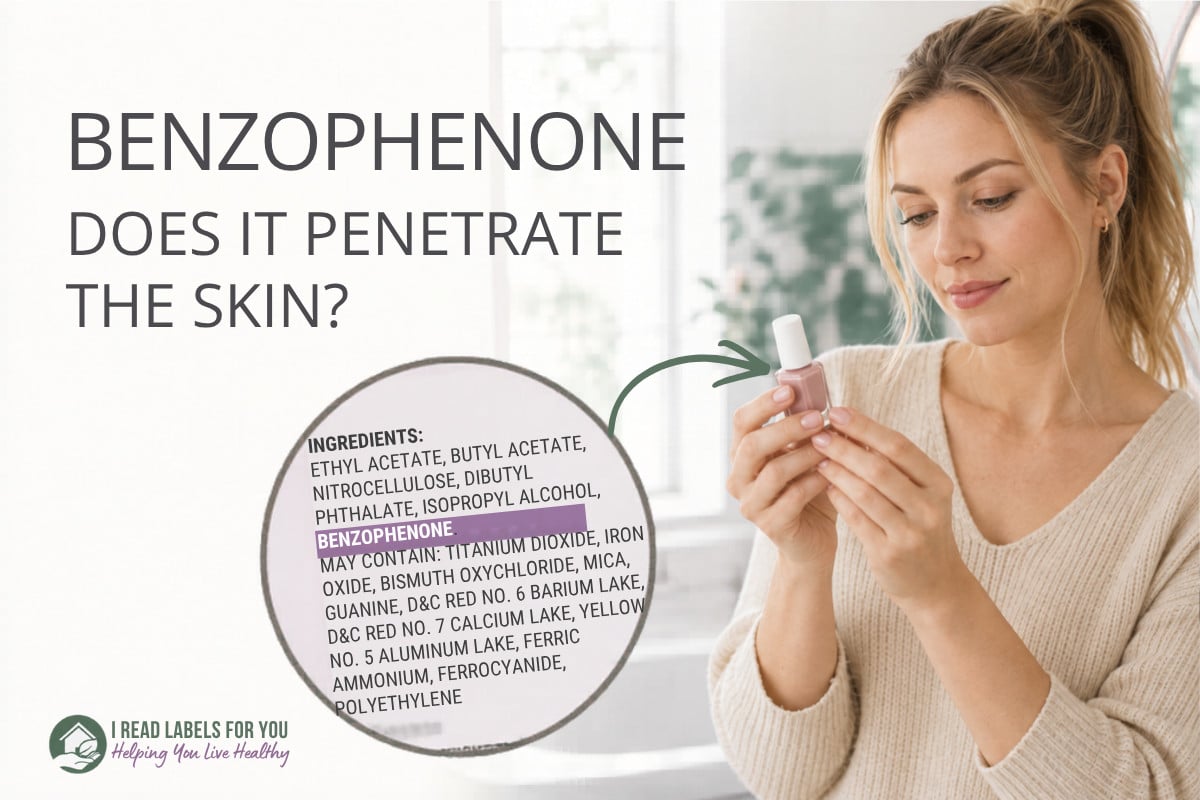
No, I would keep Benzophenone out of every product you own. It’s a small petroleum-based chemical used in fragrance, plastics and printing inks. Europe removed it from cosmetics entirely, and its cancer classification is the reason. I rate it Not A Fan.
Benzophenone is prohibited in European cosmetics, which is the strictest status the EU has. Canada restricts it, and California names it on its state cancer list. The United States allows it in cosmetics with no limit at all.
Below you will find why a banned ingredient still reaches your skin through sunscreen. You will also see why one popular rating site scores it low while barring it from its own seal. Finally, you will learn how to tell it apart from the sunscreen filters that share its name.
What Is Benzophenone?
Benzophenone is a simple synthetic chemical made of two rings joined by a carbon and an oxygen. Its formula is C13H10O and it weighs 182.22, which makes it a small molecule. At room temperature, it’s a white crystalline solid with a faint rose-like smell.
The name causes more confusion than the chemical does. Benzophenone-1, Benzophenone-3, and Benzophenone-4 are different substances with an added hydroxyl group. They are sunscreen filters and light stabilizers, and they’re legal.
This page is about the parent chemical only, CAS number 119-61-9. Treat the numbered versions as relatives rather than the same thing.
What Does Benzophenone Do In Cosmetics?
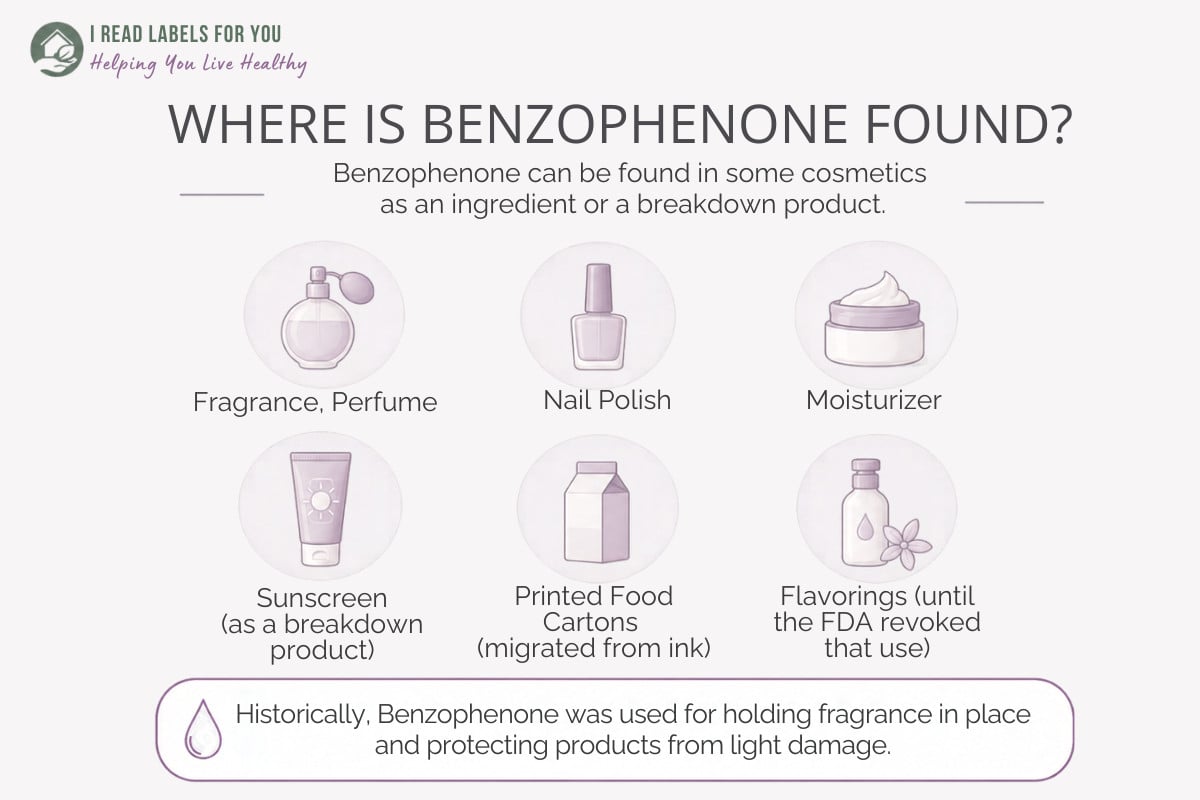
Officially, Benzophenone does almost nothing in cosmetics anymore. Its historical jobs were holding fragrance in place and protecting products from light damage.
The industrial roles of Benzophenone are much larger than its cosmetic ones. The national testing program lists it as a photoinitiator, a fragrance enhancer, an ultraviolet curing agent. It’s also used occasionally as a flavor ingredient.
Additionally, Benzophenone appears in the manufacture of insecticides, agricultural chemicals, and hypnotics, antihistamines, and other pharmaceuticals. On top of that, it’s used as an additive in plastics, coatings, and adhesive formulations.
You may encounter Benzophenone in:
- fragrance and perfume
- nail polish
- moisturizer
- sunscreen (as a breakdown product rather than an ingredient)
- printed food cartons (through migration from the ink)
- flavorings (until the FDA revoked that use)
How Is Benzophenone Made?
The industry review names one route for the Benzophenone family, namely: the Friedel-Crafts reaction. The reaction joins two benzene rings using an aluminum chloride catalyst. Both starting materials come from petroleum. Other than that, little else exists in the published literature.
Does Benzophenone Penetrate The Skin?
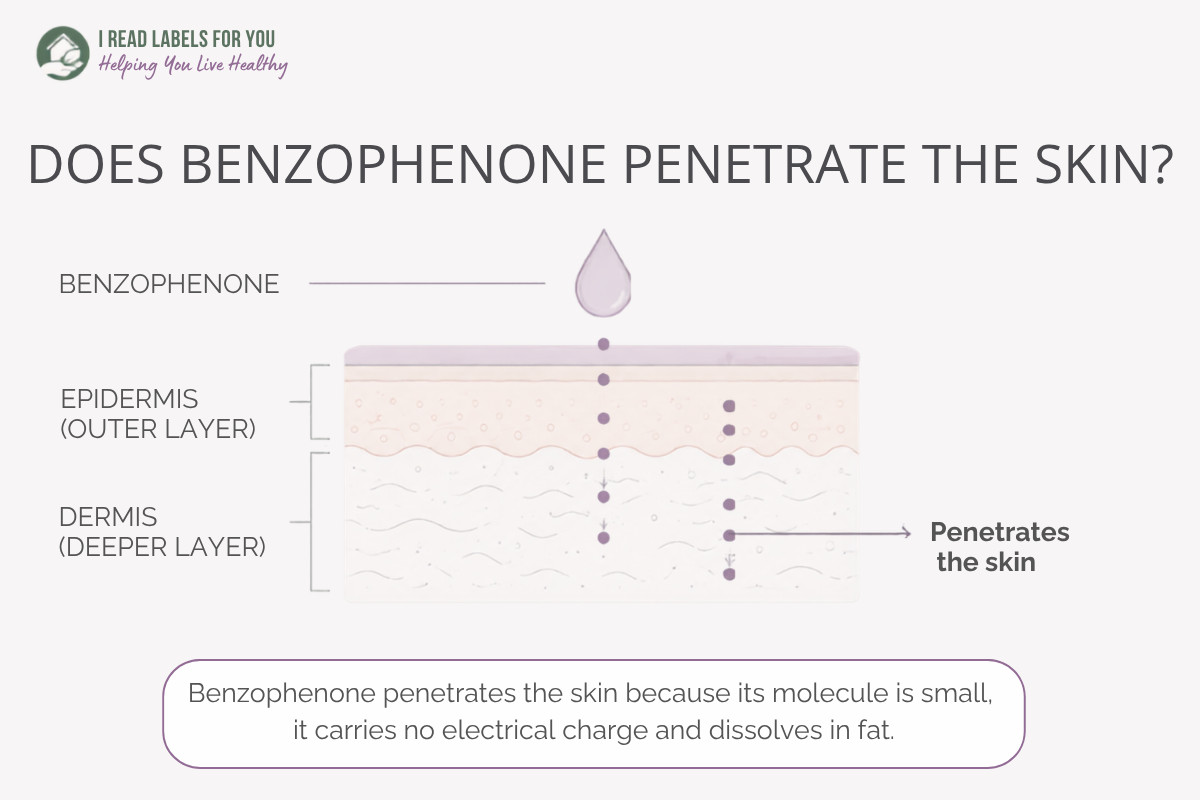
Yes, Benzophenone penetrates the skin, and chemistry leaves little room for doubt. A molecule generally crosses skin when it weighs under about 500 daltons, and this one weighs 182.
Size is not the only factor, though it is the one that matters most here. Benzophenone carries no electrical charge and dissolves in fat, so nothing holds it at the surface.
No measured absorption figure exists in the Benzophenone safety files I reviewed. For a chemical classified as a presumed carcinogen, though, that gap matters less than usual. Europe set no acceptable level; it removed the ingredient instead.
What Is Benzophenone Called On Labels?
You will rarely see Benzophenone declared, because it’s banned in Europe and little used on purpose elsewhere. When it does appear, look for these:
- Benzophenone
- Diphenylmethanone
- Diphenyl Ketone
- Benzoylbenzene
- Phenyl Ketone
- Methanone, Diphenyl-
Two names are not this chemical, and mixing them up is the most common error. Benzophenone-3 is oxybenzone, and Benzophenone-4 is sulisobenzone. Both are permitted sunscreen filters with separate safety files.
Does The U.S. FDA Restrict Benzophenone In Food And Cosmetics?
No, the United States Food and Drug Administration (FDA) sets no cosmetic limit on Benzophenone. The ingredient appears nowhere on the agency list of banned or limited cosmetic ingredients. A company may therefore use it at any strength.
Benzophenone in food is a different story, and the story is revealing. In 2018, the FDA revoked its approval as a synthetic flavoring and as a plasticizer in food-contact rubber.
Read the agency’s own explanation carefully, because it cuts both ways. It acted “despite FDA’s scientific analysis and determination that these substances do not pose a risk to public health”.
What forced the decision was a law rather than a risk judgment. Petitioners provided data demonstrating that these additives induce cancer in laboratory animals. The FDA therefore cannot as a matter of law maintain the listing.
This is my standing concern with American oversight in one example. The agency conceded the animal cancer data, then said the exposure was fine anyway. Europe starts from the opposite instinct and acts while the science is still being argued.
EU Regulations On Benzophenone
Europe prohibits Benzophenone in cosmetics outright. It sits at entry 1703 of Annex II, the list of banned substances, applicable from November 17, 2023.
Annex II entries carry no concentration limit and no warning label option. There is nothing to measure, because nothing is permitted.
The ban followed a hazard classification rather than a safety opinion. The EU hazard table lists Benzophenone under Index number 606-153-00-5 as Carc. 1B with hazard statement H350, the code meaning it may cause cancer, signal word Danger.
Category 1B means presumed to cause cancer in people, based on animal evidence. Under European cosmetic law that classification removes an ingredient automatically.
U.S. And EU Disagreements On Benzophenone
The two systems looked at the same animal studies and landed in opposite places. Europe treated the findings as a hazard and banned Benzophenone from cosmetics.
Conversely, the United States treated Benzophenone findings as an exposure question and cleared cosmetics. Food came off the list only because a 1958 clause required it. One regulator asks what a substance can do; the other asks how much you get.
Canadian Regulations On Benzophenone
Canada restricts Benzophenone, and it acted recently. It was added to the restricted list of the Cosmetic Ingredient Hotlist in May 2024.
The stated reason is not cancer, which makes Canada worth reading separately. Health Canada added Benzophenone “due to adverse maternal effects such as decreased body weight.”
One Benzophenone relative was treated more harshly in the same update. Michler’s ketone, a related Benzophenone used in dyes, was added as a prohibition rather than a restriction.
Can Benzophenone Cause Skin Allergy And Sensitization?
No, Benzophenone is not a recognized contact allergen, and that is one of the few clean answers here.
The Core Allergen Series kept by the American Contact Dermatitis Society leaves it out entirely. Two of its relatives are on that panel instead, listed as Benzophenone-3 and Benzophenone-4.
The benzophenone family did take the society’s Allergen of the Year title in 2014. That award went to the ultraviolet absorbers in sunscreen, not to the parent chemical on this page.
Is Benzophenone A Hormone (Endocrine) Disruptor?
Probably weakly, and the honest answer is that Benzophenone’s relatives are better studied than it is.
European regulators found clear hormone activity in two numbered versions. For Benzophenone-1, the committee reported “clear demonstration of estrogenic activity and weak anti-androgenic activity both in vitro and in vivo.”
For Benzophenone-2, it found “a clear demonstration of estrogenic activity both in vitro and in vivo.” Neither finding is about the parent chemical, and no committee has assessed the parent for hormone effects.
Canada’s restriction offers the nearest signal. It rests on reproductive harm in animals rather than on cancer, which points the same direction without proving it.
Is Benzophenone Safe To Use While Pregnant?
No, I would avoid Benzophenone during pregnancy, and Canada’s reasoning explains why.
The Canadian restriction was made on the basis of adverse maternal effects such as decreased body weight in animal testing. That’s a pregnancy finding, not a general toxicity finding.
Add the cancer classification and there’s no upside to weigh against it. This chemical does nothing for your skin that another ingredient cannot do better.
Exposure here usually comes through sunscreen rather than a labeled ingredient. Check which filters your sunscreen uses. For choices you make daily, you should consult with your medical provider.
Are There Any Cancer Concerns Linked To Benzophenone?
Yes, and this is the finding that drives every regulation on this page.
The international cancer agency classifies Benzophenone in Group 2B, possibly carcinogenic to humans. The EU went further and classified it Carc. 1B, presumed carcinogenic, which is one step stronger.
California lists it too. The Proposition 65 entry reads “Benzophenone, cancer, CAS 119-61-9,” dated June 22, 2012.
What The Animal Studies Actually Found
All of this traces to one government feeding study, and its findings are more modest than the classifications suggest. Rats and mice ate benzophenone in their feed for two years.
The researchers graded each result rather than declaring a flat finding. There was “some” evidence of carcinogenic activity in male rats, based on increased incidences of renal tubule adenoma.
Male mice showed increased incidences of hepatocellular neoplasms, primarily adenoma, also graded as some evidence. In female rats, the grade was “equivocal” evidence of carcinogenic activity.
One result runs the other way and belongs in any fair summary. Breast tumors in female rats went down as the dose went up. Rates fell from 27 of 50 in controls to 7 of 50.
Benzophenone also failed to damage DNA in every test. It was not mutagenic in Salmonella typhimurium strains TA98, TA100, TA1535, or TA1537. Two micronucleus tests in mice were also negative.
Is Benzophenone Bad For The Environment?
Somewhat, though it’s not the main reason to avoid it.
The chemical is not on Canada’s national list of toxic substances, and the American environmental agency has never assessed it. It also carries no environmental hazard classification in the EU hazard table.
Its likeliest route into water is the one that matters for people too. Sunscreen rinses off swimmers, and Benzophenone forms inside a widely used sunscreen filter.
Common Claims About Benzophenone: What’s True And What’s Not
Claim: Benzophenone And Oxybenzone Are The Same Thing
False, and this is the confusion worth clearing first. Oxybenzone is Benzophenone-3, a different molecule with an added hydroxyl and methoxy group.
The practical difference is regulatory. Oxybenzone is a permitted sunscreen filter with its own safety file, while the parent chemical Benzophenone is banned in Europe.
Claim: Benzophenone Is Banned, So You Are Not Exposed
False, and this is the most important thing on the page. The EU’s own scientific committee documented the loophole in its opinion on octocrylene, a common sunscreen filter.
The committee wrote that “Octocrylene generates benzophenone (CAS 119-61-9, EC 204-3376) through a retro-aldol condensation.” It also found benzophenone present in the pure manufactured filter before any ageing.
Its verdict on that is unambiguous. Verbatim: “Benzophenone is a hazardous impurity and degradation product of Octocrylene”. It “should be monitored and kept at trace levels.”
In other words, Europe bans the chemical as an ingredient while permitting a UV filter that makes it. That’s why an old sunscreen is the realistic exposure, not an ingredient list.
Claim: Benzophenone Damages Your DNA
False, and overstating this weakens the real case. Every genetic test on Benzophenone in the two-year government study came back negative.
The cancer concern is about organ-specific tumors at sustained doses, not about mutation. Saying otherwise hands critics an easy correction.
What I Think About Benzophenone — And What You Should Do
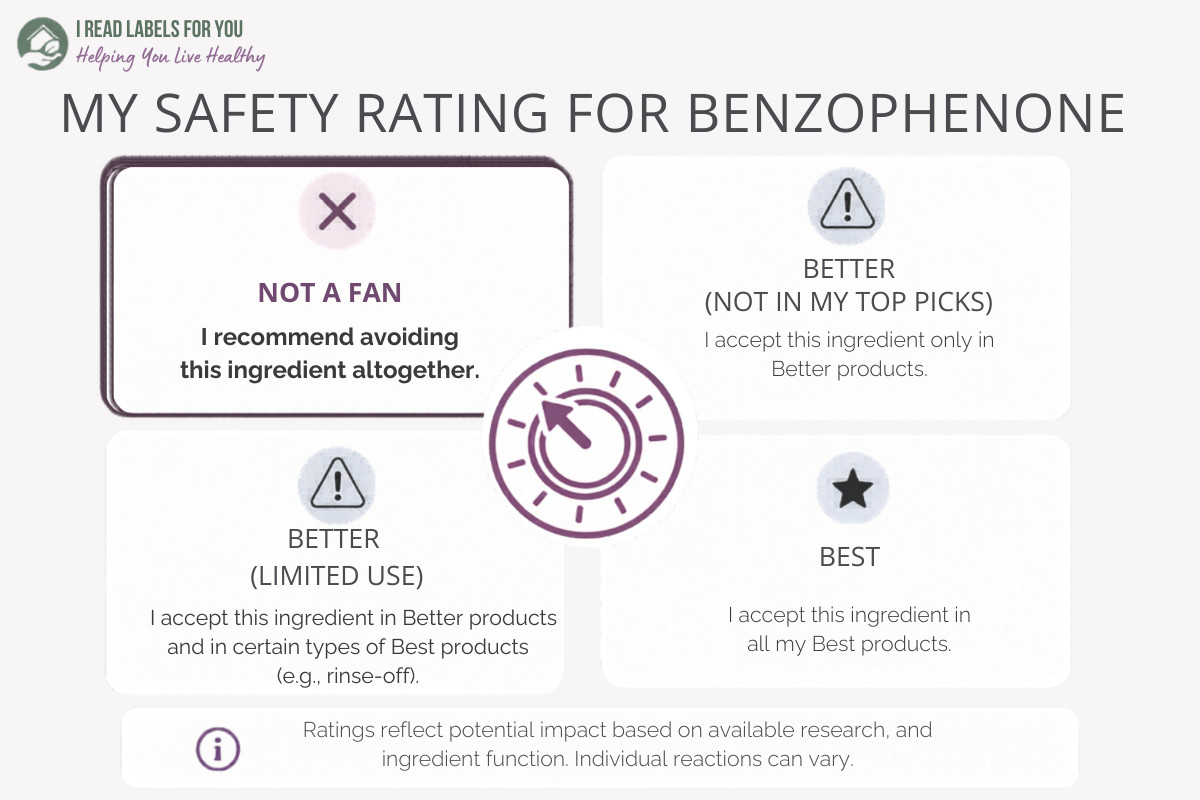
I rate Benzophenone Not A Fan. Europe banned it. The EU hazard table calls it a presumed human carcinogen. Canada restricts it for harm to pregnancy, and California lists it for cancer.
What’s missing here is the usual counterweight. On most ingredients, an industry panel has declared the substance safe, and I must weigh that against the regulators. For this chemical, no such review exists, because nobody adds it to cosmetics on purpose.
I also want to be fair about the underlying data. The animal evidence is one feeding study graded “some” and “equivocal” evidence, and the chemical does not damage DNA. Ultimately, my verdict rests on a settled regulatory position, not on dramatic findings.
What This Means For Your Sunscreen
The practical risk is not an ingredient list, it’s a jar that has been open too long. Benzophenone forms inside octocrylene over time, and heat speeds that up.
What should you do? Check your sunscreen for octocrylene, replace it every season, and never leave it in a hot car.
More broadly, I recommend mineral sunscreen over chemical sunscreen, for three reasons. The first is chemistry. Zinc oxide and titanium dioxide sit on skin and break down into nothing new.
The second reason is hormone activity, and Europe has documented it inside the Benzophenone family. Its safety committee found “clear demonstration of estrogenic activity” for Benzophenone-1. It reported the same finding for Benzophenone-2.
The third reason is water. Chemical filters wash off swimmers and enter the sea, and no cosmetic regulator weighs that. Europe says so outright: “The SCCS mandate does not address environmental aspects.”
Fragrance is the other likely route into your routine, so treat unscented as the safer default. A final note on names. Benzophenone-3 and Benzophenone-4 are different molecules, with their own files and their own concerns.
Frequently Asked Questions About Benzophenone
Is Benzophenone Harmful To Humans?
The honest answer is that no human study shows harm, and regulators acted on animal data instead. Two-year feeding studies produced kidney tumors in male rats and liver tumors in male mice.
Europe treated that as sufficient to presume human risk and banned Benzophenone. No study has measured what ordinary exposure does to people.
What Is Another Name For Benzophenone?
Diphenylmethanone is the systematic name, and diphenyl ketone is the most common alternative. You may also see benzoylbenzene, phenyl ketone or methanone, diphenyl-.
Benzophenone’s identifying number is CAS 119-61-9. If a label or database shows a different number, you are looking at a different chemical.
Is Benzophenone-4 A Carcinogen?
No, Benzophenone-4 has no cancer classification anywhere. It is sulisobenzone, a permitted sunscreen filter, and European regulators reviewed it separately.
The cancer classifications on this page belong to the parent chemical, Benzophenone, alone. Do not transfer them to the numbered versions.
Is Benzophenone Safe For Babies And Children?
No, and there’s no reason to accept any exposure in this age group. An ingredient banned in Europe as a presumed carcinogen has no place in a child’s routine. For children, the sunscreen question matters. Pick a fresh mineral sunscreen rather than an aged octocrylene one.
Why Does EWG Rate Benzophenone Differently?
EWG actually rates it two ways at once, and the two disagree with each other. The EWG Skin Deep database gives the chemical a 3 out of 10, in the low hazard band. Data quality is marked good.
On the other hand, the EWG certification program bars the ingredient completely. The EWG Verified criteria read: “Unacceptable: EWG VERIFIED products cannot contain this ingredient.”
Timing is the likeliest explanation. The cancer reference behind that score dates from 2012. Europe classified the chemical in 2022 and banned it in 2023.
EWG says its Verified criteria are “updated annually,” while database scores are not refreshed on the same cycle. When two parts of one rating system disagree, follow the stricter one and the newer evidence.
Sources
EU SCCS / SCCP Opinions:
No SCCS or SCCP opinion on Benzophenone itself (checked); the EU acted through hazard classification and Annex II instead: SCCS opinions portal
SCCS/1627/21, Opinion on Octocrylene, adopted March 30 to 31, 2021; source of the retro-aldol degradation finding and of the statement that benzophenone is a hazardous impurity of octocrylene: SCCS Opinion on Octocrylene
SCCS/1672/24, Opinion on Benzophenone-1, adopted March 27, 2025; a derivative, not this ingredient: SCCS Opinion on Benzophenone-1
SCCS/1679/25, Scientific Advice on Benzophenone-2 and Benzophenone-5, adopted June 26, 2025; also derivatives: SCCS advice on Benzophenone-2 and Benzophenone-5
Cosmetic Ingredient Review (CIR) Reports:
Johnson W Jr, Zhu J, et al. (2021), Amended Safety Assessment of Benzophenones as Used in Cosmetics, Final Amended Report, released April 6, 2021; covers Benzophenone-1 to -12 and NOT this ingredient: CIR reports
Final Report on the Safety Assessment of Benzophenones-1, -3, -4, -5, -9 and -11 (1983), Journal of the American College of Toxicology, 2(5); also derivatives only: CIR reports
European Union Regulatory Databases:
Regulation (EC) No 1223/2009, Annex II entry 1703, Benzophenone, CAS 119-61-9, EC 204-337-6, prohibited, applicable 17/11/2023: CosIng annexes
CLP Regulation Annex VI harmonized classification, Index No 606-153-00-5, introduced by Regulation (EU) 2022/692: Carc. 1B, H350, GHS08, signal word Danger, applicable November 23, 2023: EUR-Lex Regulation (EU) 2022/692
ECHA substance record 100.003.943, benzophenone; REACH registered, no Candidate List entry: ECHA CHEM
Other Regulators:
International Agency for Research on Cancer, Monographs Volume 101 (2012); benzophenone classified Group 2B, possibly carcinogenic to humans: IARC Volume 101
U.S. NTP Technical Report TR-533, Toxicology and Carcinogenesis Studies of Benzophenone in F344/N Rats and B6C3F1 Mice (Feed Studies), February 2006: NTP TR-533
U.S. NTP, 15th Report on Carcinogens; benzophenone is not listed, confirmed by its absence from the report’s CAS number index: NTP Report on Carcinogens
California OEHHA, Proposition 65 list; entry reads Benzophenone, cancer, 119-61-9, June 22, 2012: OEHHA Proposition 65 list
U.S. FDA, Food Additive Regulations; Synthetic Flavoring Agents and Adjuvants, 83 FR 50490, October 9, 2018; revoked the flavoring and food-contact plasticizer listings: Federal Register 83 FR 50490
U.S. FDA, Prohibited and Restricted Ingredients in Cosmetics; benzophenone is not named, so no US cosmetic restriction applies: FDA prohibited and restricted ingredients
Health Canada, Changes to the Cosmetic Ingredient Hotlist, May 2024; benzophenone added to the restricted list for adverse maternal effects: Changes to the Hotlist
Environment Canada, CEPA Schedule 1 List of Toxic Substances; benzophenone not listed: CEPA Schedule 1
U.S. EPA, Integrated Risk Information System; no assessment for benzophenone: EPA IRIS
PubChem Records (Chemistry, Identifiers, Skin Penetration, Hazard Codes):
PubChem CID 3102, benzophenone, CAS 119-61-9, formula C13H10O, molecular weight 182.22: PubChem CID 3102
Peer-Reviewed Studies:
Downs CA, DiNardo JC, Stien D, Rodrigues MS, Lebaron P (2021), Benzophenone accumulates over time from the degradation of octocrylene in commercial sunscreen products, Chemical Research in Toxicology, 34(4): 1046-1054, PMID 33682414: PubMed 33682414
Foubert K, Dendooven E, Theunis M, Naessens T, Ivanova B, Pieters L, Gilissen L, Huygens S, De Borggraeve W, Lambert J, Aerts O (2021), The presence of benzophenone in sunscreens and cosmetics containing the organic UV filter octocrylene, Contact Dermatitis, 85(1): 69-77, PMID 33763894: PubMed 33763894
Natural Cosmetic Standards:
COSMOS-standard approved raw materials; benzophenone not listed: COSMOS-standard approved raw materials
NATRUE certified and approved raw materials; benzophenone not listed: NATRUE certified world
Skin Allergy Resource:
American Contact Dermatitis Society (ACDS), Helpful References including the Core Allergen Series 2020; benzophenone is not among the screening allergens, while benzophenone-3 and benzophenone-4 are: ACDS Helpful References
Advocacy groups:
Environmental Working Group (EWG) Skin Deep entry for Benzophenone; hazard score 3 out of 10, data availability good, with EWG VERIFIED status listed as unacceptable: EWG Skin Deep Benzophenone
Last verified: 09-20-2026

Download The Free Guide!
5 Powerful Steps To A Non-Toxic Home
Join our informed consumer community and get our free guide the “5 Powerful Steps To A Non-Toxic Home”.

Before commenting, please read our Comment Policy.