
Is Benzalkonium Chloride Safe? A Simple Answer You Can Trust
 Written by Irina Webb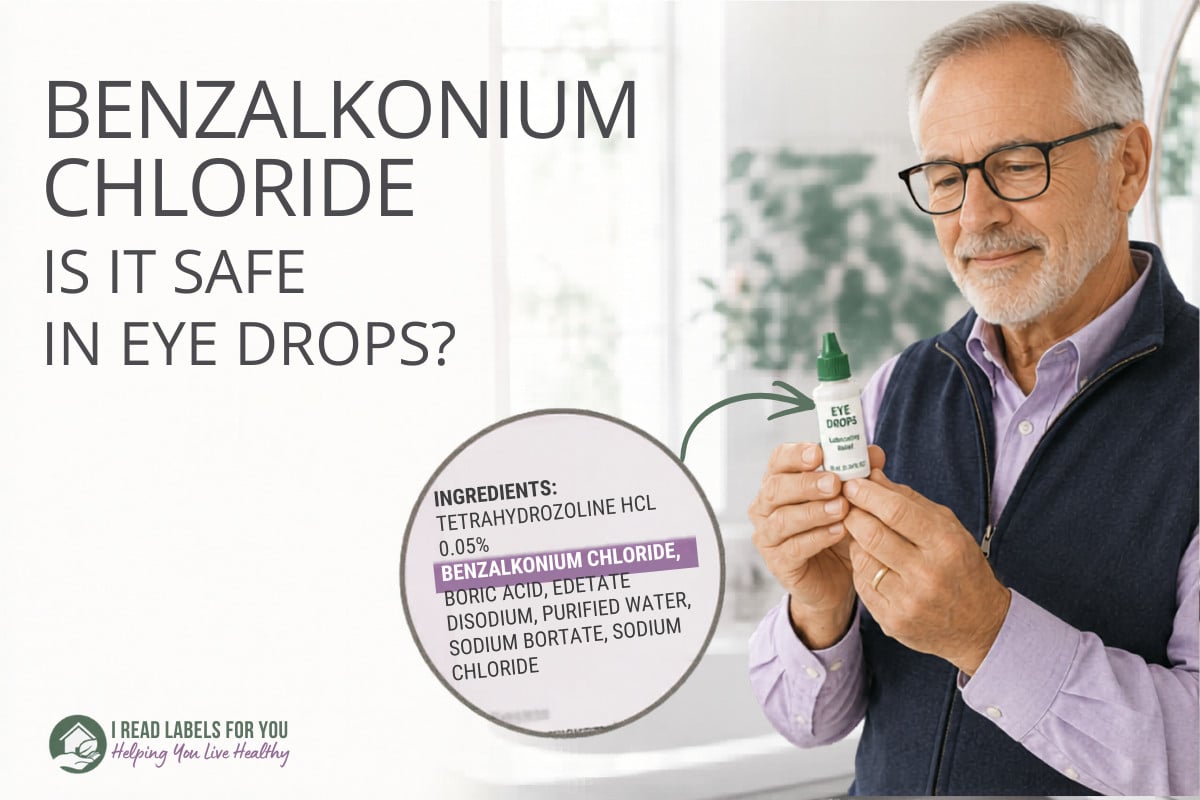
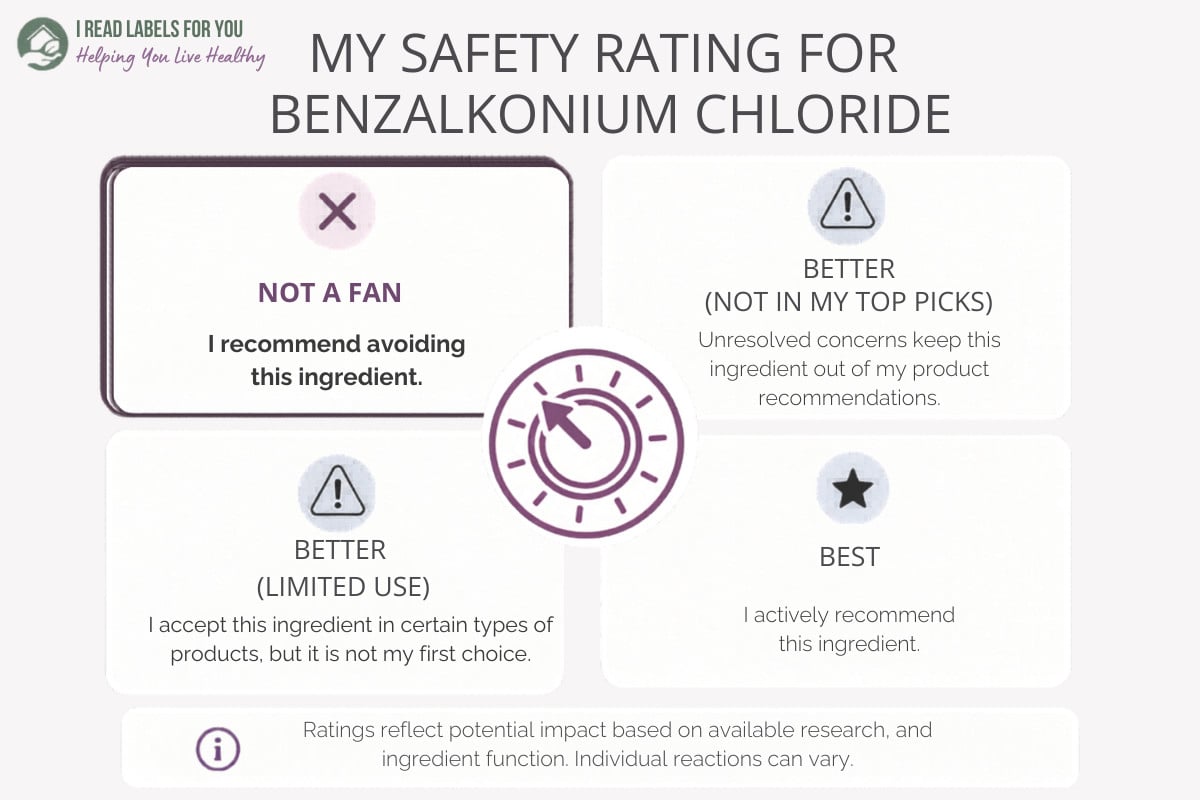
No, Benzalkonium Chloride is not safe for everyday use in cosmetics. It’s a strong disinfectant and preservative, a known skin allergen, and an eye and airway irritant. Plus, it’s hard on the environment. I rate it Not A Fan.
Both the European Union and Canada allow Benzalkonium Chloride as a preservative at no more than 0.1%. They also require an “avoid contact with eyes” warning because the ingredient irritates the skin and eyes and can trigger allergy.
Ahead, you’ll find answers to questions if Benzalkonium Chloride is safe in eye drops, whether its ability to kill viruses is actually a good thing for you, and whether it’s okay to use hand sanitizers with this ingredient during pregnancy.
What Is Benzalkonium Chloride?
Benzalkonium Chloride is a quaternary ammonium compound, often shortened to a “quat.” It carries a positive charge and works as a disinfectant, preservative, and antiseptic. Unlike the gentle conditioning quats, this one is built to kill germs.
Benzalkonium Chloride is actually a mixture of related molecules with different chain lengths. That mix is why you’ll also see it called alkyldimethylbenzylammonium chloride.
What Does Benzalkonium Chloride Do In Cosmetics?
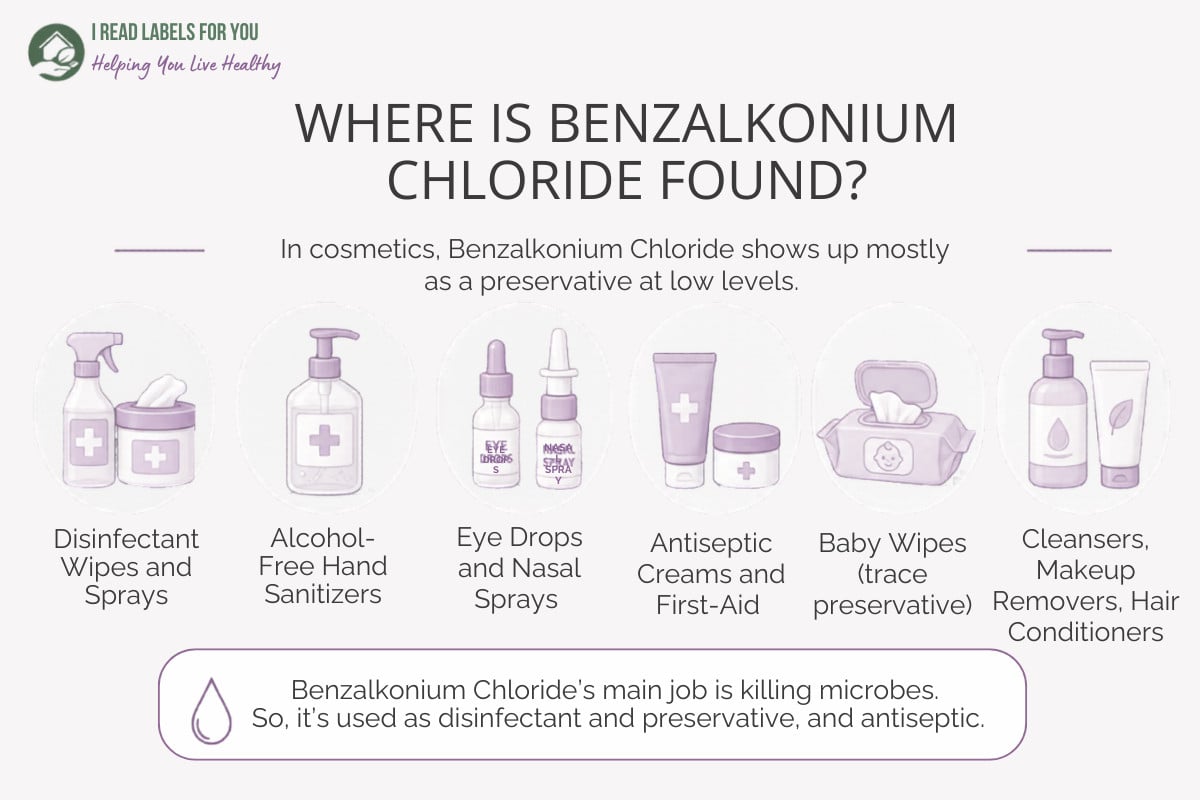
Benzalkonium Chloride’s main job is killing microbes. It breaks open the outer membranes of bacteria and many viruses, which makes it a popular disinfectant and preservative. In cosmetics, it shows up mostly as a preservative at low levels.
You’ll find Benzalkonium Chloride most often in:
- disinfectant wipes and sprays
- alcohol-free hand sanitizers
- eye drops and nasal sprays (as a preservative)
- antiseptic creams and first-aid products
- baby wipes (as a trace preservative)
- some cleansers, makeup removers, and hair conditioners
Benzalkonium Chloride isn’t added to food, but it can show up as a residue. A 2024 study notes it’s been measured in milk, dairy, and produce, left behind by sanitizing, and that swallowing it disturbed gut bacteria in mice.
How Is Benzalkonium Chloride Made?
Benzalkonium Chloride is made by joining a fatty amine with benzyl chloride, the chemical used to make it. This reaction locks a benzyl group onto the molecule and gives it a permanent positive charge.
Here’s a manufacturing concern: benzyl chloride itself is a probable carcinogen (IARC Group 2A). It reacts away during production, yet it points to a harsher chemical footprint than gentler ingredients carry.
Does Benzalkonium Chloride Penetrate The Skin?
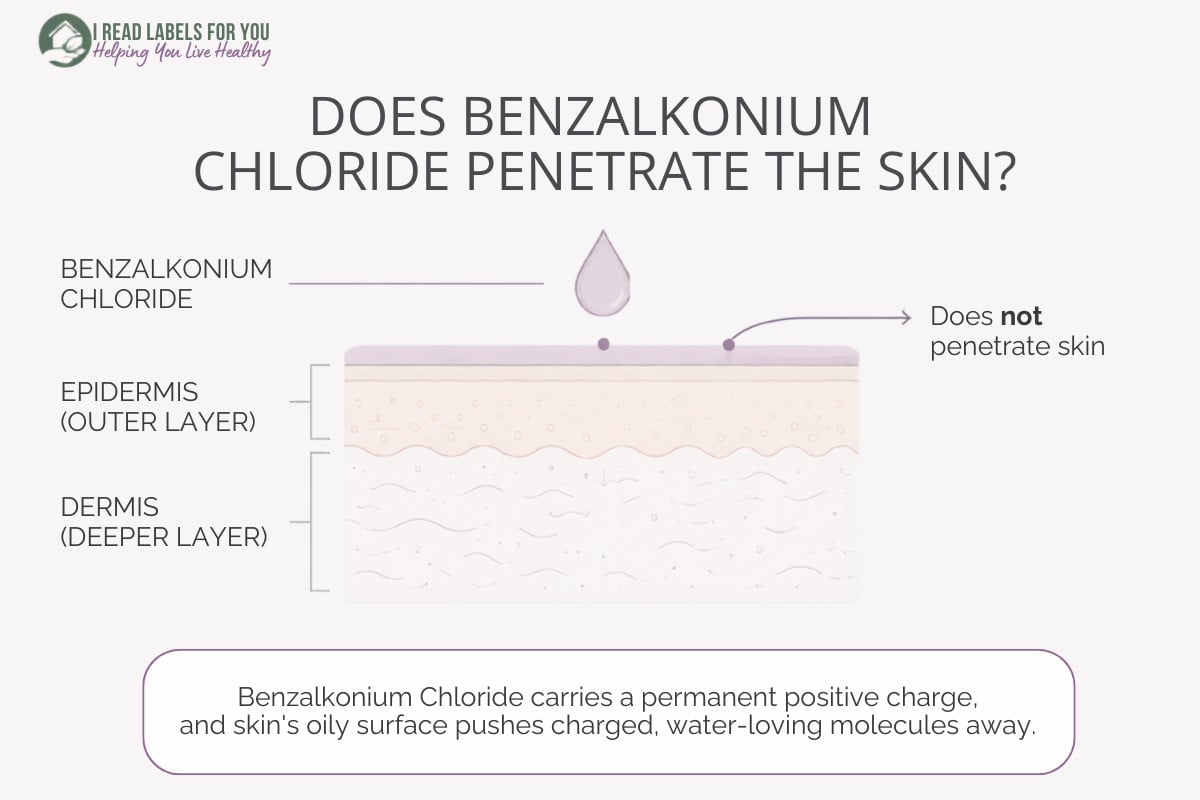
No, hardly any of it gets into the skin. The main reason is its electric charge.
Benzalkonium Chloride carries a permanent positive charge, and skin’s oily surface pushes charged, water-loving molecules away. That charge is also why it has no normal LogP, the score for how oily or watery something is.
Size plays only a small part here. At about 354 daltons it isn’t heavy enough to be blocked by size alone, so the charge is what keeps it out.
There’s a catch, though. Benzalkonium Chloride can loosen the skin’s surface and act like a door-opener, helping other ingredients (e.g., endocrine disruptors) soak in more easily.
What Is Benzalkonium Chloride Called On Labels?
You may see it under several names:
- Benzalkonium Chloride
- BAC or BAK (short names)
- Alkyldimethylbenzylammonium Chloride
- ADBAC
- Alkyl Dimethyl Benzyl Ammonium Chloride
Does The U.S. FDA Restrict Benzalkonium Chloride In Food And Cosmetics?
Benzalkonium Chloride is not a food additive. The U.S. Food and Drug Administration (FDA) regulates it mainly as an over-the-counter (OTC) antiseptic active ingredient and as an antimicrobial agent.
I view the FDA’s cosmetic oversight with caution. To date it has restricted just 11 ingredients in cosmetics, and it lets brands judge their own safety. For a known allergen and asthma trigger, that light touch is hardly reassuring.
Europe works the other way around. Under the precautionary principle, regulators there can restrict an ingredient on reasonable doubt, without waiting for proof of harm.
EU Regulations About Benzalkonium Chloride
The European Union (EU) allows Benzalkonium Chloride as a preservative but caps it. Under CosIng Annex V (entry 54), products can contain at most 0.1%, with a required warning to “avoid contact with eyes.”
That eye warning is telling. The limit and the warning exist because Benzalkonium Chloride irritates skin and eyes and can trigger allergy.
Canadian Regulations About Benzalkonium Chloride
Canada restricts it. Health Canada lists Benzalkonium Chloride as restricted on its Cosmetic Ingredient Hotlist. As a preservative it’s capped at 0.1%, and any product above 0.1% must warn to avoid the eyes.
Can Benzalkonium Chloride Cause Skin Allergy And Sensitization?
Yes, and this is a real concern. Benzalkonium Chloride is a recognized contact allergen. It sits on the American Contact Dermatitis Society (ACDS) core allergen list, the standard reference for skin allergens.
In a 2021 patch-test study of over 7,000 patients, Benzalkonium Chloride acted as a strong irritant and a weaker allergen, with about 1.5% testing positive. Allergy is more likely on broken or already-irritated skin.
For people with sensitive skin, eczema, or eye conditions, the risk runs higher. That’s a big reason it sits low on my list.
Is Benzalkonium Chloride A Hormone (Endocrine) Disruptor?
There’s no solid evidence that Benzalkonium Chloride disrupts hormones in people. It’s not on the European Chemicals Agency (ECHA) endocrine list.
In a 2024 fish study, Benzalkonium Chloride lowered fertility and altered the gonads in medaka. Those are environmental findings in water, though, not human ones. For now, hormone disruption isn’t the main worry with this ingredient.
Is Benzalkonium Chloride Safe To Use While Pregnant?
There’s little human data on Benzalkonium Chloride during pregnancy. It’s poorly absorbed through skin, which means everyday topical contact likely reaches a baby in tiny amounts, if at all.
One animal study adds a note of caution. In a 2014 mouse study, a disinfectant blend of Benzalkonium Chloride and a related quat lowered fertility. That test used a high-dose mixture by mouth, not skin contact, yet the reproductive signal is worth knowing.
Still, given its allergy and irritation profile, I’d avoid leave-on products with it during pregnancy. Consult with your medical provider in case of concerns.
Are There Any Cancer Concerns Linked To Benzalkonium Chloride?
Benzalkonium Chloride is not classified as a carcinogen. It is not listed by the International Agency for Research on Cancer (IARC), the U.S. National Toxicology Program (NTP), or California Proposition 65.
In bacterial mutation tests, Benzalkonium Chloride was not genotoxic, and a 2018 risk assessment agreed it shows no cancer-causing potential. A long-term skin study in mice and rabbits produced no tumors. The cancer-adjacent flag really points to benzyl chloride, the manufacturing chemical, not the finished ingredient.
Is Benzalkonium Chloride Bad For The Environment?
Yes. Benzalkonium Chloride is a biocide built to kill microbes, and it’s very toxic to aquatic life. Hazard labels mark it as very toxic to fish and water organisms, with long-lasting effects.
It’s used in huge volumes in cleaners and sanitizers, and plenty washes into waterways. On top of that, it breaks down slowly and can build up.
Common Claims About Benzalkonium Chloride: What’s True And What’s Not
Claim: It’s Just A Gentle Preservative
Not quite. Benzalkonium Chloride is a powerful disinfectant first, used at low levels as a preservative. It’s far harsher than mild preservatives, and it’s a known allergen and irritant.
Claim: It’s Safe Because It’s In Hand Sanitizer
Being common doesn’t mean gentle. Alcohol-free sanitizers use Benzalkonium Chloride at around 0.1%, higher than cosmetics do. Frequent use can dry and irritate skin, especially for sensitive types.
Claim: It Kills Viruses, So It Must Be Good For You
Killing germs and being skin-friendly are two different things. Benzalkonium Chloride does inactivate many viruses, yet the same membrane-breaking action irritates your skin, eyes, and airways.
What I Think About Benzalkonium Chloride — And What You Should Do
I rate Benzalkonium Chloride Not a Fan, and I avoid it across the board. It’s an effective germ-killer, but safer disinfectants and preservatives do the same job. From cleaning sprays to leave-on cosmetics, I reach for something else.
The reasons are clear. Benzalkonium Chloride is a recognized allergen, an eye and airway irritant, and a known asthma trigger. On top of that, it’s hard on the environment and made with a harsher chemical footprint.
Here’s my bottom line: skip it in your everyday products and choose quat-free alternatives. Be extra strict if you have sensitive skin, eczema, asthma, or dry eyes.
Frequently Asked Questions About Benzalkonium Chloride
Is Benzalkonium Chloride Safe In Eye Drops?
Benzalkonium Chloride is used as a preservative in many eye drops, usually at 0.01% or less. For occasional use, most eyes tolerate it. With daily, long-term use, though, it can damage the eye’s surface and worsen dryness.
If you use drops every day, ask your eye doctor about preservative-free options.
Does Benzalkonium Chloride Kill Viruses?
Yes, but it depends on the virus and the strength. It’s good at killing enveloped viruses. Against tougher, non-enveloped ones like some adenoviruses, a 2019 lab study found it worked only at higher levels (0.1%), not at low preservative amounts.
What Is Benzalkonium Chloride Used For?
Benzalkonium Chloride is mainly a disinfectant and preservative. You’ll find it in hand sanitizers, surface wipes, antiseptics, eye and nasal drops, and as a preservative in some cosmetics.
What Are The Side Effects Of Benzalkonium Chloride?
The most common side effects of Benzalkonium Chloride are skin irritation, allergic reactions, and eye stinging. Breathing it in is a bigger concern, because it can irritate the airways and trigger asthma.
In fact, a 2019 animal study found Benzalkonium Chloride was far more toxic to the lungs when inhaled than when swallowed. That said, a 2018 review concluded it’s generally well tolerated at the low levels in inhaled medicines.
Sources
EU SCCS / SCCP Opinions:
No dedicated SCCS or SCCP opinion on Benzalkonium Chloride (checked; its EU listing traces to an older SCCNFP review of the preservatives annex, not a substance-specific dossier): SCCS opinions portal
Cosmetic Ingredient Review (CIR) Reports:
Cosmetic Ingredient Review (CIR). Elder RL (ed.). (1989). Final Report on the Safety Assessment of Benzalkonium Chloride. Journal of the American College of Toxicology 8(4): 589-625: cir-reports.cir-safety.org
Cosmetic Ingredient Review (CIR). (2008). Annual Review of Cosmetic Ingredient Safety Assessments 2005/2006 (Benzalkonium Chloride re-review). International Journal of Toxicology 27(Suppl. 1): 77-142: cir-reports.cir-safety.org
European Union Regulatory Databases:
EU CosIng entry for Benzalkonium Chloride (entry 28801, EC 264-151-6; Annex V/54 preservative, max 0.1%, “avoid contact with eyes”; Annex III/65 non-preservative use): ec.europa.eu CosIng
CLP Annex VI Harmonised Classifications / ECHA C&L (acute toxicity, skin corrosion H314, eye damage H318, aquatic H400/H410): echa.europa.eu Annex VI to CLP
ECHA substance regulatory obligations for Benzalkonium Chloride (CAS 8001-54-5); Cosmetics Regulation and Biocidal Products Regulation entries: echa.europa.eu
Other Regulators:
U.S. FDA, Cosmetic Ingredients (Benzalkonium Chloride is regulated as an over-the-counter antiseptic active and antimicrobial agent; not a food additive): fda.gov/cosmetics
U.S. FDA, Prohibited & Restricted cosmetic ingredients (Benzalkonium Chloride not listed): fda.gov
Health Canada Cosmetic Ingredient Hotlist (Benzalkonium Chloride RESTRICTED: preservative 0.1%; conditioning agent in rinse-off hair care, chain length ≥16 C, 3%; “avoid contact with eyes”): canada.ca Hotlist
Environment and Climate Change Canada, CEPA Schedule 1 List of Toxic Substances (Benzalkonium Chloride not listed): canada.ca CEPA Schedule 1
IARC List of Classifications (Benzalkonium Chloride not classified): monographs.iarc.who.int
NTP 15th Report on Carcinogens (Benzalkonium Chloride not listed): ntp.niehs.nih.gov
California Proposition 65 List (Benzalkonium Chloride not listed): oehha.ca.gov Prop 65 list
PubChem Records (Chemistry, Identifiers, Skin Penetration, Hazard Codes):
Benzalkonium Chloride, PubChem CID 3014024 (CAS 8001-54-5; mixture of C8-C18 alkylbenzyldimethylammonium chlorides): pubchem.ncbi.nlm.nih.gov/compound/3014024
Peer-Reviewed Studies:
Dear K, et al. (2021). Contact allergy and allergic contact dermatitis from benzalkonium chloride in a tertiary dermatology center in Melbourne, Australia. Contact Dermatitis. PMID 33656745: pubmed.ncbi.nlm.nih.gov/33656745
Romanowski EG, Yates KA, Shanks RMQ, Kowalski RP. (2019). Benzalkonium Chloride Demonstrates Concentration-Dependent Antiviral Activity Against Adenovirus In Vitro. Journal of Ocular Pharmacology and Therapeutics 35(5): 311-317: doi.org/10.1089/jop.2018.0145
Lee H, Park K. (2019). Acute toxicity of benzalkonium chloride in Balb/c mice following intratracheal instillation and oral administration. Environmental Analysis Health and Toxicology 34(3): e2019009: doi.org/10.5620/eaht.e2019009
Lopez VA, Lim JJ, Seguin RP, et al. (2024). Oral exposure to benzalkonium chlorides in male and female mice reveals alteration of the gut microbiome and bile acid profile. Toxicological Sciences 202(2): 265-277: doi.org/10.1093/toxsci/kfae116
Melin VE, Potineni H, Hunt P, et al. (2014). Exposure to common quaternary ammonium disinfectants decreases fertility in mice. Reproductive Toxicology 50: 163-170. PMID 25483128: pubmed.ncbi.nlm.nih.gov/25483128
Goldstein MH, Silva FQ, Blender N, Tran T, Vantipalli S. (2021). Ocular benzalkonium chloride exposure: problems and solutions. Eye (London). PMID 34262161: pubmed.ncbi.nlm.nih.gov/34262161
Mukai M, et al. (2024). Exposure effects of benzalkonium chloride (BAC) on gonadal physiology and fertility suppression in medaka (Oryzias latipes). Environmental Pollution. PMID 39173869: pubmed.ncbi.nlm.nih.gov/39173869
Hong S, et al. (2018). Risk assessment of benzalkonium chloride in cosmetic products. Journal of Toxicology and Environmental Health, Part B 21(1). PMID 29211634: pubmed.ncbi.nlm.nih.gov/29211634
Johnson NF. (2018). Pulmonary Toxicity of Benzalkonium Chloride. Journal of Aerosol Medicine and Pulmonary Drug Delivery 31(1): 1-17. PMID 28683210: pubmed.ncbi.nlm.nih.gov/28683210
Natural Cosmetic Standards:
COSMOS-standard databases (Benzalkonium Chloride not found; it is a synthetic biocide not permitted by the COSMOS-standard): cosmos-standard.org
NATRUE certified/approved raw materials (Benzalkonium Chloride not found): natrue.org
Skin Allergy Resource:
American Contact Dermatitis Society (ACDS), Helpful References (including Core Allergen Series 2020; Benzalkonium Chloride IS listed, entry 60, 0.1% pet.): contactderm.org
Last verified: 06-12–2026
Download The Free Guide!
5 Powerful Steps To A Non-Toxic Home
Join our informed consumer community and get our free guide the “5 Powerful Steps To A Non-Toxic Home”.
Before commenting, please read our Comment Policy.