
Is Chlorphenesin Safe? A Simple Answer You Can Trust
 Written by Irina Webb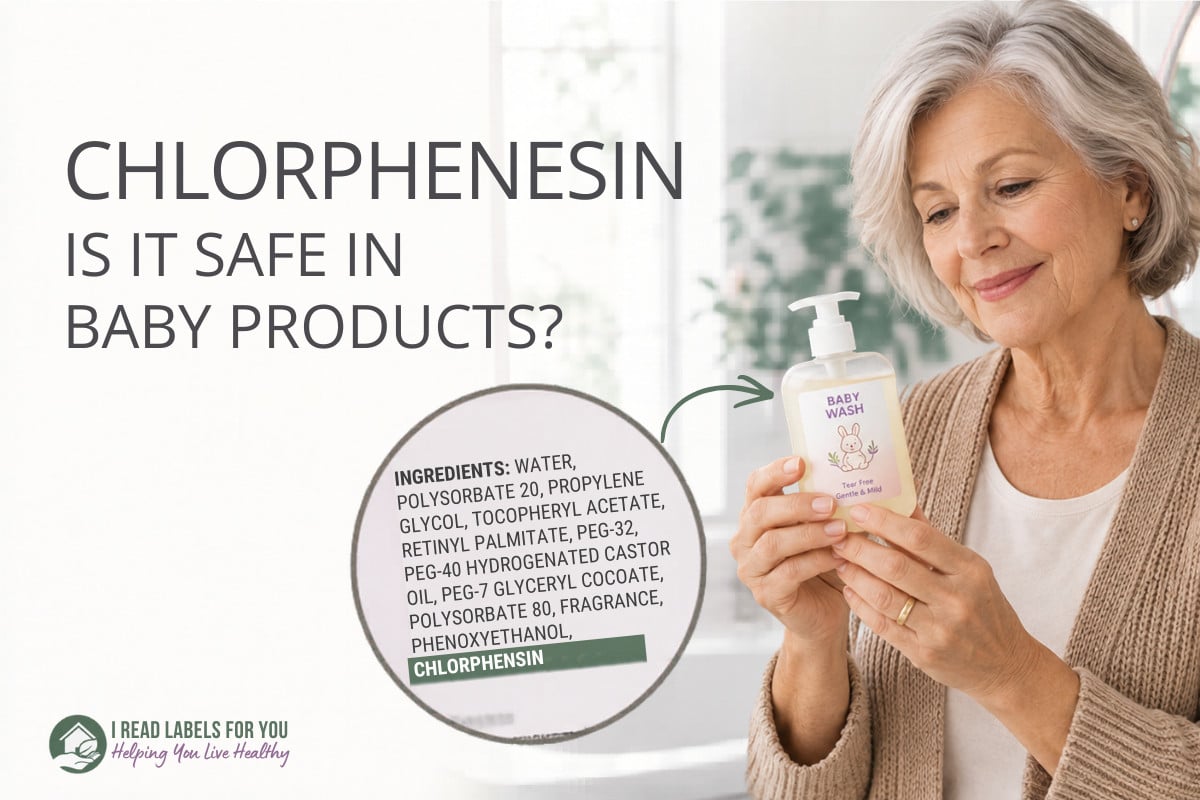
No, Chlorphenesin is not an ingredient I can recommend. Its job is keeping bacteria and fungi from growing in a product, and it does that well. Unlike most ingredients I review, though, this one passes through skin into the body. My verdict is Not A Fan.
Chlorphenesin is a permitted preservative in Europe, capped at 0.3 percent. Europe assessed it twice, in 1993 and again in 1995, and has not looked at it since. The industry panel in the United States reviewed it once, in 2014, and called it safe.
In this post, you’ll see why Europe’s own safety margin for this ingredient shrinks from 120 to 12. You’ll learn which known carcinogen is one of the two starting chemicals. You’ll also find out why the FDA warned mothers about a nursing product containing it in 2008.
What Is Chlorphenesin?
Chlorphenesin is a synthetic preservative, classed as a chlorinated glycerol ether. That name describes its structure rather than its job.
The chemistry record at PubChem gives the formal definition. Chlorphenesin is “glycerol in which the hydrogen of one of the primary hydroxy groups is substituted by a 4-chlorophenyl group.” In plainer terms, it’s glycerin with a chlorine-carrying ring attached.
That chlorinated ring is what kills microbes, and it keeps the molecule small. Small matters here more than anywhere.
What Does Chlorphenesin Do In Cosmetics?
Chlorphenesin keeps products from spoiling. The EU database lists two functions: antimicrobial and preservative.
The 2014 industry review describes Chlorphenesin as a biocide with a wide reach. Testing showed activity against bacteria, fungi, and yeasts including Candida albicans. Brands usually pair it with other preservatives rather than relying on it alone.
That review counted 1,386 cosmetic products containing Chlorphenesin. Of those, 1,224 were leave-on products which stay on skin rather than rinsing away. Reported concentrations ran up to 0.3 percent in leave-on formulas.
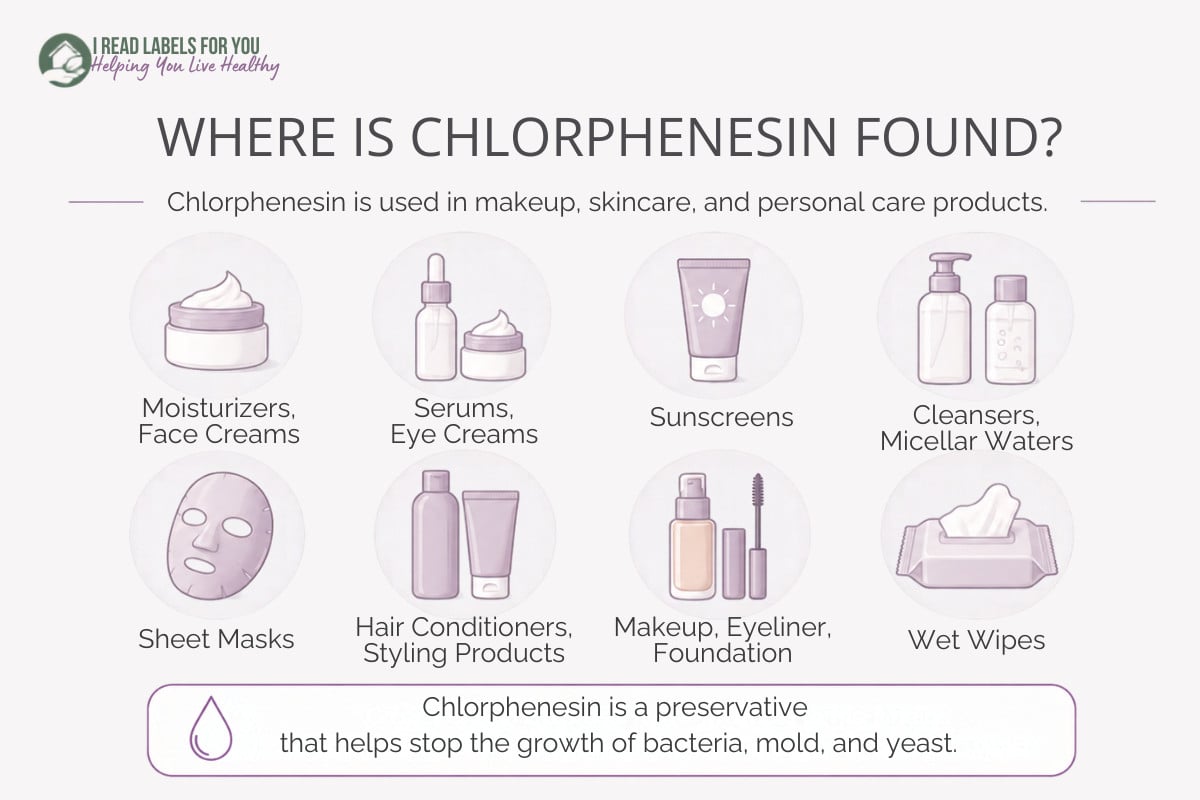
You’ll find Chlorphenesin most often in:
- moisturizers and face creams
- serums and eye creams
- sunscreens
- cleansers and micellar waters
- sheet masks
- hair conditioners and styling products
- makeup, including foundation and eyeliner
- wet wipes
Chlorphenesin has no food use whatsoever. All four American food inventories were checked, and it’s in none of them. It holds no European additive number either.
How Is Chlorphenesin Made?
Two chemicals are combined to make Chlorphenesin, and one of them matters a great deal. The 2014 review states that Chlorphenesin “is prepared by condensing equimolar amounts of p-chlorophenol and glycidol.”
Equimolar means equal amounts of each. So glycidol is not a trace helper in this reaction. It’s one of the two starting chemicals.
Glycidol is a carcinogen by every measure that counts. Under European hazard law, it sits in Category 1B, the band for substances presumed to cause human cancer. It also sits in the United States Report on Carcinogens, and IARC places it in Group 2A.
Here’s the problem, and it’s the reason this post exists. No document mentions glycidol as a possible leftover, sets a limit, or reports a measurement. The only purity control specified is an assay of “not less than 99.0%,” leaving one percent unaccounted for.
Does Chlorphenesin Penetrate The Skin?
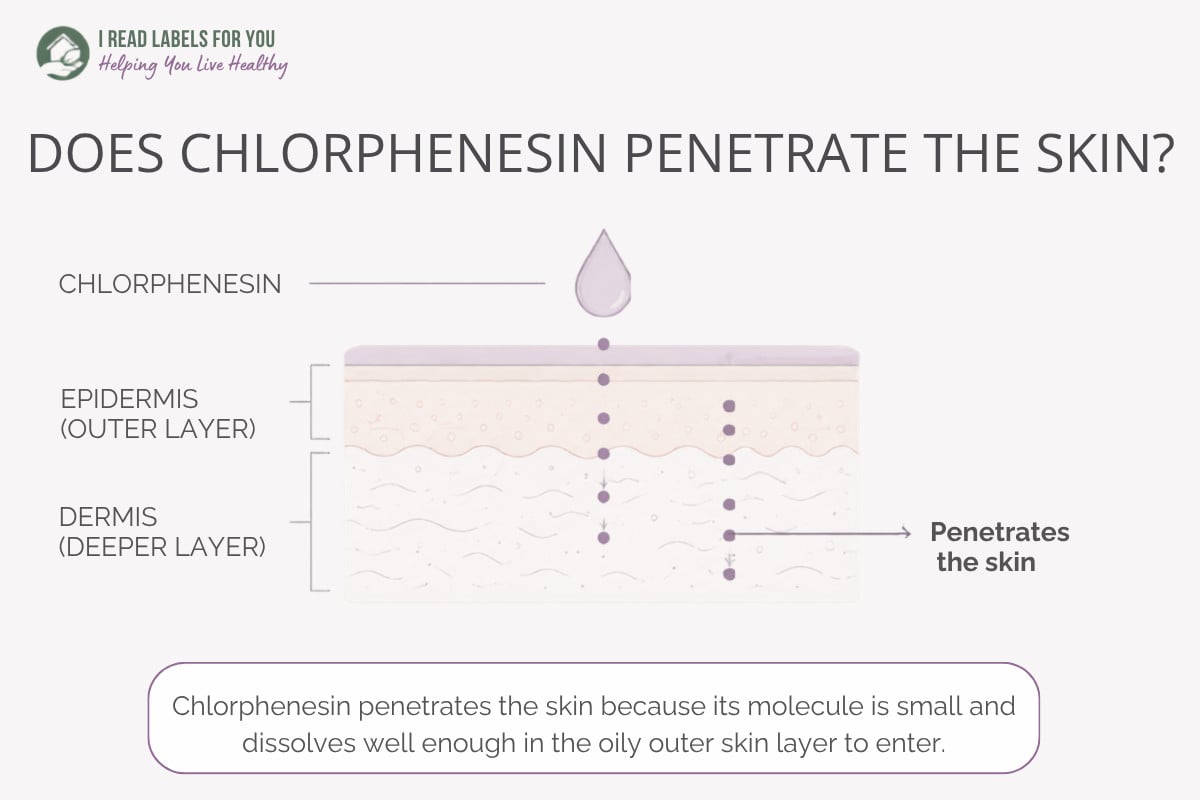
Yes, Chlorphenesin penetrates the skin, and this is the most important fact about it. Somebody measured it, in living animals, and the answer was not small.
Molecular weight decides most penetration questions, and it decides this one. Below roughly 500 daltons, size stops being a barrier at all. Chlorphenesin weighs 202.63 daltons, so size presents no barrier at all.
LogP is the second marker, describing whether a molecule prefers oil or water. At 1.2, Chlorphenesin sits in the range that crosses skin most easily. It dissolves well enough in the oily outer layer to enter, and in water to keep going.
The measurement settles it. In a rat study, “up to 57% of the dose was absorbed” over 96 hours under a dressing. Roughly 48 percent of the applied dose turned up in urine.
Both review bodies said so plainly. The European committee wrote that “chlorphenesin is well absorbed through the skin.”
Two caveats cut against my case. The study used a sealed dressing, which pushes absorption above normal use. And absorption was slow, which the review says kept blood levels low.
What Is Chlorphenesin Called On Labels?
On a label, Chlorphenesin appears under its own name. Names and close relatives you may encounter:
- Chlorphenesin
- 3-(4-Chlorophenoxy)-1,2-Propanediol
- 3-(p-Chlorophenoxy)-Propane-1,2-Diol
- p-Chlorophenyl Glyceryl Ether
- Chlorphenesinum
- Elestab CPN (A Supplier Trade Name)
One name is worth flagging even though it’s not this ingredient. Chlorphenesin carbamate is a prescription muscle relaxant with a different registry number. The industry panel warns that the two get confused, and they are not the same thing.
Does The U.S. FDA Restrict Chlorphenesin In Food And Cosmetics?
No, Chlorphenesin faces no FDA restriction in American cosmetics. It appears on none of the prohibited or restricted cosmetic ingredients, a list that names only ten items. No concentration cap applies, so American products may contain more than Europe permits.
For food the answer is equally short. Chlorphenesin holds no food status of any kind, and appears in none of the four food inventories.
I treat that silence as weak evidence. No cosmetic ingredient gets reviewed before it reaches a shelf. Absence from a list of ten tells you almost nothing.
The FDA did act once on this ingredient, and I cover that below. Europe starts from the opposite instinct, the precautionary principle. A regulator there may set limits while the science is still unsettled.
EU Regulations On Chlorphenesin
Chlorphenesin is a permitted preservative in Europe, with a limit. It holds entry 50 in Annex V of the Cosmetics Regulation, the list of approved preservatives. The CosIng database entry caps it at “Maximum concentration in ready for use preparation 0.3%.”
No other condition attaches. No product type is excluded, no warning is required, and no age limit applies.
Two European opinions exist, and finding them takes some digging. They came from the Scientific Committee on Cosmetology, which preceded today’s committee. Neither sits on the modern opinions portal.
The first, from 1993, classified the ingredient B and closed with the line “A teratogenicity study is needed.”
The second, from 1995, moved it to A once that study arrived. One study changed the classification, and thirty-one years have passed since.
U.S. And EU Disagreements On Chlorphenesin
The two regions treat this ingredient in opposite directions. Europe sets a numerical limit but has not reviewed it since 1995.
The United States sets no limit at all. Yet its regulator is the only one that ever warned the public.
On May 23, 2008, the FDA advised mothers against a nipple cream sold for nursing. It named two ingredients as the reason, and Chlorphenesin was one. The stated concern was a depressed nervous system and slowed breathing in infants.
Read that warning carefully, because part of it is questionable. The mechanism the FDA described, relaxing skeletal muscle, belongs to chlorphenesin carbamate, the prescription drug. The industry panel warns specifically that the drug “has muscle relaxant effects not expected for the cosmetic ingredient.”
Yet the animal data do not let the preservative off entirely. Acute dosing produced dyspnea, decrease in spontaneous activity, hypotonia, piloerection, and loss of reflex. Dyspnea is labored breathing, so the concern was not invented.
Two things keep this in proportion. No injuries were ever reported, and the warning named one product rather than the ingredient. But a nipple cream is the one cosmetic an infant swallows directly.
Canadian Regulations On Chlorphenesin
Canada attaches no conditions to Chlorphenesin. Neither part of the Cosmetic Ingredient Hotlist, prohibited or restricted, names it.
Environmental law is equally quiet. The country’s toxic substances list, Schedule 1 of its Environmental Protection Act, does not include it. No screening assessment exists either, so Canada has not examined it rather than cleared it.
Can Chlorphenesin Cause Skin Allergy And Sensitization?
Chlorphenesin causes allergy rarely, but it does cause it, and it irritates more often than that. The evidence pulls in two directions and both directions are worth knowing.
Start with the reassuring side, which is genuinely strong. Two patch test studies used materials containing 5 to 9 and 12 to 17 percent Chlorphenesin. Across 108 patients neither found sensitization, at up to fifty times the permitted level.
Now the case reports, which span four decades. Published reports describe reactions to an antifungal cream, a cosmetic product, a deodorant, and a facial cosmetic. Six patients in total, each with a positive patch test at 0.5 or 1 percent.
Irritation is a more common problem, and one study puts a number on it. In a Korean series, 8 of 30 healthy control patients reacted to 0.5 percent Chlorphenesin. Its authors concluded that the maximum concentration of chlorphenesin for avoiding skin reactions is less than 0.5%.
Stinging is a separate effect, and testing picked it up. At 0.4 percent, it scored 0.54 for facial stinging against 0.22 for the control. It was worse alongside parabens, which matters because preservatives are usually combined.
Two clean negatives deserve stating. Photoallergy testing found no positive reactions in patients photopatch tested with Chlorphenesin. It’s absent from the American Contact Dermatitis Society panel, too.
Is Chlorphenesin A Hormone (Endocrine) Disruptor?
No, Chlorphenesin is not known to disrupt hormones, and the reason needs stating carefully. No study has ever looked for that effect. It appears on no endocrine disruptor assessment list anywhere.
Neither European opinion examined the question. The 2014 industry review does not address Chlorphenesin either. A search of the published literature turns up no study of its hormone activity.
An untested question is not a cleared one, and I will not present it as one. What I can say is that no signal has appeared in the studies that were done. The 13-week rat study examined the oestrous cycle and found no evidence of interference with oestrus.
Is Chlorphenesin Safe To Use While Pregnant?
The developmental testing on Chlorphenesin is clean, and better than on most ingredients I review. Pregnant rats received it daily during the critical window of pregnancy, at up to 100 milligrams per kilogram. The review found no adverse effect on embryo-fetal survival, growth, or development in utero.
That study is why Europe upgraded its classification in 1995. It was conducted to a recognized guideline and under formal quality rules. The no-effect level for the developing fetus was set at the highest dose tested.
So why am I still cautious here? Because this ingredient reaches the bloodstream. And because the margin between your dose and the dose that causes effects is thin.
For anything specific to your own pregnancy you should consult with your medical provider.
Are There Any Cancer Concerns Linked To Chlorphenesin?
No agency classifies Chlorphenesin itself as a cancer risk, and the genetic testing is consistently negative. The concern here attaches to what it’s made from, not to what it is.
Take the ingredient first. Chlorphenesin appears on neither the IARC list nor the Report on Carcinogens. It’s absent from California’s Proposition 65 list and has no EPA IRIS assessment.
Genetic testing points the same way. The review concludes that chlorphenesin is not genotoxic in bacterial or mammalian assays. That covers two separate Ames tests, a hamster cell mutation assay, and a human lymphocyte test.
One gap is worth naming plainly. No conventional cancer study of Chlorphenesin exists. What the review reports instead is antitumor activity in mouse promotion models.
Now the manufacturing side, which is where my concern sits. Glycidol, one of the two starting chemicals, is a presumed human carcinogen in Europe and Group 2A at IARC. No document sets a limit for how much glycidol may remain, and none reports a measurement.
Is Chlorphenesin Bad For The Environment?
No regulator treats Chlorphenesin as an environmental hazard, though nobody has looked closely either. Europe applies no environmental classification to it, and Canada lists it nowhere.
One published finding is worth knowing. A 2022 study of its breakdown in light identified 4-chlorophenol among the products formed. That’s the same chemical used to make it, so the molecule partly reverts to its starting material.
Chlorinated organic compounds tend to persist, which is a fair general concern. Neither COSMOS nor NATRUE admits Chlorphenesin, though that reflects their rules on synthetic ingredients rather than any hazard finding.
Common Claims About Chlorphenesin: What’s True And What’s Not
Claim: Chlorphenesin Is Toxic
False as stated, and the acute numbers are not close. The dose that killed half of test rats was 3,000 milligrams per kilogram. That sits in the low toxicity band. A single cosmetic product contains a fraction of a percent.
The word “toxic” is doing the wrong work here. Nothing about a face cream containing the Chlorphenesin preservative is acutely dangerous. My concern is a thin long-term margin and an unmeasured impurity.
Claim: Chlorphenesin And Chlorphenesin Carbamate Are The Same Thing
False, and this mix-up drives most of the alarming material online. Chlorphenesin carbamate is a prescription muscle relaxant taken by mouth. Chlorphenesin is a preservative used at up to 0.3 percent in cosmetics, and they have different registry numbers.
The industry panel addresses the confusion directly. It notes the drug “has muscle relaxant effects not expected for the cosmetic ingredient.” So claims about muscle relaxation, sedation or drug interactions are describing the wrong substance.
One qualification keeps this honest. The cosmetic preservative did produce hypotonia and loss of reflex in animals, at very high oral doses. The two are genuinely different substances, and the Chlorphenesin preservative is not entirely without nervous system effects.
Claim: Chlorphenesin Side Effects Are Common
False for most people, and the testing supports that. At the 0.3 percent level used in products, it was rated as having “negligible dermal irritation potential” in 25 patients. Animal skin testing classed it a non-irritant.
The grain of truth is stinging rather than rash. If a cream stings without leaving a mark, this ingredient is a plausible suspect.
What I Think About Chlorphenesin
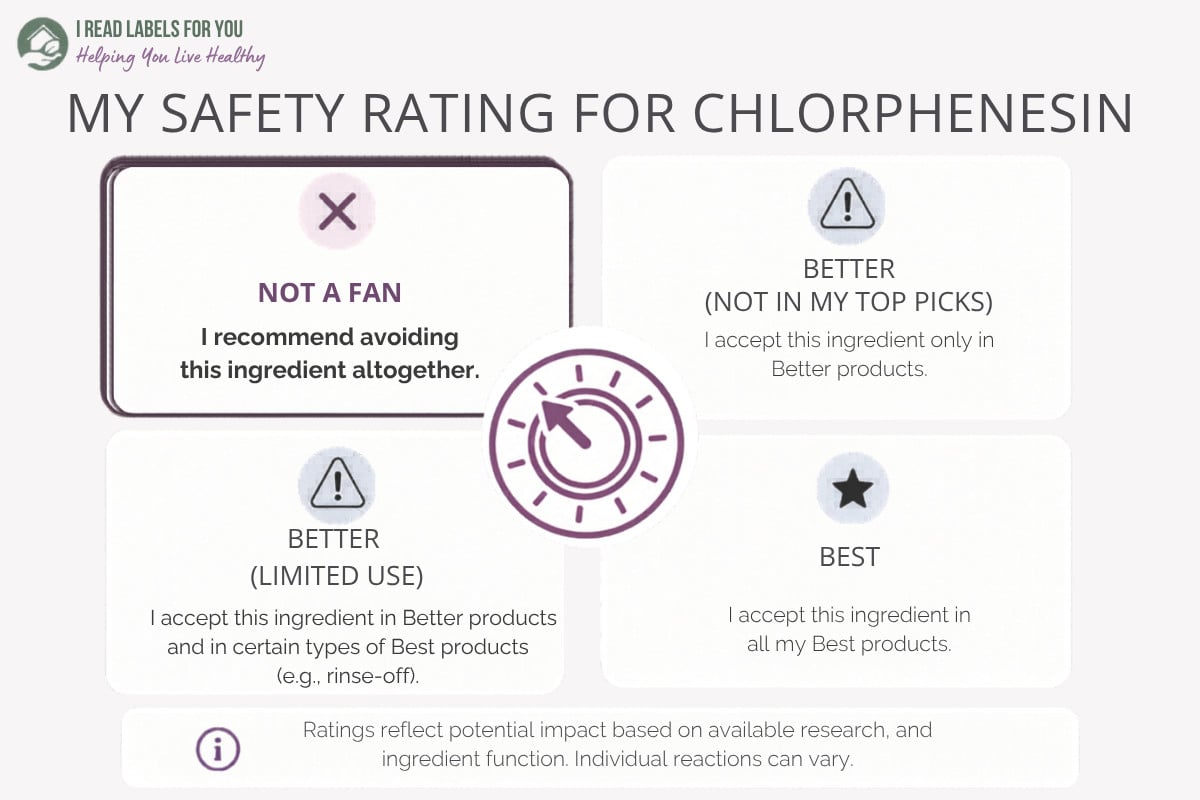
My rating for Chlorphenesin is Not A Fan. That is my strongest rating, so let me set out what earns it.
Start with what Chlorphenesin has in its favor, because it’s not a short list. Genetic testing was negative across four assays, developmental testing in pregnancy was clean, and 108 patch-tested patients showed no sensitization.
Two Reasons I Say No To Chlorphenesin
First, Chlorphenesin gets into you, at up to 57 percent of what is applied. That is measured, not assumed, and almost nothing else I rate does it.
Getting in only matters if the margin is thin, and here it is. Europe put the absorbed dose at 0.83 milligrams per kilogram. It divided 100 by that, reached a margin of 120, and called it acceptable.
But 100 is the dose the same opinion calls a marginal effect, a measured drop in hemoglobin. Measure from 10, where nothing happened, and the margin is 12. Regulators want at least 100 that way, and nobody has recalculated it since 1995.
The second reason is what it’s made from. Glycidol is a presumed human carcinogen, and one of the two starting chemicals. No limit exists for what remains, and no measurement is published.
Two things would soften my view. A measured limit for residual glycidol, and a modern margin calculated through skin.
What You Should Do
I keep Chlorphenesin out of every tier of my recommendations, including my Better products. There are other preservatives that raise none of these questions.
What you should do is calmer. Finding Chlorphenesin on a label is no cause for alarm and nothing needs throwing away. Choose differently next time, especially for a baby.
Frequently Asked Questions About Chlorphenesin
Is Chlorphenesin For Skin Safe?
For most adults, on normal skin, at the levels used, nothing dramatic will happen. It’s not an aggressive irritant and it rarely causes allergies. My objection is about what crosses into the body over years, not about what you’ll feel today.
Is Chlorphenesin Banned?
No, no country has banned Chlorphenesin. Europe allows it as a preservative up to 0.3 percent, and neither North American regulator restricts it. The 2008 FDA warning concerned one nursing product, not the ingredient itself.
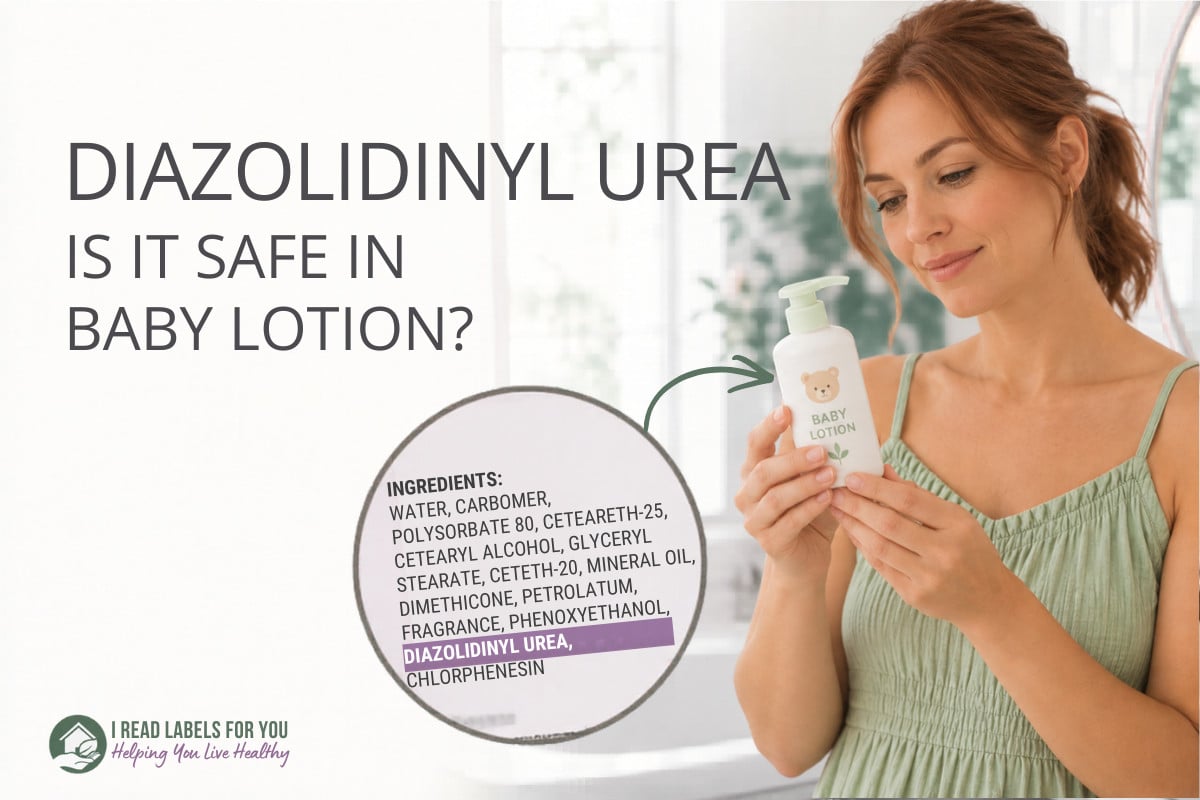
Is Chlorphenesin In Baby Products Safe?
This is where I’m least comfortable, and the industry panel shared the concern. It wrote that stinging worries “may be more relevant for baby products, for example, diaper creams.” It then set the question aside because the ingredient was not reported in baby products at the time.
That concern was parked rather than answered. Infant skin is more permeable than adult skin, and an infant absorbs more per kilogram of body weight. For a baby product, I’d choose a different preservative.
Chlorphenesin Vs Phenoxyethanol: Which Is Safer?
Phenoxyethanol, and the reason is not what you might expect. Both are absorbed through skin, and Phenoxyethanol is absorbed more, at up to 85 percent from leave-on products. Both are also made using a carcinogenic chemical, and phenoxyethanol’s is the more strictly classified of the two.
The difference is the quality of the evidence behind each one. Phenoxyethanol was assessed in 2016 using a 90-day study through skin, measured from a dose where nothing adverse happened. Chlorphenesin rests on a 28-day study by mouth, measured from a dose that lowered haemoglobin, last reviewed in 1995.
Why Does EWG Rate Chlorphenesin Differently?
EWG scores Chlorphenesin 4 out of 10, in its moderate band, which is gentler than my rating. Its Skin Deep entry also notes “Data: Limited,” meaning it found little to work with.
Look further down that page, and EWG turns stricter than its own score. Under its certification criteria, it lists the ingredient as “Unacceptable,” meaning EWG VERIFIED products cannot contain it at all. So on the practical question of whether to use it, EWG and I largely agree.
Sources
EU SCCS / SCCP Opinions:
Scientific Committee on Cosmetology, 53rd plenary meeting of June 25, 1993, entry P4, 3-(p-chlorophenoxy)-propane-1,2-diol; classification B, teratogenicity study requested. Published in the printed Reports of the Scientific Committee on Cosmetology, not on the current portal: SCCS opinions portal
Scientific Committee on Cosmetology, 60th plenary meeting of June 23, 1995, entry P4, Chlorphenesin; classification A, safety margin of 120 over the marginal effect level. Same compendium.
No SCCNFP, SCCP or SCCS opinion on Chlorphenesin exists; all six Commission opinion listings checked.
Cosmetic Ingredient Review (CIR) Reports:
Johnson W Jr, Bergfeld WF, Belsito DV, et al. Safety Assessment of Chlorphenesin as Used in Cosmetics. International Journal of Toxicology, 2014;33(Supplement 2):5S to 15S: CIR 2014 assessment, also listed at CIR reports
European Union Regulatory Databases:
CosIng entry for Chlorphenesin, Annex V entry 50, maximum 0.3 percent in the ready for use preparation, functions antimicrobial and preservative: CosIng
CosIng Annex V, entry 50, confirmed in the current annex export; Chlorphenesin appears in no other annex.
CLP Annex VI harmonized classifications: no entry for Chlorphenesin. Glycidol, its starting material, is classified Carc. 1B, Muta. 2 and Repr. 1B at index 603-063-00-8.
ECHA dossier: 21 REACH registrations, no harmonized classification, not a substance of very high concern: ECHA
Other Regulators:
U.S. FDA, prohibited and restricted ingredients in cosmetics, checked; Chlorphenesin not listed: FDA cosmetics restrictions
U.S. FDA consumer warning of May 23, 2008 against Mommy’s Bliss Nipple Cream, naming chlorphenesin and phenoxyethanol, as reported in the trade press: FDA warns moms against nipple cream with chlorphenesin
Health Canada Cosmetic Ingredient Hotlist: not listed, neither prohibited nor restricted: Hotlist
Environment and Climate Change Canada, CEPA Schedule 1: not listed: Schedule 1
IARC Monographs list of classifications: Chlorphenesin not evaluated; glycidol is Group 2A: IARC
NTP Report on Carcinogens: Chlorphenesin not listed; glycidol is listed: Report on Carcinogens
California Proposition 65 list: Chlorphenesin not listed; glycidol listed for cancer since July 1, 1990: Proposition 65
U.S. EPA IRIS: no assessment for Chlorphenesin: IRIS
PubChem Records (Chemistry, Identifiers, Skin Penetration, Hazard Codes):
Chlorphenesin, PubChem CID 7697, CAS 104-29-0; molecular weight 202.63, LogP 1.2: PubChem
Peer-Reviewed Studies:
Brown R. Chlorphenesin sensitivity. Contact Dermatitis, 1981;7(3):162. PMID 6456118: PubMed
Burns DA. Allergic contact sensitivity to chlorphenesin. Contact Dermatitis, 1986;14(4):246. PMID 2941223: PubMed
Goh CL. Dermatitis from chlorphenesin in a deodorant. Contact Dermatitis, 1987. PMID 3621931: PubMed
Wakelin SH, White IR. Dermatitis from chlorphenesin in a facial cosmetic. Contact Dermatitis, 1997;37(3):138 to 139. PMID 9330833: PubMed
Photodegradation and ecotoxicity of chlorphenesin, 2022, identifying 4-chlorophenol as a degradation product. PMID 34958151: PubMed
Natural Cosmetic Standards:
COSMOS-standard approved raw materials, checked; Chlorphenesin not listed: COSMOS
NATRUE certified and approved raw materials, checked; not listed: NATRUE
Skin Allergy Resource:
American Contact Dermatitis Society, Helpful References including the Core Allergen Series 2020; Chlorphenesin is not on the panel: ACDS
Advocacy groups:
Environmental Working Group (EWG) Skin Deep entry for Chlorphenesin, hazard score 4, Data: Limited, and Unacceptable under EWG VERIFIED criteria: EWG Skin Deep
Last verified: 09-26-2026

Download The Free Guide!
5 Powerful Steps To A Non-Toxic Home
Join our informed consumer community and get our free guide the “5 Powerful Steps To A Non-Toxic Home”.

Before commenting, please read our Comment Policy.