
Is Acetyl Hexapeptide-8 Safe? A Simple Answer You Can Trust
 Written by Irina Webb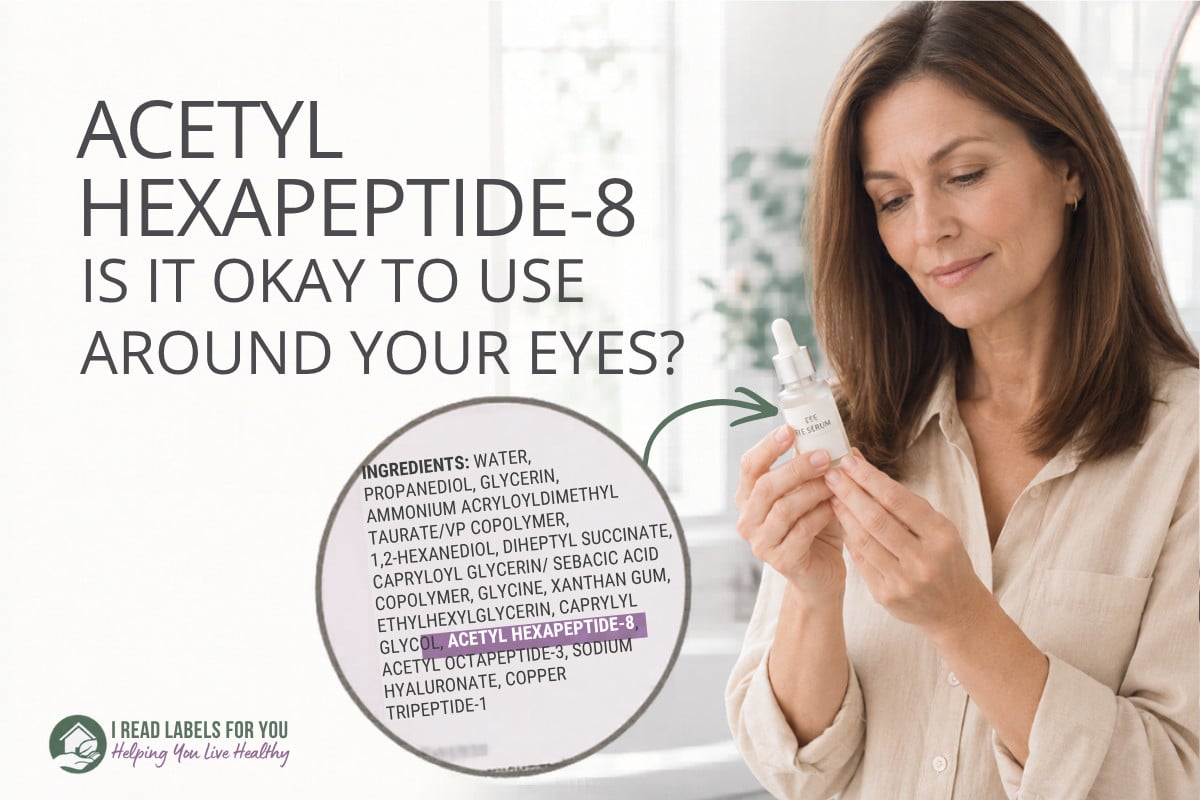
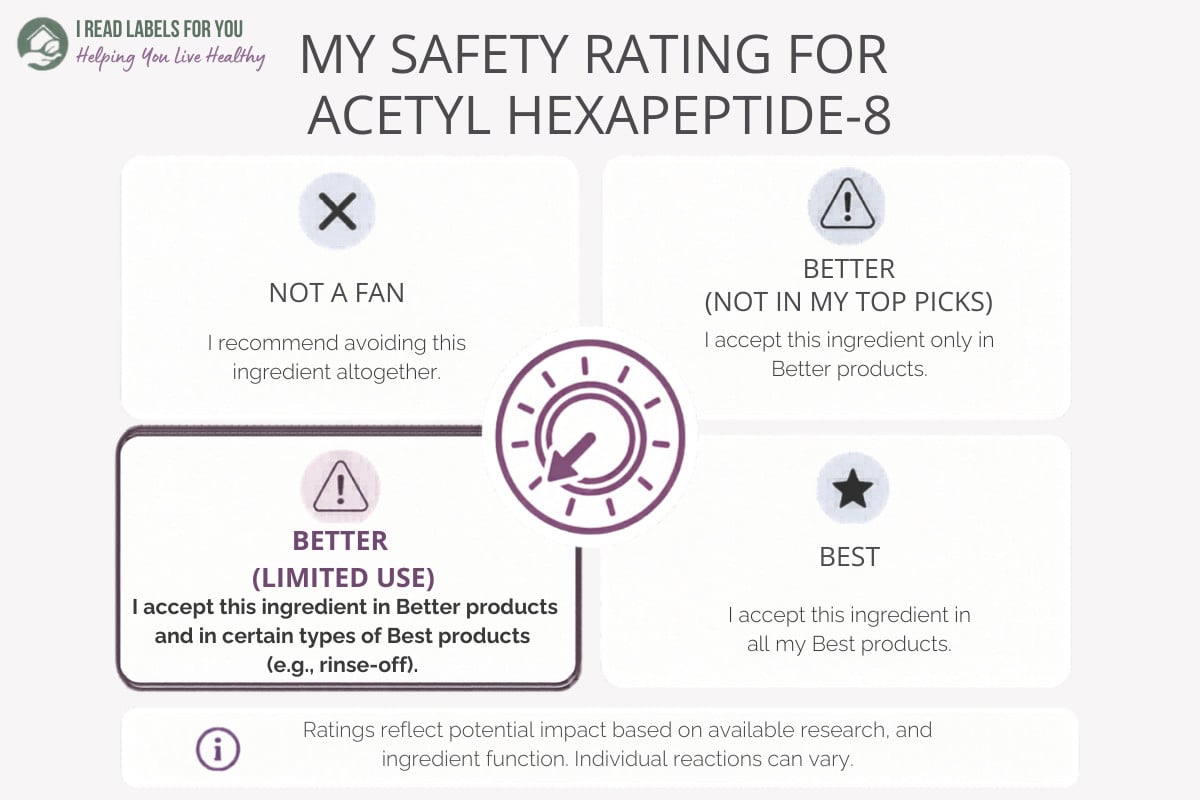
Yes, Acetyl Hexapeptide-8 is safe at the tiny amounts used in ordinary creams and serums, and I welcome it in my Best products at that strength. It’s a lab-made chain of six amino acids sold as Argireline, a “Botox-like” wrinkle smoother. It’s not a known allergen and barely gets past the skin’s surface. My rating is Better (Limited Use).
Acetyl Hexapeptide-8 has no restrictions in the European Union, and Europe’s safety committee has never assessed it. In addition, no regulator in the United States, Canada or the European Union classifies it as a hazard. In the U.S., the industry-funded review panel judged it safe only up to 0.005% and found too little data above that.
Keep reading to learn:
- whether this peptide can actually relax the muscles under your wrinkles
- what the “10%” on an Argireline serum label really means
- the one type of product I keep it out of, and why
What Is Acetyl Hexapeptide-8?
Acetyl Hexapeptide-8 is a small, man-made protein fragment. It strings together six amino acids: two glutamic acids, one methionine, one glutamine and two arginines. Furthermore, both ends are capped, one with an acetyl group and one with an amide group, to make it sturdier.
In fact, the peptide copies a short stretch of SNAP-25 (synaptosomal-associated protein 25), a protein your nerve cells use to release chemical signals. That copying is the whole idea behind the “Botox-like” label. Botulinum toxin also targets SNAP-25, although it works in a very different way.
What Does Acetyl Hexapeptide-8 Do In Cosmetics?
In a test tube, the peptide gets in the way of the protein machinery that lets nerves tell muscles to tighten. Accordingly, brands sell it to soften the expression lines around the eyes and forehead. The European Union’s ingredient database lists its official jobs as humectant, which means it holds water, and skin conditioning.
The results in people are modest. In the 2002 study that introduced the peptide, 10 women used a cream with it on one side of the face for 30 days. Wrinkle depth dropped 30%, compared with 10% for the plain cream, but the trial was small and short.
Moreover, a 2025 review from Jan Długosz University in Poland found that no study in people has shown the peptide relaxes facial muscles. Instead, its authors suspect any smoothing comes from effects in the outer skin, such as better hydration.
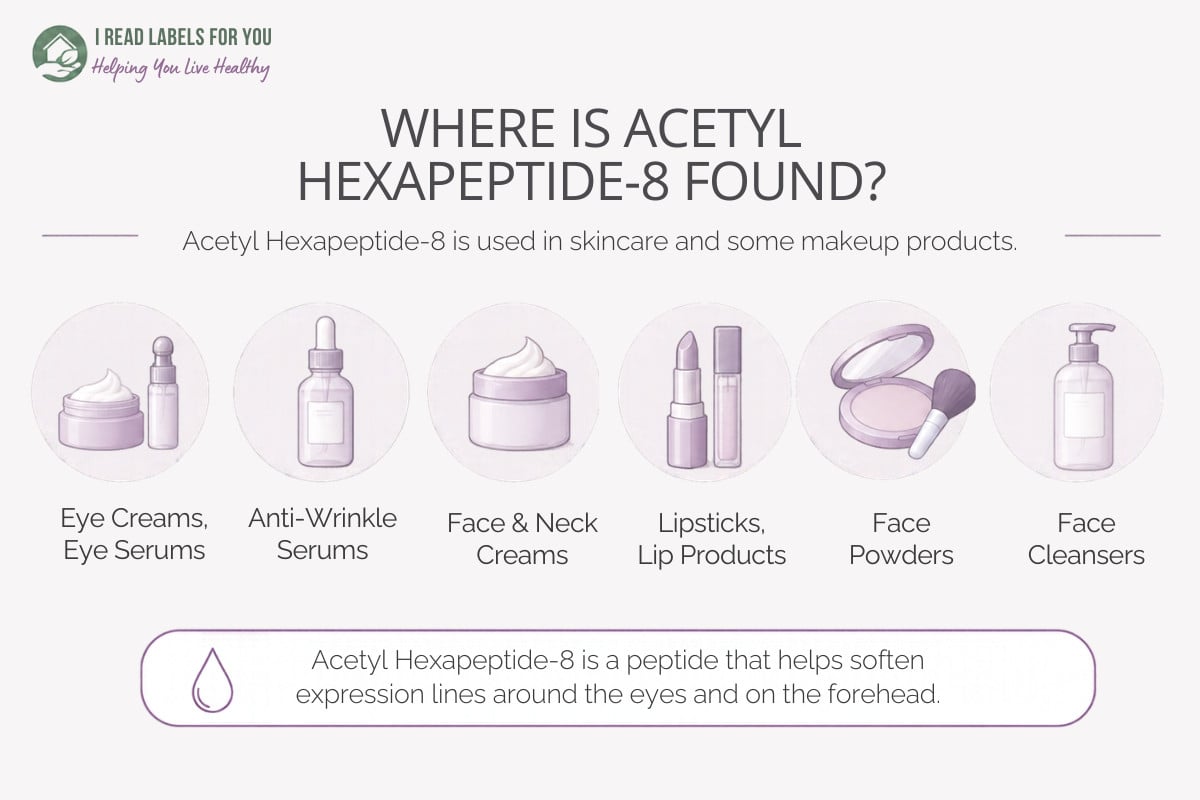
You’ll find Acetyl Hexapeptide-8 most often in:
- eye creams, eye serums
- anti-wrinkle serums
- face and neck creams
- lipsticks, lip products
- face powders
- face cleansers
Acetyl Hexapeptide-8 has no food use. The U.S. Food and Drug Administration (FDA) has not approved it as a food additive, and Europe gives it no food code.
How Is Acetyl Hexapeptide-8 Made?
Factories build Acetyl Hexapeptide-8 one amino acid at a time on tiny resin beads, a method called solid-phase peptide synthesis. Then, a strong acid called trifluoroacetic acid cuts the finished chain off the beads. Finally, makers wash it with ether, purify it, and freeze-dry it into a white powder.
Purity varies by supplier. The Cosmetic Ingredient Review (CIR), an industry-funded panel, reports that one supplier promises over 95% purity, while another promises only over 80%. In the second case, leftover amino acids made up several percent of the powder.
Does Acetyl Hexapeptide-8 Penetrate The Skin?
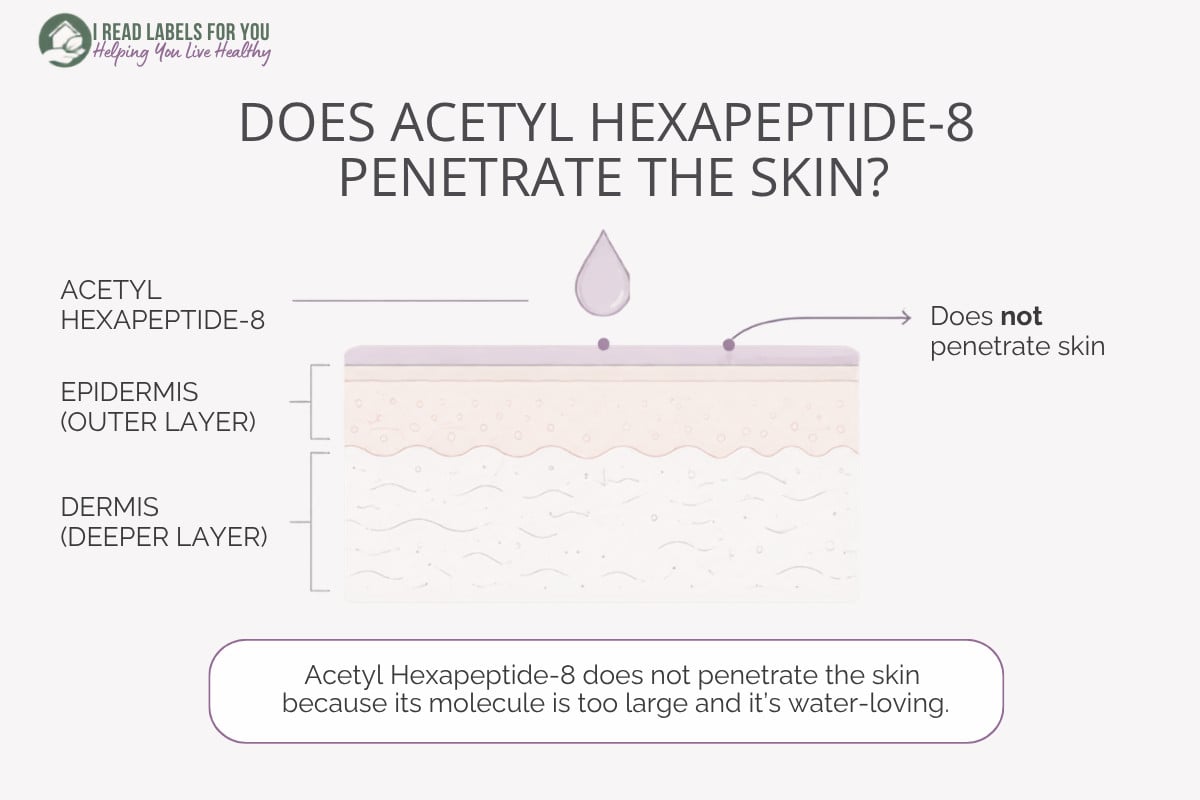
No, Acetyl Hexapeptide-8 does not meaningfully penetrate healthy skin from an ordinary cream. Its size is the main barrier. At about 889 daltons, a unit chemists use to measure molecule size, it’s far above the roughly 500-dalton cutoff where skin starts blocking molecules.
In addition, the peptide loves water. Its LogP, a number showing whether a molecule prefers oil or water, is about -5.2 on PubChem. Negative numbers mean water-loving, and the skin’s outer layer is oily, which keeps water-loving molecules out.
In a 2015 study on donated human skin, most of a 10% cream washed off. Only 0.22% of the dose stayed in the outer layer. Just 0.01% reached the layer beneath, and none crossed into the deeper skin or the fluid below.
On the other hand, the 2002 study above reported that 30% passed through. That test used only the thin outer layer of skin, peeled away from the living layers beneath. Also, needle-based treatments change everything; the 2025 review notes that microneedling boosted the amount passing through pig skin over 31-fold.
What Is Acetyl Hexapeptide-8 Called On Labels?
Look for any of these names on an ingredient list:
- Acetyl Hexapeptide-8
- Acetyl Hexapeptide-3
- Acetyl Hexapeptide-8 Amide
- Argireline
- Argireline NP
- Acetyl Hexapeptide-24
Acetyl Hexapeptide-3 is the older name for the same peptide, and you’ll still see it on some labels. Watch out for a look-alike, though. Acetyl Hexapeptide-1 is a different peptide made to boost skin pigment, and it has nothing to do with wrinkles.
Does The U.S. FDA Restrict Acetyl Hexapeptide-8 In Food And Cosmetics?
No, the FDA does not restrict Acetyl Hexapeptide-8 in cosmetics, and it has no rule about it at all. In fact, the agency keeps a list of banned and restricted cosmetic ingredients that names only about a dozen chemicals. That short list is a weak safety net, since U.S. law lets companies sell most cosmetic ingredients without FDA approval first.
The FDA’s food system is not much stronger. Under its Generally Recognized As Safe (GRAS) program, a company can decide on its own that a food ingredient is safe, without telling the agency. This peptide is not a food ingredient, but that gap shows how much U.S. rules depend on companies policing themselves.
There’s one more U.S. line worth knowing. The FDA treats a product as a drug if it’s meant to change how the body works, such as relaxing muscles. Consequently, a cream that truly worked like Botox would legally be an unapproved drug.
Europe takes a different path. It follows the precautionary principle, meaning regulators may limit an ingredient when the evidence raises doubts, before harm is proven.
EU Regulations On Acetyl Hexapeptide-8
The European Union places no limits on Acetyl Hexapeptide-8. It appears in the CosIng ingredient database, entry 54135, but on none of the annexes that ban or restrict ingredients. In other words, brands can use any amount they choose.
Furthermore, the Scientific Committee on Consumer Safety (SCCS), the European Union’s expert panel for cosmetic safety, has never reviewed this peptide. The European Chemicals Agency (ECHA) holds no registration file on it, and it carries no official hazard label. All 106 company reports to the agency’s hazard inventory call it not classified.
That leaves an odd gap. Europe usually acts on what its experts have studied, and nobody there has studied this ingredient in depth. Silence from Europe here means “not reviewed,” not “proven safe.”
Canadian Regulations On Acetyl Hexapeptide-8
Canada does not restrict Acetyl Hexapeptide-8. It’s not on Health Canada’s Cosmetic Ingredient Hotlist, the list of ingredients banned or limited in cosmetics. Environment Canada has not placed it among the toxic substances in Schedule 1 of the Canadian Environmental Protection Act, either.
Can Acetyl Hexapeptide-8 Cause Skin Allergy And Sensitization?
No, Acetyl Hexapeptide-8 is not a known skin allergen, and no published case report links it to an allergic rash. It’s not on the American Contact Dermatitis Society (ACDS) Core Allergen Series, the list dermatologists use to patch test patients. It has never been the ACDS Allergen of the Year, either.
The testing is thin, though. The only patch test the CIR panel reported involved 50 volunteers using the 0.05% supplier solution, and no one became sensitized. Because that solution is very weak, the test says little about stronger products.
In a placebo-controlled trial run by the U.S. National Institutes of Health, 24 patients with eyelid spasms took part. Half applied a 0.005% cream to their eyelids twice daily for about seven months, and half used the same cream without the peptide. Two people in each group had mild eyelid irritation that cleared on its own, and no one had a serious reaction.
Is Acetyl Hexapeptide-8 A Hormone (Endocrine) Disruptor?
No, Acetyl Hexapeptide-8 is not a known hormone disruptor, but nobody has tested it for hormone effects. The CIR panel’s report never mentions hormones. Similarly, a PubMed search turned up no study of estrogen, thyroid or other hormone activity.
The peptide is designed to act on nerve signaling, not on hormone receptors. Nothing known about how it works points to a hormone effect.
Is Acetyl Hexapeptide-8 Safe To Use While Pregnant?
No pregnancy study exists for Acetyl Hexapeptide-8. The CIR panel states that reproductive and developmental studies were “neither found in the published literature nor were these data submitted.”
On the plus side, very little crosses healthy skin from an ordinary cream, which limits how much could reach a baby. Nevertheless, during pregnancy I would skip high-strength “Botox alternative” products and any use with microneedling. If you’re pregnant or breastfeeding, you should consult with your medical provider before starting any wrinkle peptide.
Are There Any Cancer Concerns Linked To Acetyl Hexapeptide-8?
No, Acetyl Hexapeptide-8 is not linked to cancer. It’s not listed by the International Agency for Research on Cancer (IARC), the U.S. National Toxicology Program, or California’s Proposition 65.
It also passed an Ames test, a bacterial check for DNA mutations.
Separately, a 2014 Jagiellonian University study found the peptide slowed the growth of human skin cells in a dish at high doses. That’s cell damage, not cancer, and the doses far exceed what a cream delivers. Still, the authors warned that very high doses and very long use should be considered potentially dangerous.
Is Acetyl Hexapeptide-8 Bad For The Environment?
We have no evidence that Acetyl Hexapeptide-8 harms the environment, but nobody has tested it. No company has filed a European registration file for it, and those files are where wildlife and breakdown data normally appear. As a result, no study shows how it behaves in water or soil.
Interestingly, two natural cosmetic standards accept some versions. COSMOS approves two supplier versions, and NATRUE approves one. Those approvals cover how the ingredient is made and sourced, not a full environmental safety review.
Common Claims About Acetyl Hexapeptide-8: What’s True And What’s Not
Claim: Argireline Is Botox In A Bottle
This claim is false. Shoppers have called one cheap Argireline serum “literally Botox in a bottle”, but the comparison falls apart quickly. In a lab dish, the CIR panel reports, the peptide needed a dose about 5,000 times higher than botulinum toxin to block nerve signals.
Furthermore, Botox is injected straight into the muscle, while this peptide barely gets past the skin’s outer layer. The 2025 review concludes that delivering it to the muscles to relax them is “likely impossible” from a cream.
Claim: Argireline Is A Neurotoxin
This claim is false. Botulinum toxin is a large protein made by bacteria that cuts SNAP-25 apart, shutting down nerve signals for months. In contrast, Acetyl Hexapeptide-8 (aka Argireline) is a tiny six-amino-acid copy of part of SNAP-25 that only competes with it.
Even a dermatology commentary on MDedge that calls it “neurotoxinlike” doubts it works that way in skin. The author points out that without deeper penetration, the effect probably comes from something else, such as hydration.
Claim: Argireline Soaks Into Your Bloodstream
This claim is mostly false for ordinary creams. In the 2015 donated-skin study, none of the peptide crossed the skin. The often-quoted 30% figure came from a test on the thin outer layer alone, without the living skin beneath it.
Claim: Argireline Lowers Acetylcholine And Harms Your Memory
This claim is very unlikely for a skin cream. Acetylcholine is a chemical messenger that nerves use to signal muscles, and it also helps your brain form memories. In a lab dish, the peptide blocked the release of this messenger, but it did not lower how much your body makes.
Four reasons make a memory effect improbable:
- It’s weak. Its nerve-blocking effect in the lab took roughly 5,000 times more peptide than botulinum toxin.
- It barely enters skin. In the 2015 donated-skin study, none of it reached the deeper skin or the fluid below.
- The brain sits much farther away. The peptide would have to enter the blood, survive there and cross the barrier that guards the brain, a step small protein fragments rarely manage.
- Nobody has found or even studied a memory effect. No animal or human study has examined memory. Moreover, the National Institutes of Health eyelid trial reported no severe side effects over about seven months.
Still, microneedling and injections bypass the skin’s barrier, and no one has measured the peptide in users’ blood. That’s one more reason I keep it out of high-strength products and needle treatments.
What I Think About Acetyl Hexapeptide-8 — And What You Should Do
My rating for Acetyl Hexapeptide-8 is Better (Limited Use). At ordinary strength, up to 0.005%, I welcome it in my Best products, including eye creams, face creams, and serums. I keep it out only of products sold as a high-strength “Botox alternative.”
The good news is real. It’s not an allergen, no regulator flags it, and the best skin study found almost nothing gets through. Small studies also suggest it smooths wrinkles modestly.
I draw the line only at high strength. The peptide is built to interfere with nerve signals, and at high doses it slowed skin cell growth in a dish. In addition, the only safety ceiling anyone set is 0.005%, yet stronger products are on shelves today.
Purity also varies by supplier, from over 95% down to over 80%. That matters little at 0.005%, but more in high-strength products.
Here’s what I suggest:
- choose regular creams and serums over products promising stronger, needle-free Botox results
- skip it with microneedling, derma rollers or on broken skin
- pass on high-strength products during pregnancy and breastfeeding
Frequently Asked Questions About Acetyl Hexapeptide-8
What Does “10% Argireline” On A Label Mean?
It usually means 10% of the supplier’s Argireline solution, not 10% pure peptide. The CIR panel describes that solution as 0.05% peptide in water. If a brand uses that standard solution, a “10%” serum holds about 0.005% peptide, right at the panel’s ceiling.
How Long Does Argireline Take To Work?
Small studies measured changes after about 15 to 30 days of twice-daily use. In the 2002 study, wrinkle depth dropped 20% by day 15 and 30% by day 30. The changes are modest, and no long-term study exists.
Can I Use Argireline Around My Eyes?
Yes, eye creams are one of its most common uses. Brands report using up to 0.005% in eye lotions. The National Institutes of Health trial applied that amount to eyelids for seven months, with only mild irritation.
Is Argireline Safer Than Botox Injections?
They’re not really comparable. Botox reliably relaxes muscles and carries injection risks, such as a drooping eyelid. Argireline carries far lower risk because so little enters the skin, but for that same reason it does far less.
Why Does EWG Rate Acetyl Hexapeptide-8 Differently?
The Environmental Working Group (EWG) gives Acetyl Hexapeptide-8 a low hazard score of 1 to 2, with limited data. I agree it is low risk at ordinary strength, so my Limited Use rating applies only to products above the panel’s 0.005% ceiling. Interestingly, EWG also lists its contamination concern as high, which echoes the purity range noted above.
Sources
EU SCCS / SCCP Opinions:
No SCCS or SCCP opinion on Acetyl Hexapeptide-8 (checked). SCCS opinions portal: SCCS opinions
Cosmetic Ingredient Review (CIR) Reports:
Johnson W Jr, Bergfeld WF, Belsito DV, et al., 2025. Safety Assessment of Acetyl Hexapeptide-8 Amide as Used in Cosmetics. International Journal of Toxicology 44(Suppl 2):54S to 63S. Sponsored by CIR, which is funded by the Personal Care Products Council. Covers manufacturing, impurities, use levels, skin penetration, toxicity and clinical studies: DOI 10.1177/10915818251340391; CIR database: cir-reports.cir-safety.org
European Union Regulatory Databases:
CosIng entry 54135, ACETYL HEXAPEPTIDE-8, functions humectant and skin conditioning, no annex restrictions: CosIng 54135
The CosIng entry 95697, ACETYL HEXAPEPTIDE-8 AMIDE: CosIng 95697
CosIng Annexes II, III, IV, V and VI (2026 versions), checked; Acetyl Hexapeptide-8 not listed in any annex: CosIng
CLP Regulation Annex VI harmonized classifications (2026 table), checked; no harmonized classification: ECHA CHEM
ECHA CHEM, EC 801-648-4. Not registered under REACH; 106 of 106 company notifications report it as not classified; no regulatory activities: ECHA CHEM overview; ECHA CHEM activities
Other Regulators:
U.S. FDA, prohibited and restricted cosmetic ingredients. Acetyl Hexapeptide-8 not listed; no food or cosmetic regulation: FDA
U.S. FDA, cosmetic or drug definitions: FDA
Health Canada Cosmetic Ingredient Hotlist. Not listed: Health Canada Hotlist
Environment Canada, Canadian Environmental Protection Act Schedule 1. Not listed: CEPA Schedule 1
International Agency for Research on Cancer (IARC) classifications. Not classified: IARC list
U.S. National Toxicology Program, Report on Carcinogens. Not listed: NTP Report on Carcinogens
California Proposition 65 list. Not listed: OEHHA
U.S. EPA Integrated Risk Information System. No assessment: IRIS A to Z list
PubChem Records (Chemistry, Identifiers, Skin Penetration, Hazard Codes):
Acetyl Hexapeptide-8 (record title Acetyl hexapeptide-3), PubChem CID 71587772, CAS 616204-22-9. XLogP3 of -5.2; GHS not classified: PubChem CID 71587772
Peer-Reviewed Studies:
Blanes-Mira C, Clemente J, Jodas G, et al., 2002. A synthetic hexapeptide (Argireline) with antiwrinkle activity. International Journal of Cosmetic Science 24(5):303 to 310. PMID 18498523: PubMed 18498523
Lungu C, Considine E, Zahir S, Ponsati B, Arrastia S, Hallett M, 2013. Pilot study of topical acetyl hexapeptide-8 in treatment of blepharospasm in patients receiving botulinum neurotoxin therapy. European Journal of Neurology 20(3):515 to 518. PMID 23146065: PubMed 23146065
Grosicki M, Latacz G, Szopa A, Cukier A, Kieć-Kononowicz K, 2014. The study of cellular cytotoxicity of argireline, an anti-aging peptide. Acta Biochimica Polonica 61(1):29 to 32. PMID 24644551: PubMed 24644551
Zdrada-Nowak J, Surgiel-Gemza A, Szatkowska M, 2025. Acetyl Hexapeptide-8 in Cosmeceuticals: A Review of Skin Permeability and Efficacy. International Journal of Molecular Sciences 26:5722. No external funding. PMID 40565185: PubMed 40565185
Kraeling MEK, Zhou W, Wang P, Ogunsola OA, 2015. In vitro skin penetration of acetyl hexapeptide-8 from a cosmetic formulation. Cutaneous and Ocular Toxicology 34(1):46 to 52. Reviewed in the CIR 2025 report: CIR 2025
Hoppel M, Reznicek G, Kählig H, et al., 2015. Topical delivery of acetyl hexapeptide-8 from different emulsions: influence of emulsion composition and internal structure. European Journal of Pharmaceutical Sciences 68:27 to 35. Reviewed in the CIR 2025 report: CIR 2025
Dermatology commentary, Meet Argireline, the neurotoxinlike cosmeceutical, MDedge Dermatology: MDedge
Natural Cosmetic Standards:
COSMOS-standard approved raw materials. Two Acetyl Hexapeptide-8 supplier materials approved: COSMOS-standard approved raw materials
NATRUE certified and approved raw materials. One Acetyl Hexapeptide-8 supplier material approved: NATRUE certified raw materials
Skin Allergy Resource:
American Contact Dermatitis Society (ACDS), Helpful References, including the Core Allergen Series 2020. Acetyl Hexapeptide-8 is not on the series and has never been Allergen of the Year: ACDS Helpful References
Advocacy groups:
Environmental Working Group (EWG) Skin Deep entry for Acetyl Hexapeptide-8. Hazard score 1 to 2, data limited, contamination concern listed as high: EWG Skin Deep
Last verified: 10-10-2026

Download The Free Guide!
5 Powerful Steps To A Non-Toxic Home
Join our informed consumer community and get our free guide the “5 Powerful Steps To A Non-Toxic Home”.


Before commenting, please read our Comment Policy.