
Do Water Filters Filter Out Lead?
 Written by Irina Webb
Have you ever wondered whether your drinking water is safe—only to be reassured because “it tastes fine?” I’m here to tell you that your instincts were right to question it. Lead has no taste, no smell, and no color, which means your tap water can be contaminated with harmful levels of lead without you even knowing it. And because lead can enter water through several pathways, it’s far more common than most people realize. The good news? A surprisingly simple and budget-friendly water filter can remove lead and help you protect your health.
Do Water Filters Filter Out Lead?
To begin with, lead has been part of human life for years—used in pipes, paints, gasoline, and countless industrial products. Even though regulations have dramatically reduced its use, the legacy of those older materials still shows up in some plumbing systems and environments today. According to the EPA, drinking water can make up more than 20% of a person’s total exposure to lead. For infants, that number can be 40-60% if tap water is used to mix baby formula (source).
The good news is that many modern water filters, specially designed for the job, can reduce lead. These filtering systems use special media, like activated carbon blocks or reverse osmosis membranes, proven to reduce lead levels in water.
Before we talk about which filtering media work best, it’s essential to understand the bigger picture. So, first I’ll walk you through how lead gets into water. This will help you evaluate whether you need to get a water test and invest in filters certified for removing heavy metals, including lead.
How Does Lead Get Into Water?
There are several ways lead finds its way into your tap water:
- Lead Pipes, Solder, & Plumbing Fixtures: Older homes built before 1986 often have lead pipes or solder, and water—especially hot water—can pick up lead as it sits in them. Even post-2014 “lead-free” fixtures can still contain up to 0.25% lead (source).
- Corrosion: When water is naturally acidic or low in minerals, it becomes more corrosive, which can cause older lead pipes or solder to slowly leach lead into tap water—often without any visible signs until a water test detects it (source).
- Water Treatment Changes: Switching a water source or changing its chemistry can increase corrosion, causing more lead to leach from pipes. As seen in Flint, Michigan, a 2014 switch to a more corrosive water source without corrosion control caused widespread lead contamination before residents were informed (source).
- Environmental Contamination: Lead from past uses—like gasoline, paint, plumbing, and pesticides—lingers in soil and groundwater, while modern activities such as mining, smelting, battery production, and improper e-waste disposal continue adding contamination. Old industrial sites and failing waste facilities can further leach heavy metals into aquifers, leaving some regions with naturally higher background levels of lead long after the original pollution occurred (source and source).
Based on this, if you suspect that lead might be present in your drinking water, you can test for it easily with an in-home testing kit that I’ve used many times. By the way, even bottled water can have contaminants including lead. Plus, there is concern about the Safety Of Water Stored In Plastic Water Bottles, so it’s best to focus on getting a water filter.

What Is The Safe Level Of Lead In Drinking Water?
The short answer is no level of lead is safe in drinking water. In fact, although the U.S. Environmental Protection Agency (EPA) set an action level of 15 parts per billion (ppb), it acknowledges that zero is the only safe level. And the American Academy of Pediatrics (AAP) recommends that school water fountains contain no more than 1 ppb (source, source, source, and source).
Removing lead from your water is a top priority. Indeed, lead has been associated with a variety of health risks. Some risks of exposure to lead include:
- neurotoxicity (source)
- undermining of brain development in children and unborn babies (source)
- increased blood pressure (source)
- harm to kidney function (source)
- reproductive harm (source)
- endocrine disruption (source)
- potentially irreversible damage to developing brain (source).
The best approach is prevention—keeping lead out of your water in the first place. That’s where water filtration systems come in.
Download The Free Guide!
5 Powerful Steps To A Non-Toxic Home
Join our informed consumer community and get our free guide the “5 Powerful Steps To A Non-Toxic Home”.
Does A Water Filter Remove Lead?
Yes—there are water filters that can remove lead. The good news is that even relatively simple and affordable filters like water pitchers can do an excellent job.
Two organizations test and certify water filters: the National Sanitation Foundation (NSF) and the American National Standards Institute (ANSI). Together, they set strict standards for water filter performance. Specifically, NSF/ANSI Standard 53 for lead applies to carbon filters, while NSF/ANSI Standard 58 applies to reverse osmosis systems.
It’s important to keep in mind that both NSF/ANSI 53 and NSF/ANSI 58 standards require to reduce lead to 5 ppb, not zero (source). Second, getting a water filter certified to reduce lead is expensive, so not every high-quality filter will have the certification. And third, a certification doesn’t automatically mean the filter is of high quality. I’ve learned this both through my own experience and through the experiences of many of my blog readers. That’s why it’s so important not to rely on certifications alone but to understand which types of filters actually work well.

What Water Filters Filter Out Lead?
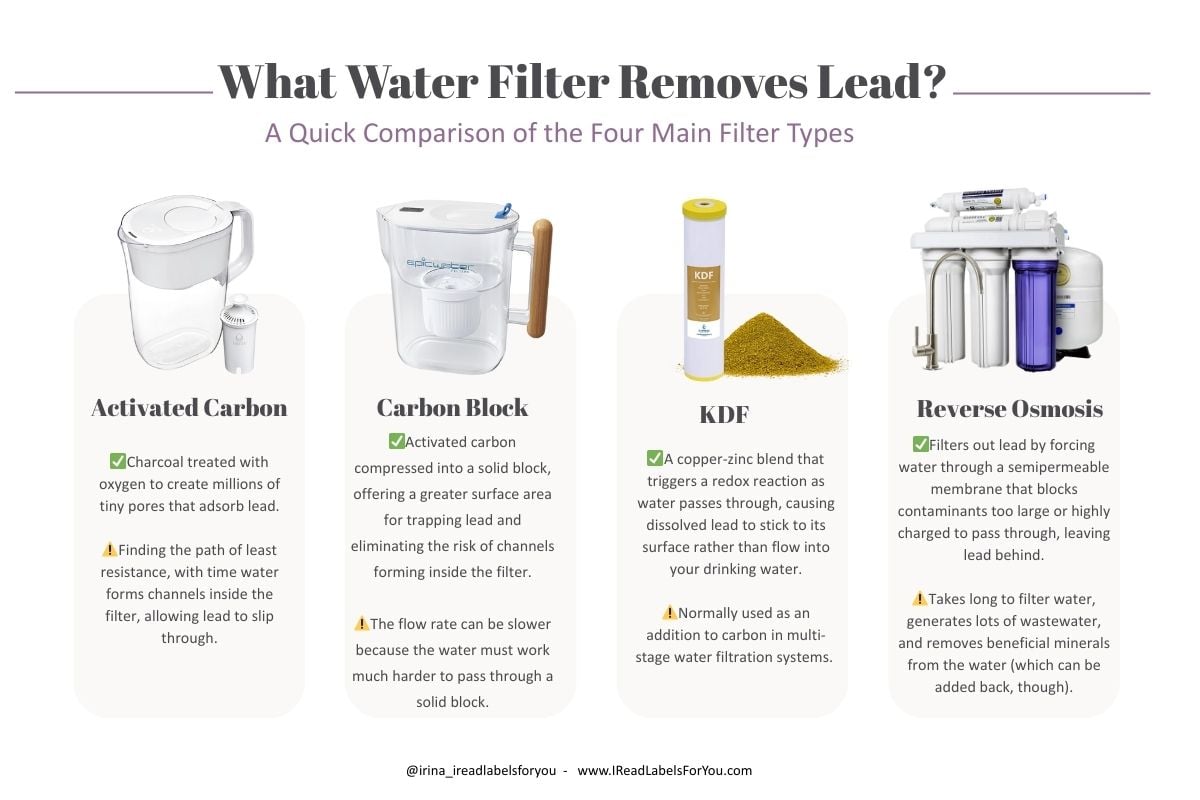
The most common types of filters known for reliably reducing lead include:
- activated carbon
- carbon block
- KDF
- reverse osmosis (RO)
Let me explain how they work so you know which one to choose.
Activated Carbon
First, activated carbon is the most common filter material on the market. You’ll find it in nearly every type of filtration system—from simple water pitchers to multi-stage water filtration systems that require installation. It is charcoal treated with oxygen to create billions of tiny pores between carbon atoms. These pores give it a massive surface area, which allows it to trap contaminants like lead through a process called adsorption (not absorption). In adsorption, contaminants adhere to the surface of the carbon rather than getting soaked in.
Although activated carbon is pretty effective, it does have a downside. Water finds the path of least resistance. Over time, tiny channels can form inside it, allowing some contaminants—like lead—to slip through (source and source).
That brings me to the second type of filter—more effective at removing contaminants including a broader range of heavy metals in tap water.
Carbon Block
Second, carbon block is basically activated carbon compressed into a solid block. The benefit is that it offers an even greater surface area than loose carbon and eliminates the risk of those tiny channels or “rivers” forming inside the filter. The main downside is that the flow rate can be slower because the water must work much harder to pass through a solid block.
If you’re shopping for a water filtration system and notice that one of the stages uses carbon block, it’s a good idea to ask about the flow rate so you know what to expect.
For example, the water pitcher I bring with me when traveling contains a carbon block filter, and yes—the water drips pretty slowly. I just make sure to filter it in advance, so I always have clean water ready.
To reiterate, both activated and block carbon block can be standalone inexpensive filters like water pitchers. Despite slower filtration process, I suggest choosing carbon block.
KDF
Third, kinetic degradation fluxion (KDF) is common in multi-stage water filtration systems along with carbon. KDF is a blend of copper and zinc, and when water passes through it, a redox reaction occurs. In plain terms, this reaction changes certain contaminants—like chlorine—into safer forms. But when it comes to lead, the process works differently.
Instead of transforming lead into another substance, KDF causes dissolved lead to bond to its surface. The lead essentially “plates out” onto the copper-zinc media, which removes it from the water stream and keeps it out of your drinking water. This makes KDF a helpful addition to systems designed to reduce heavy metals, including lead.
In addition to lead, KDF is effective for chlorine, chloramine, iron, hydrogen sulfide, mercury, and some forms of chromium. Another advantage is that KDF can handle higher water temperatures, which some other filter materials cannot.
Reverse Osmosis
Last, the RO process works by pushing water through a semipermeable membrane that blocks nearly all dissolved contaminants—including ions, molecules, and larger particles. RO is particularly effective for lead because the membrane rejects contaminants based on size and charge—lead particles are simply too large to pass through (source). The same mechanism also blocks arsenic, fluoride, uranium, and other heavy metals. (Find out How To Filter Fluoride Out Of Water.)
Something to consider about reverse osmosis systems is that the filtration process takes long, generates lots of wastewater, and removes beneficial minerals from the water (which you can add back). Yet, if your water has lots of other contaminants, RO might be the best solution for you.
Conclusion: What Can Help You Get Rid Of Lead In Water?
You Can Remove Lead From Water with Activated Carbon, Carbon Block, KDF, Or Reverse Osmosis Filtering Media.
In conclusion, since no amount of lead exposure is truly safe, reducing lead exposure through drinking water becomes important. While contamination can come from aging pipes, corrosion, or environmental sources, there are water filters that can offer valuable protection. Systems designed to reduce heavy metals provide peace of mind by effectively targeting lead and other harmful contaminants.
You might find helpful filters such as Pure Effect Water Filtration Systems (I have their filtration system at home) and Clean Water Revival.
Remember to maintain your filtration system and replace filter cartridges when necessary so the trapped contaminants don’t leach back into your water.
Visit my blog post about Lead Free Glassware to learn about potential presence of lead in other areas. And get my free emails to unlock premium offers, unique resources, and inspiring tips to support your wellness journey!
Download The Free Guide!
5 Powerful Steps To A Non-Toxic Home
Join our informed consumer community and get our free guide the “5 Powerful Steps To A Non-Toxic Home”.






Before commenting, please read our Comment Policy.