
Is Lauramidopropyl Betaine Safe? A Simple Answer You Can Trust
 Written by Irina Webb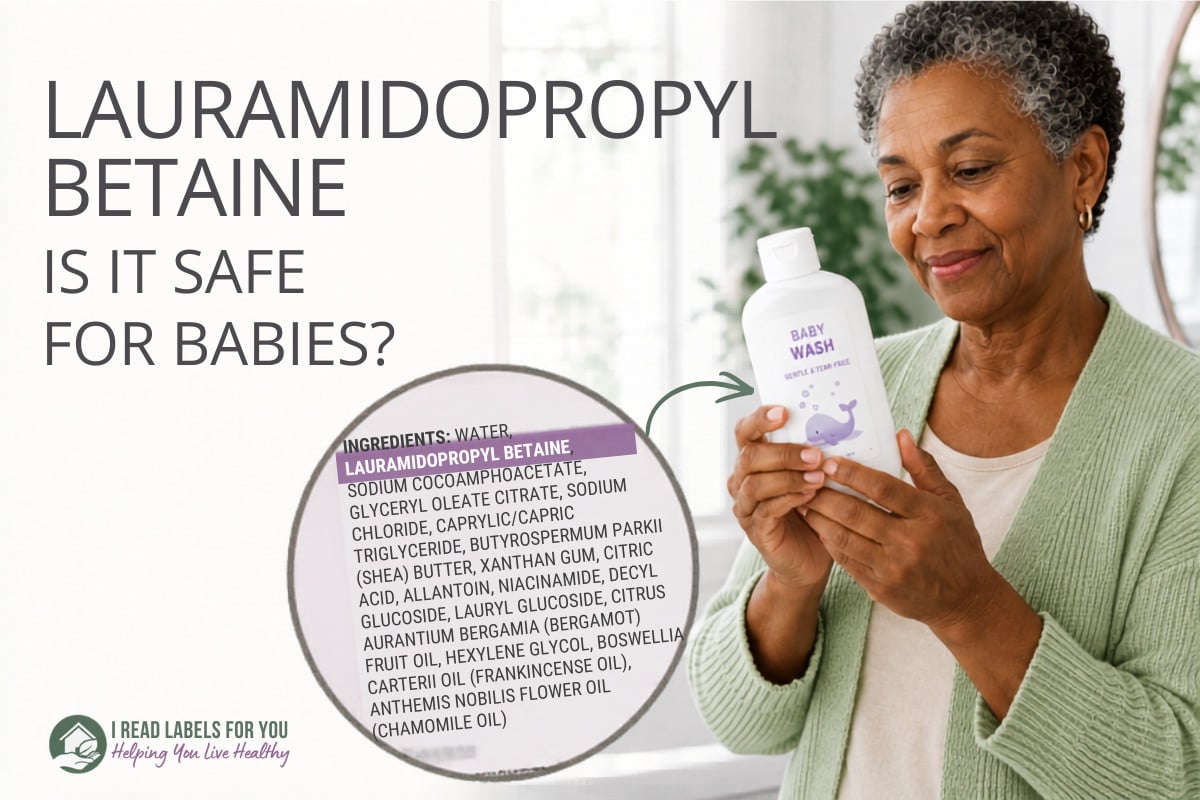
Yes, Lauramidopropyl Betaine is safe for most people. It’s a gentle, coconut-based surfactant that helps harsher cleansers work more softly. It shows no link to cancer, hormones, or reproductive harm, and it never travels past the skin’s surface. My reservation is not the ingredient itself. Production can leave traces of DMAPA and amidoamine behind, and those impurities can cause allergic reactions. I rate it Better (Not In My Top Picks).
Lauramidopropyl Betaine carries no restrictions in Europe, and that is less reassuring than it sounds. It appears in the EU cosmetic database as a surfactant and foam booster, with no limit on amount. Europe’s safety committee has never studied it, and silence is not the same as approval. Health Canada does not restrict it either, and it’s absent from Canada’s list of toxic substances.
Find out below if Lauramidopropyl Betaine is the same as Cocamidopropyl Betaine, if it’s gentle enough for skin, and why I stay cautious about it in baby washes.
What Is Lauramidopropyl Betaine?
Lauramidopropyl Betaine is a gentle cleansing ingredient made from coconut-derived lauric acid. Each of its molecules carries both a positive and a negative charge, and their balance is what keeps it mild.
The word betaine in its name simply refers to this family of dual-charge, gentle cleansers (chemists also call them amphoteric). Lauramidopropyl Betaine is a close relative of the better-known Cocamidopropyl Betaine. The difference is the starting fat: Lauramidopropyl Betaine is made from just one fatty acid, lauric acid, while Cocamidopropyl Betaine is made from a blend of coconut fatty acids.
What Does Lauramidopropyl Betaine Do In Cosmetics?
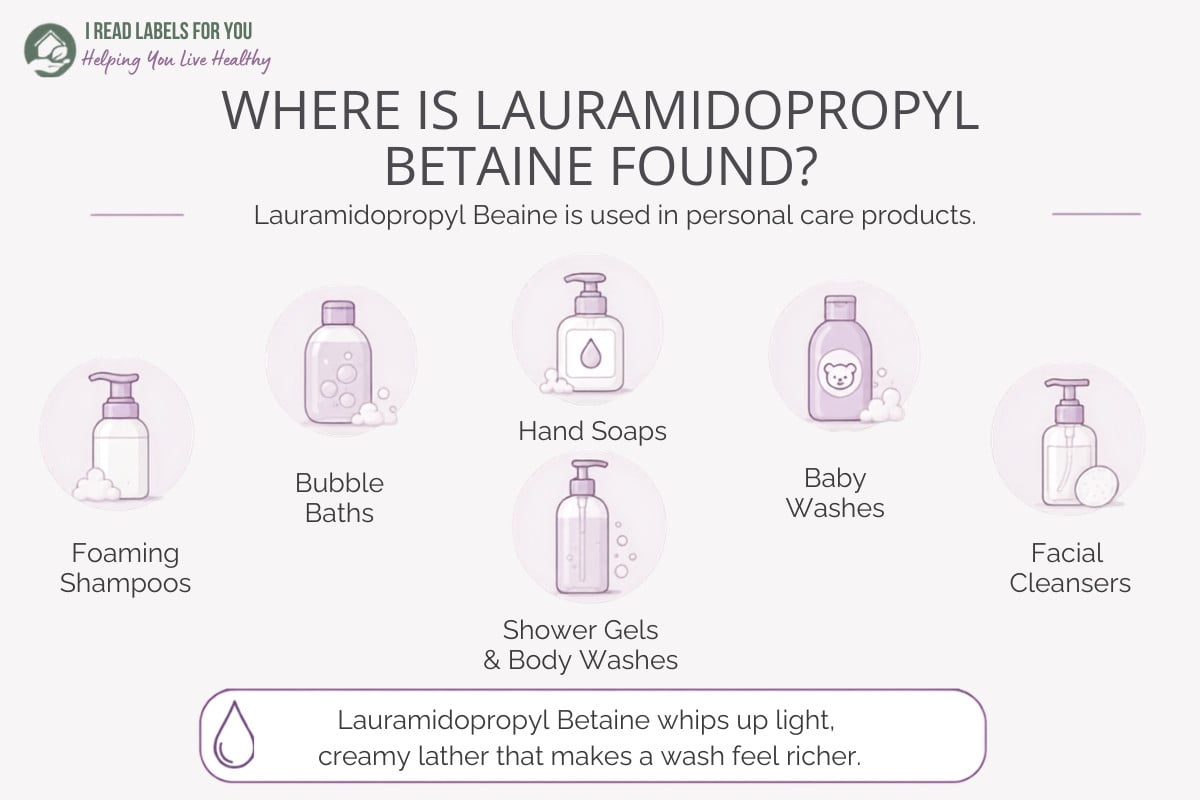
Its main value is foam. Lauramidopropyl Betaine whips up a light, creamy lather that makes a wash feel richer. It also softens harsher detergents so they sit more kindly on skin.
A few smaller jobs round out Lauramidopropyl Betaine, such as thickening a thin formula, cutting static, and light conditioning. Next to its core role of gentle cleansing, these stay in the background.
You’ll find Lauramidopropyl Betaine most often in:
- foaming shampoos
- body washes and shower gels
- facial cleansers
- bubble baths
- liquid hand soaps
- baby washes
You will only meet Lauramidopropyl Betaine in cosmetics and household cleaners, never in food.
How Is Lauramidopropyl Betaine Made?
Making Lauramidopropyl Betaine begins with lauric acid, a coconut fatty acid. Paired with dimethylaminopropylamine (DMAPA), it yields a go-between compound, amidoamine.
A closing reaction with sodium monochloroacetate, the manufacturing chemical, converts that go-between into the finished Lauramidopropyl Betaine.
The catch is the leftovers. Small amounts of DMAPA and amidoamine can stay behind, and these impurities, not Lauramidopropyl Betaine itself, cause most allergic reactions. Makers cap them, with amidoamine suggested near 0.2% and DMAPA under 0.5% in the final product.
Also, because Lauramidopropyl Betaine is a secondary amide, it can form trace nitrosamides if it is not made carefully. Nitrosamides come from the nitrosamine family, are also carcinogens, and are more reactive. However, this happens only when Lauramidopropyl Betaine shares a formula with a nitrosating ingredient, such as the preservative bronopol, so careful makers keep the two apart.
Does Lauramidopropyl Betaine Penetrate The Skin?
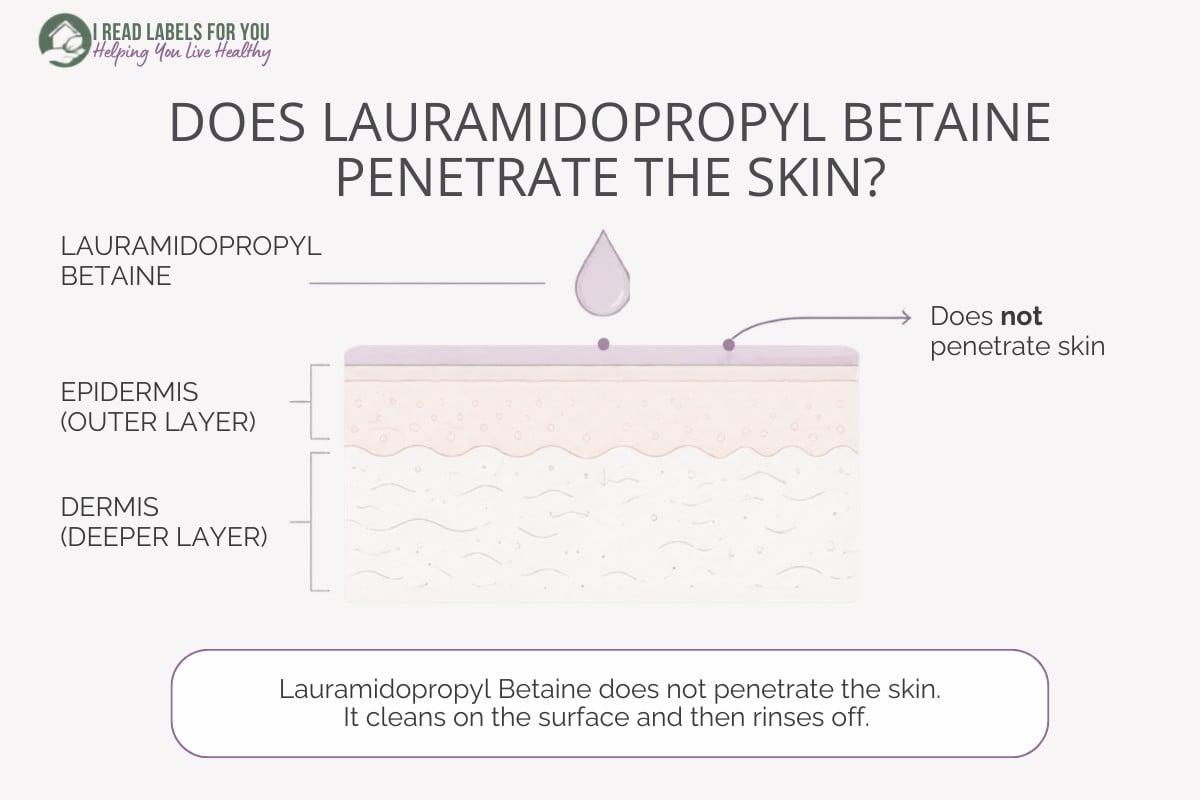
No. Lauramidopropyl Betaine stays on top of the skin and does not work its way in.
Lauramidopropyl Betaine’s charge decides this. As a betaine it holds a fixed positive and negative charge and loves water, and skin’s oily outer layer repels water-loving molecules. So the charge, more than anything, blocks it.
At roughly 342 daltons, a unit of molecular size, Lauramidopropyl Betaine falls under the 500-dalton mark, so it is small enough that size would not stop it. Its permanent charge is the real gatekeeper, and it also leaves the molecule without a meaningful oil-versus-water rating (LogP).
What Is Lauramidopropyl Betaine Called On Labels?
On a label, Lauramidopropyl Betaine may appear as:
- Lauramidopropyl Betaine
- Lauramidopropyl Dimethyl Glycine
- Glycine, N-(3-Lauramidopropyl)-N,N-Dimethyl, Betaine
Does The U.S. FDA Restrict Lauramidopropyl Betaine In Food And Cosmetics?
The U.S. Food and Drug Administration (FDA) allows Lauramidopropyl Betaine in cosmetics, but that clearance means less than it seems.
American rules restrict only a handful of cosmetic ingredients and let the rest reach shelves with no safety check first. Lauramidopropyl Betaine is also not cleared for use in food.
Europe starts from the other end. Under its precautionary principle, regulators can act on reasonable doubt instead of waiting for proof of harm.
EU Regulations About Lauramidopropyl Betaine
In the European Union (EU), Lauramidopropyl Betaine shows up in the CosIng database as a surfactant and foam booster, with no cap on how much a product may hold.
Reading the EU restricted-ingredient annexes, I found no entry for Lauramidopropyl Betaine, so the EU places no conditions on it.
Canadian Regulations About Lauramidopropyl Betaine
Canada lands in the same place. Lauramidopropyl Betaine is missing from Health Canada’s Cosmetic Ingredient Hotlist, the roster of ingredients the country bans or limits.
Lauramidopropyl Betaine is likewise off Schedule 1 of Canada’s environmental-protection act, which catalogs substances judged toxic.
Can Lauramidopropyl Betaine Cause Skin Allergy And Sensitization?
Yes, Lauramidopropyl Betaine can cause skin allergy and sensitization, though reports are few, and the betaine is usually not the real culprit. Those few reports partly reflect how much less Lauramidopropyl Betaine is used than Cocamidopropyl Betaine, not proof that it is safer. The two share the same impurity sensitizers, the leftover DMAPA and amidoamine.
In a patch-test study of these betaines, the reactions traced back to the amine impurities, DMAPA and amidoamine, rather than Lauramidopropyl Betaine itself.
Another patch and use test pointed to amidoamine as a key trigger. In its own human tests, Lauramidopropyl Betaine at use levels showed no sensitization.
If your skin is sensitive, or you already react to Cocamidopropyl Betaine, choose a product without Lauramidopropyl Betaine.
Is Lauramidopropyl Betaine A Hormone (Endocrine) Disruptor?
No. Nothing points to Lauramidopropyl Betaine acting on hormones, and no endocrine watch list names it.
Since Lauramidopropyl Betaine does not get into the body, a hormone effect is hard to imagine, and no published study ties it to estrogen or similar activity.
Is Lauramidopropyl Betaine Safe To Use While Pregnant?
Lauramidopropyl Betaine rinses off and barely reaches the body, so it is a low worry in pregnancy, above all in products you wash away.
Skin often turns touchier during these months, so a plain, mild cleanser is a sensible default. To be sure about what fits you, you should consult with your medical provider.
Are There Any Cancer Concerns Linked To Lauramidopropyl Betaine?
No. No major health body classifies Lauramidopropyl Betaine as a carcinogen. In lab testing it did not damage DNA, coming back clean in bacterial (Ames) and micronucleus assays, and a 20-month study painting it on mouse skin produced no extra tumors.
The one indirect concern is nitrosamide formation. If Lauramidopropyl Betaine is poorly made, its amide group can form trace nitrosamides, which are carcinogens, so careful manufacturing matters.
Is Lauramidopropyl Betaine Bad For The Environment?
Lauramidopropyl Betaine is a coconut-derived surfactant, and surfactants like it generally break down in wastewater treatment. Still, it carries a self-classification of H412, meaning it is harmful to aquatic life with long-lasting effects, which is common for cationic and amphoteric cleansers.
With Lauramidopropyl Betaine, as with any cleanser, using only what you need is the simplest way to lower its footprint.
What I Think About Lauramidopropyl Betaine — And What You Should Do
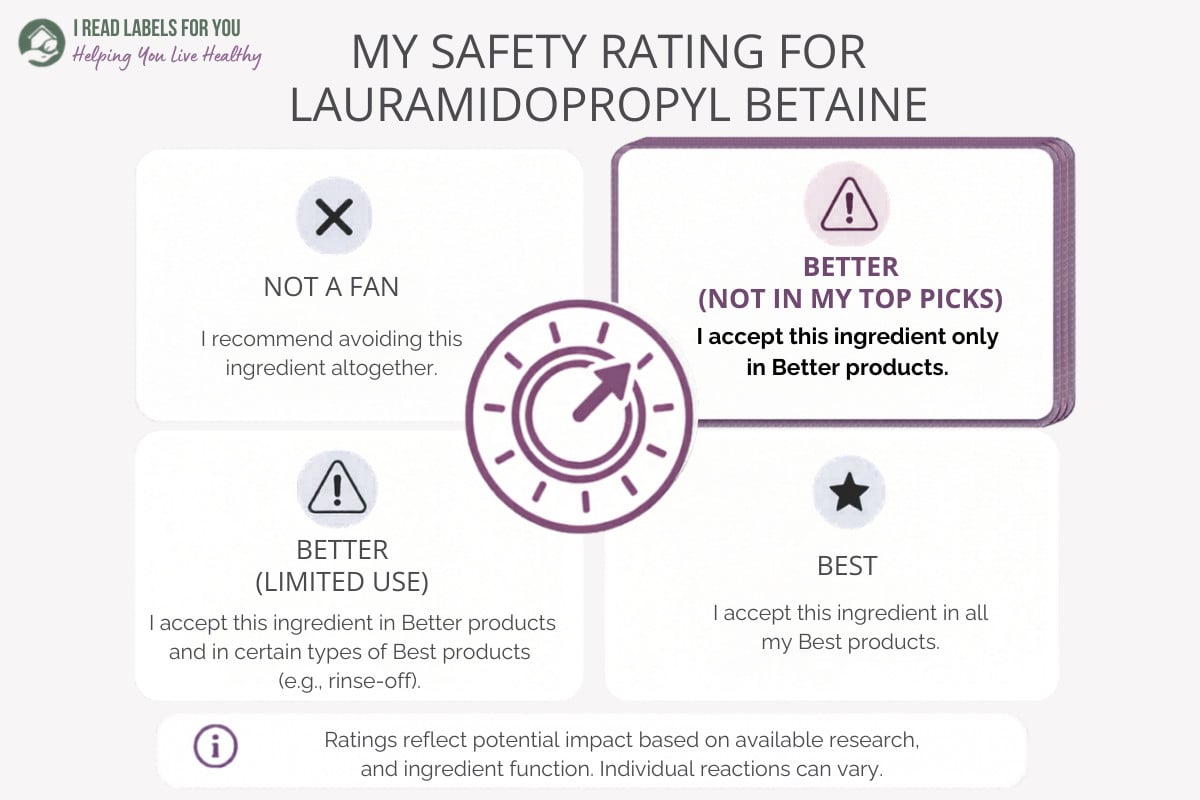
My verdict on Lauramidopropyl Betaine is Better (Not In My Top Picks). Take away one issue and it looks great. It is a gentle cleanser that never sinks past the surface and shows no tie to cancer, hormones, or reproductive harm.
What pulls Lauramidopropyl Betaine down is its production. Its DMAPA-based route can leave behind traces of DMAPA and amidoamine, the residues that drive most reactions, and its amide group can turn into trace nitrosamides when made carelessly. Nitrosamides are carcinogens, so I would rather steer clear than manage that.
For daily washing, Lauramidopropyl Betaine suits most people, above all in something that rinses away fast. If your skin flares easily, or a past cleanser left it sore, look for a formula without it.
Frequently Asked Questions About Lauramidopropyl Betaine
Is Lauramidopropyl Betaine Safe For Skin?
Yes, for most people. In a rinse-off product, Lauramidopropyl Betaine is gentle and well tolerated. The few reactions that occur usually trace to its allergenic impurities, not the betaine.
Is Lauramidopropyl Betaine Natural?
Partly. Lauramidopropyl Betaine begins with lauric acid from coconut, then goes through chemical steps that make it a synthetic surfactant. That makes it coconut-derived, not natural in the strict sense.
Is Lauramidopropyl Betaine The Same As Cocamidopropyl Betaine?
They are close cousins, not twins. Lauramidopropyl Betaine is made from just lauric acid, and Cocamidopropyl Betaine is made from a coconut blend of fatty acids. Both are made the same way and share the same impurity concern.
Is Lauramidopropyl Betaine Safe For Babies?
You will see Lauramidopropyl Betaine in some baby washes, and most babies handle it well. Even so, an infant’s skin is thinner, its barrier is still developing, and it takes in a bit more than grown-up skin.
Given the impurity question with Lauramidopropyl Betaine, the leftover DMAPA and the slim chance of nitrosamides, I would choose a simpler, gentler wash for very sensitive or eczema-prone baby skin.
Sources
EU SCCS / SCCP opinions:
No SCCS or SCCP opinion on Lauramidopropyl Betaine (checked; none listed): https://health.ec.europa.eu/scientific-committees/scientific-committee-consumer-safety-sccs_en
Cosmetic Ingredient Review (CIR) safety assessment:
Burnett CL, Bergfeld WF, Belsito DV, et al. (2012). Final Report of the CIR Expert Panel Safety Assessment of Cocamidopropyl Betaine (CAPB) and related amidopropyl betaines (includes Lauramidopropyl Betaine). International Journal of Toxicology 31(Suppl 1):77S-111S: https://cir-reports.cir-safety.org
European Union regulatory databases:
EU CosIng entry for Lauramidopropyl Betaine (surfactant, foam booster, conditioning; no Annex restriction): https://ec.europa.eu/growth/tools-databases/cosing/details/34880
EU CosIng Annexes (II, III, IV, V; Lauramidopropyl Betaine not listed): https://ec.europa.eu/growth/tools-databases/cosing/reference/annexes
CLP Annex VI Harmonised Classifications (no harmonised classification for Lauramidopropyl Betaine): https://echa.europa.eu/information-on-chemicals/annex-vi-to-clp
Other regulators:
U.S. FDA cosmetic ingredients (cosmetic surfactant, no special restriction; not an approved food additive): https://www.fda.gov/cosmetics/cosmetic-ingredients
Health Canada Cosmetic Ingredient Hotlist (Lauramidopropyl Betaine not listed): https://www.canada.ca/en/health-canada/services/consumer-product-safety/cosmetics/cosmetic-ingredient-hotlist-prohibited-restricted-ingredients/hotlist.html
Environment and Climate Change Canada, CEPA Schedule 1 (not listed): https://www.canada.ca/en/environment-climate-change/services/canadian-environmental-protection-act-registry/substances-list/toxic/schedule-1.html
IARC List of Classifications (not classified): https://monographs.iarc.who.int/list-of-classifications/
NTP 15th Report on Carcinogens, Appendix G (not listed): https://ntp.niehs.nih.gov/whatwestudy/assessments/cancer/roc
California Proposition 65 List (not listed): https://oehha.ca.gov/proposition-65/proposition-65-list
PubChem records (chemistry, identifiers, hazard codes):
Lauramidopropyl Betaine, PubChem CID 20280 (CAS 4292-10-8; C19H38N2O3): https://pubchem.ncbi.nlm.nih.gov/compound/20280
Natural cosmetic standards:
COSMOS-standard approved raw materials (checked): https://www.cosmos-standard.org/en/databases/approved-raw-materials/
NATRUE certified/approved raw materials (checked): https://natrue.org/natrue-certified-world/
Skin allergy resource:
American Contact Dermatitis Society (ACDS), Helpful References, including Core Allergen Series 2020 (Lauramidopropyl Betaine not listed; Cocamidopropyl betaine is the listed amidopropyl betaine): https://www.contactderm.org/resources/helpful-references
Fowler JF, et al. (1997). Allergy to cocamidopropyl betaine may be due to amidoamine: a patch test and product use test study. PMID 9455630: https://pubmed.ncbi.nlm.nih.gov/9455630/
Allergic contact dermatitis from cocamidopropyl betaine, cocamidoamine, 3-(dimethylamino)propylamine, and oleamidopropyl dimethylamine: co-reactions or cross-reactions? PMID 15724349: https://pubmed.ncbi.nlm.nih.gov/15724349/
Nitrosamide safety:
Alkylation of DNA and carcinogenicity of N-nitroso compounds (covering both N-nitrosamines and N-nitrosamides). Journal of Toxicology and Environmental Health (1980) 6(5-6). PMID 6162032: https://pubmed.ncbi.nlm.nih.gov/6162032/
Last verified: 06-30–2026
Download The Free Guide!
5 Powerful Steps To A Non-Toxic Home
Join our informed consumer community and get our free guide the “5 Powerful Steps To A Non-Toxic Home”.
Before commenting, please read our Comment Policy.