
What Is Marine Collagen? What It Does For Skin, Joints, And More
 Written by Irina Webb
If your skin feels less firm than it used to or your joints feel a little stiffer over time, you’re not imagining it. Your body naturally makes less collagen as you age.
Collagen is a protein that helps support your skin, bones, joints, hair, nails, and connective tissue. Because collagen production slows down with age, many of us choose to add collagen supplements to our routine.
One popular option is marine collagen, also called fish collagen peptides.
In this guide, you’ll learn what marine collagen is, what it is good for, how it compares to bovine collagen, and the collagen supplement I personally use.
What Is Marine Collagen?
To begin with, marine collagen is collagen that comes from fish and other marine organisms like jellyfish or sponges. It is usually made from fish skin, scales, and bones.
Out of around 30 types of collagen, the most prominent in the human body are:
- Type I collagen: provides structure to the body’s skin, bones, tendons, and ligaments (source).
- Type II collagen: the main component of cartilage, also found in other connective tissues and bones (source).
- Type III collagen: provides structure and strength to connective tissues in the body, including the skin, lungs, intestinal walls, and blood vessels (source).
- Type IV collagen: gives structural support and stability to cells and is a key component of basement membranes (source).
Marine collagen mostly contains Type I collagen – the most abundant type of collagen in your body. It helps support your skin, bones, tendons, and connective tissue.
One reason marine collagen is popular is because of its high bioavailability. This means your body can absorb and use it more easily compared to some other collagen sources (e.g., bovine or porcine collagen). This is likely because marine collagen has a smaller molecular size and lower molecular weight (source).

What Is Marine Collagen Good For?
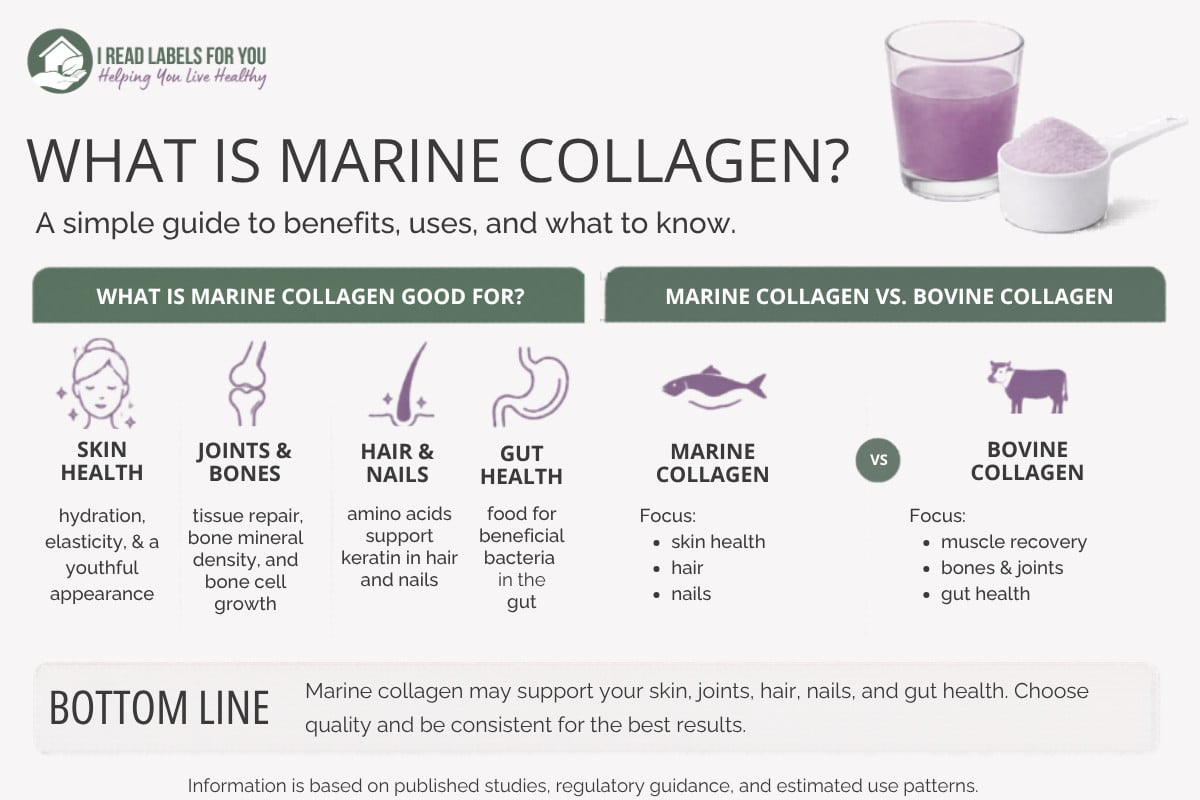
Rich in Type I collagen and amino acids, marine collagen peptides are often used to support:
Skin Health: Marine collagen can help improve skin hydration, elasticity, and firmness and decrease the appearance of wrinkles. It can also help heal skin wounds and delay skin aging (source, source, source, source, and source).
Joints & Bones: Marine collagen peptides help support connective tissue repair, bone mineral density, and bone cell growth. They can be beneficial for prevention and treatment of osteoporosis and osteoarthritis as well as tissue engineering and bone regeneration (source, source, and source).
Gut Health: Collagen peptides can act as food for beneficial gut bacteria that support a healthier gut environment. Due to its rich amino acid profile, including glycine and proline, marine collage can strengthen the intestinal lining and alleviate the “leaky gut” symptoms (source and source).
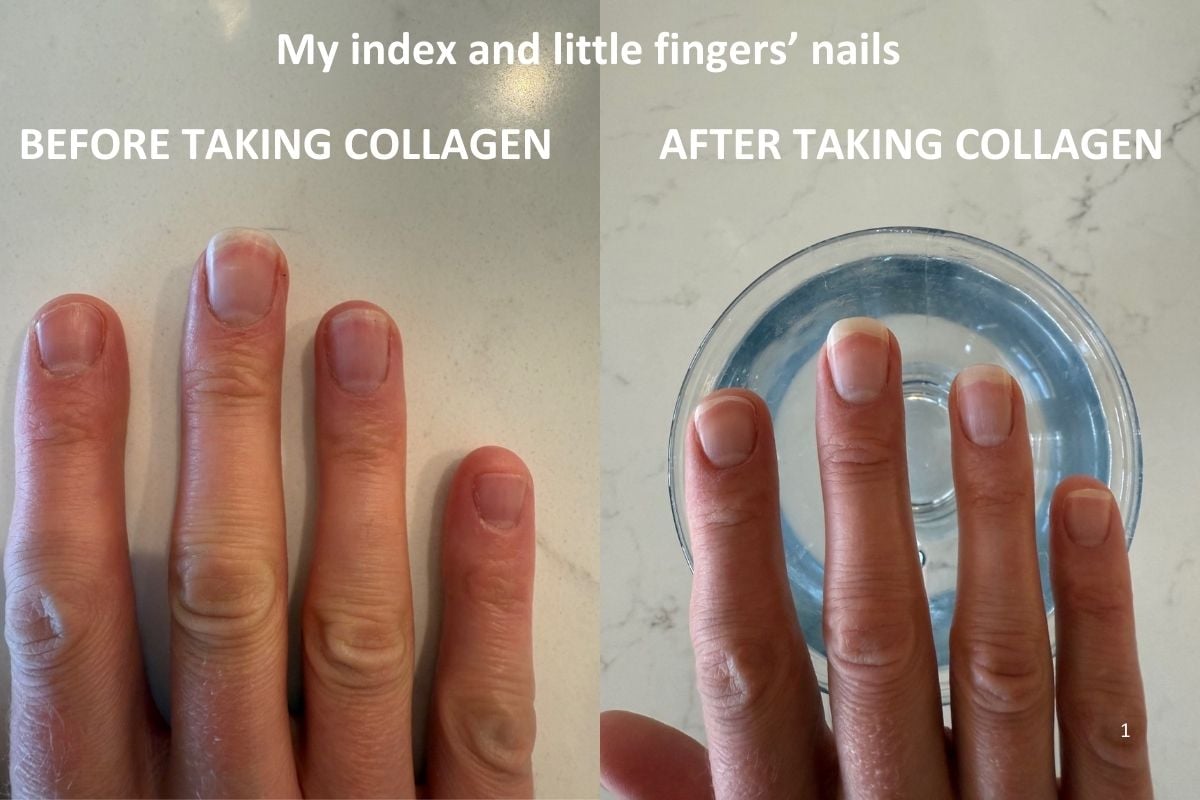
Hair & Nails: Collagen contains amino acids like glycine, proline, and hydroxyproline. Proline is also an important part of keratin, the protein that makes up your hair and nails (source and source). My nails used to peel easily, but they became much stronger and stopped peeling after just six weeks of taking marine collagen.
Marine Collagen Vs. Bovine Collagen
Both can support collagen production, but there are some differences.
First, marine collagen comes from fish. Bovine collagen comes from cows.
Second, marine collagen is mostly Type I collagen and a smaller peptide size, which allows for higher bioavailability and absorption. This makes it beneficial for hair, nails, and skin-specific needs.
Bovine collagen contains a mix of Types I and III collagen and is focused on muscles, bones, joints, and gut health.
Third, marine collagen avoids concerns related to dietary or religious preferences and bovine spongiform encephalopathy, also known as “mad cow disease.”
That said, both marine and bovine collagen provide important amino acids that help support healthy skin, joints, bones, gut health, and connective tissue throughout the body.
If you prefer bovine collagen, I recommend bovine collagen made from pasture-raised, grass-fed cows without unnecessary additives.
What Marine Collagen I Take
For context, I am recovering from autoimmune and “leaky gut” conditions, which often go hand in hand. Plus, being in my fifties, I want to support healthy aging and feel and look my best for as long as possible.
Adding marine collagen to my daily routine seemed like a practical choice for me. So, I did my homework and reviewed main collagen brands on the market.
I ended up choosing Pure Haven Marine Collagen Peptides for myself and my husband because it:
- is made from wild caught fish and meets my very strict heavy metal standards
- contains Types I, II, III, and IV collagen
- is hydrolyzed, which makes it easier to absorb
- has no flavors, preservatives, sweeteners, colorants, or any other additives or fillers.
- is gluten-free, keto-friendly, and paleo-friendly, which – by the way – makes it a great holiday gift for many of your loved ones.
To use, I mix one tablespoon with a cup of warm water and take it before bed to help my body do its revitalizing work during sleep. I also take 3-4 magnesium glycinate capsules by Pure Encapsulations. Both glycine in collagen and magnesium help with better sleep quality.
You can do it differently, too. Some people prefer adding collagen to their morning tea or coffee. The best routine is the one that feels easy and helps you stay consistent.
Since I started taking it in September 2024, I’ve noticed firmer skin, stronger fingernails and hair. I’m especially happy about my hair because there was a time when it was falling out excessively.
Bottom Line: Is Marine Collagen Good For You?
I believe marine collagen made from wild caught fish is good for you.
It is highly absorbable and can help support your skin, joints, bones, nails, hair, and gut health.
Since 2024, Pure Haven Marine Collagen Peptides has become a regular part of my wellness routine.
If you’re looking for a bovine option, Perfect Hydrolyzed Collagen is a solid choice.
The good news is that you do not need to overcomplicate this decision. Choosing any high-quality collagen supplement and using it consistently can help you support your long-term wellness goals.
Access my review of the main collagen brands on the market right now!

Download The Free Guide!
5 Powerful Steps To A Non-Toxic Home
Join our informed consumer community and get our free guide the “5 Powerful Steps To A Non-Toxic Home”.





aren’t you concerned about farm raised fish and what they are fed?
Hello Karen,
That’s a very valid concern, and it’s one of the reasons we do not recommend collagen sourced from farm-raised fish. Our preferred options use wild-caught fish that is lower in mercury.